
By WhiteOwl Research · October 23, 2026 · 7 min read
In short: As of October 2026, California's billionaire tax, Proposition 40, is a proposal, not law. If voters pass it on November 3, 2026, people who were California residents on January 1, 2026 and are worth 1.1 billion USD or more would owe a one-time tax of 5% of their whole net worth, payable over up to five years.
Why it matters
It reaches few people, but founders should check the number carefully: shares in a private company would be valued at no less than their most recent funding round, so paper wealth counts even when none of it can be sold. And leaving California during 2026 would not reduce the bill. What decides it is where you lived on January 1, 2026.
What Proposition 40 would tax
The measure is called the "2026 Billionaire Tax Act". It is a one-time tax for the 2026 tax year, on top of California's income tax and not deductible from it. The key figures:
Proposition 40, as written for the November 3, 2026 ballot. Source: California Attorney General, initiative 25-0024A1.
| Item | What the measure says |
|---|---|
| Who pays | California residents on January 1, 2026, under the residency rules the state already uses for income tax, and certain trusts |
| Threshold | Net worth of 1 billion USD or more; a married couple counts as one person |
| Rate | 5% of total net worth, not just the part above the threshold; the rate phases in between 1 billion USD (0%) and 1.1 billion USD (the full 5%) |
| Valuation date | December 31, 2026 |
| When it is due | With the 2026 California income tax return, filed in 2027, or in five equal yearly installments with a 7.5% yearly charge on the unpaid balance |
| Left out | Real estate held directly or through a revocable trust; qualified pensions and IRAs; Roth accounts up to 10 million USD in total; up to 5 million USD of art, collectibles and vehicles; tangible property kept outside California for at least 270 days of 2026 |
| Where the money goes | 90% to health care, 10% to education and food assistance |
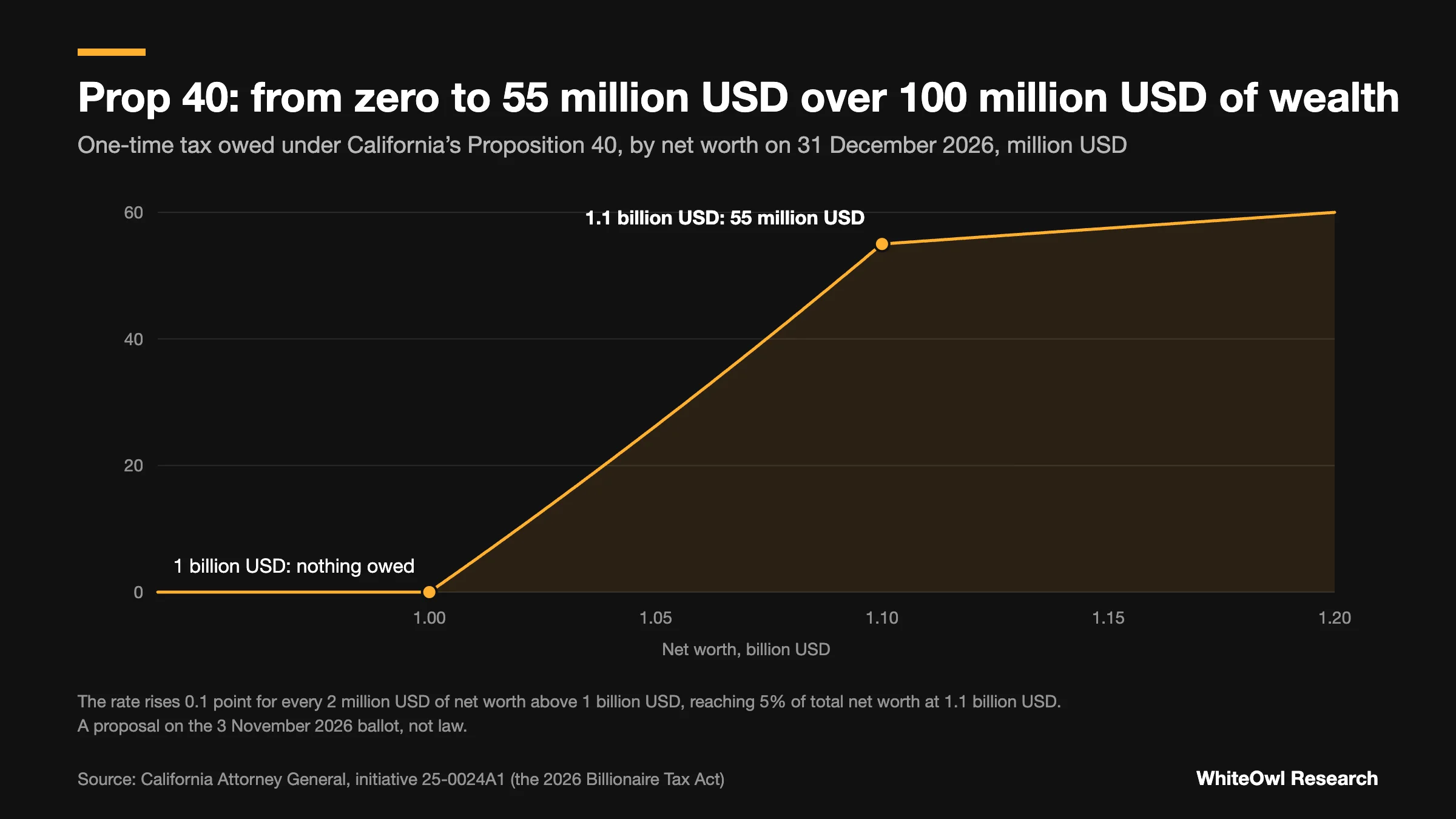
The bill climbs from nothing to 55 million USD across the last 100 million USD of a fortune.
Does leaving California help?
Not for this tax, as written. The bill depends on one fact: whether you were a California resident on January 1, 2026. Someone who was resident that day owes the full amount even if they move out in February. The measure does not shrink the bill for the months spent elsewhere.
Two narrow exceptions exist. A taxpayer can ask for a smaller California share by showing, with clear and convincing evidence, that their wealth was not built mainly in California and was not held there for 365 days or more in the four years ending December 31, 2026; even then the share cannot fall below 25% unless the constitution requires it. And a credit is given for another state's wealth tax, in proportion to the days lived there.
Whether someone who moved in late 2025 was still a resident on January 1, 2026 is decided on the facts, under the same test the Franchise Tax Board uses today: are you in California for more than a temporary purpose, or is California your home while you are away? If a court strikes the January 1 date, the measure substitutes the earliest later date the court allows, so the test date itself could move.
What founders and executives should look at
- Private company shares. They are valued at book value plus 7.5 times average book profits, and never below a funding-round price from the two years before. A founder can cross 1 billion USD on paper with little cash.
- Paying without selling. Someone whose tax is larger than their publicly traded holdings can choose a deferral account. That contract keeps binding after a move out of California, and binds the estate.
- Gifts and trusts made before the vote. Gifts of more than 1 million USD made after October 15, 2025 stay in the giver's net worth. Transfers to non-grantor trusts count in full for 2026 and at 75% for 2025.
How California already taxes people who leave
Separately from Proposition 40, current California law follows some income after a move. The Franchise Tax Board's rules for people who change residency:
- Stock options. Income from options granted while you worked in California stays partly Californian after you move. The California share is the days worked in California between grant and exercise, divided by all days worked in that period.
- Pay earned before the move. A final paycheck received after you leave is still taxed by California.
- Sales spread over time. The gain on a sale made while resident and paid in installments stays taxable after you move; the interest does not.
- Retirement income. California does not tax a nonresident's IRA or qualified pension income, and federal law stops any state from doing so.
California has tried before
Three earlier bills proposed a yearly tax on wealth, and all three died before becoming law. AB 2088 (2020) proposed 0.4% a year above 30 million USD, with a share of the tax following people for up to ten years after they left. AB 310 (2021) and AB 259 (2023) proposed 1% above 50 million USD and more above 1 billion USD, with a four-year tail for people who left. Proposition 40 is different in two ways: it is a one-time tax, and voters decide it directly. For the countries that tax wealth every year, see countries with a wealth tax.
What happens next
Voters decide on November 3, 2026. Two other measures on the same ballot, Propositions 41 and 42, would restrict new state taxes; the Legislative Analyst's Office notes that if either gets more yes votes than Proposition 40, Proposition 40 could be stopped even if it passes. If it passes, any legal challenge must be filed within 60 days in Sacramento County Superior Court, with the measure setting April 1, 2027 as the target for a first ruling. The Legislative Analyst's Office estimates the revenue at "tens of billions of dollars" over several years.
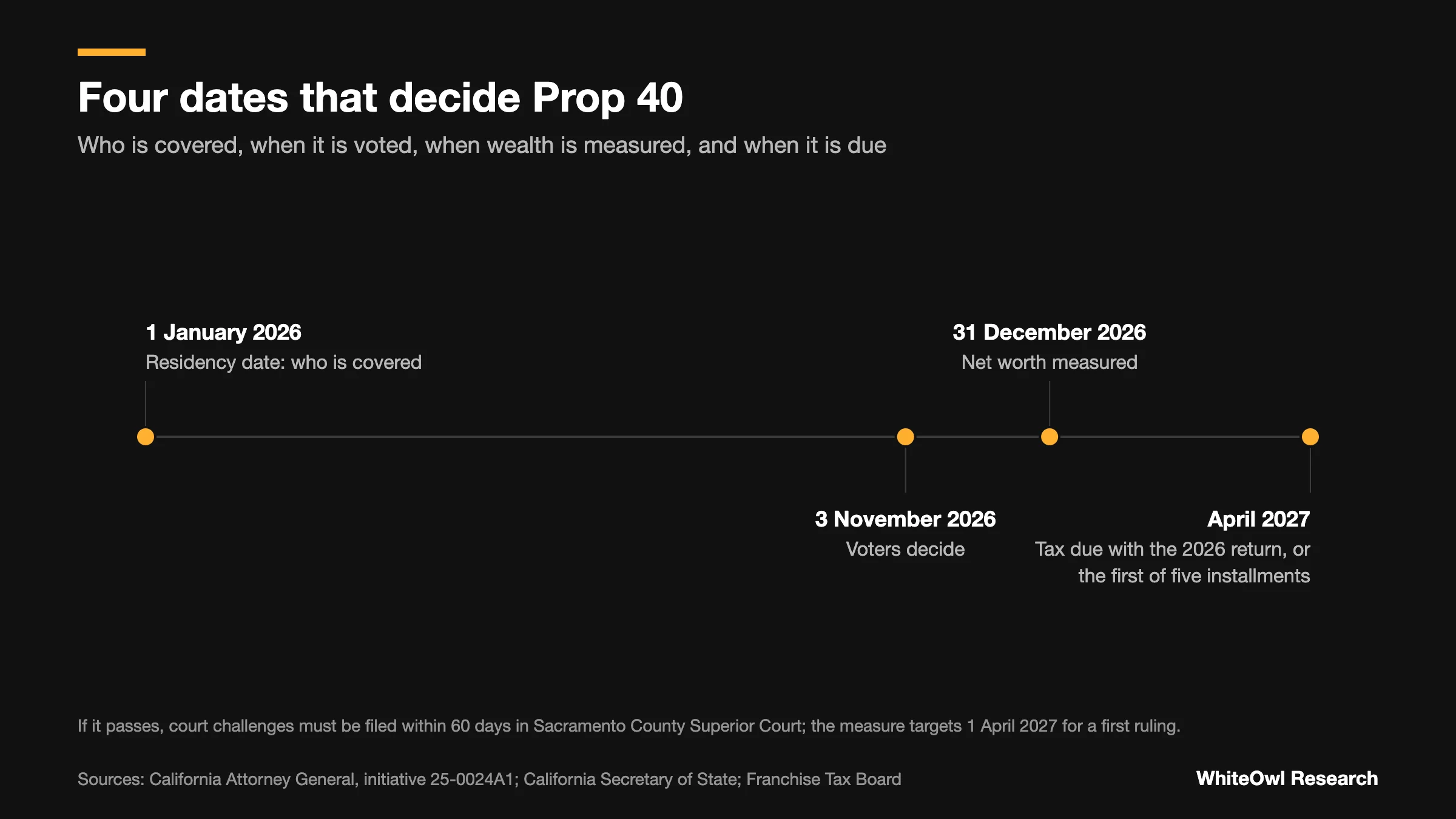
The four dates that decide who pays and when.
How WhiteOwl helps
Residency on a single date, the value of a private company and gifts made in the look-back period are specialist questions, and few advisors handle all three. WhiteOwl matches you with an advisor whose specialties and states fit your case. WhiteOwl gathers your documents, organizes your file, finds the issues and runs the numbers. A licensed advisor reviews, decides and files. See how it works.
FAQ
Is there a wealth tax in California today?
No. As of October 2026, Proposition 40 is a ballot measure for November 3, 2026. If it passes, it would apply once, to the 2026 tax year, for residents on January 1, 2026.
I moved out of California in 2025. Am I covered?
Only if you were still a California resident on January 1, 2026 under the state's usual residency test. That turns on your facts: where your home, family, work and time were. A move completed before that date, and evidenced, takes you outside the measure as written.
Is my house included?
No. Real estate held directly or through a revocable trust is left out. Real estate held through a company or partnership is not named in that exclusion, so its value would likely count through the company's shares. An advisor should confirm how your holdings are structured.
Does California have an exit tax?
Not as such. California does not tax you for leaving. Under current law it keeps taxing some income earned while you lived there, such as the California share of stock options and gains on a sale paid in installments. Proposition 40 would add a one-time tax tied to residency on January 1, 2026, which a later move would not reduce.
Can the tax be paid over time?
Yes. It can be paid with the 2026 return in 2027, or in five equal yearly installments with a 7.5% yearly charge on what is still owed.
Sources
- California Attorney General, initiative 25-0024A1, "2026 Billionaire Tax Act" (text)
- California Secretary of State, Official Voter Information Guide, Proposition 40
- Legislative Analyst's Office, analysis of Proposition 40
- California Secretary of State, qualified ballot measures
- Franchise Tax Board, Publication 1100, taxation of nonresidents and individuals who change residency
- Franchise Tax Board, residency status
- California Legislature, AB 259 (2023) · AB 2088 (2020) · AB 310 (2021)
- 4 U.S.C. 114, state taxation of nonresidents' retirement income
This article is general information, not personalized tax advice. Consult a qualified cross-border tax professional about your situation.
Related reading
Countries with a wealth tax in 2026: what changes if you move abroad
Neither the United States nor Canada taxes wealth each year, but Spain, Norway, Switzerland and others do. Rates, thresholds and who pays in 2026, and what changes when you move abroad.
By WhiteOwl Research · Oct 23, 2026
Dual citizenship taxes: how the US and Canada decide where you are taxed
How the United States and Canada decide where you are taxed: residence, source and citizenship, the treaty tie-breaker, and practical answers for US-Canadian dual citizens.
By WhiteOwl Research · Jun 23, 2026