
By WhiteOwl Research · October 23, 2026 · 8 min read
In short: As of 2026, neither the United States nor Canada taxes wealth each year, but several countries people move to do. Spain, Norway and Switzerland tax residents on their net wealth; France taxes real estate; Italy, Belgium and the Netherlands tax certain assets. Annual rates run from 0.1% to 3.5%, depending on the country and the asset.
Why it matters
If you live in the United States or Canada, your wealth is taxed when it earns income or when you sell, not simply for existing. Move to Madrid, Oslo or Geneva and that changes: the new country can tax what you own every year, often including what you own back home. This guide is for founders, executives, investors and families weighing a move, a retirement abroad or a second home. It answers two questions: will the new country tax my wealth once I live there, and will it tax what I own there even if I do not?
The list of countries is short and getting shorter. The OECD counted 12 member countries with a net wealth tax in 1990 and 4 in 2017 (France, Norway, Spain and Switzerland). France has since narrowed its tax to real estate, and Colombia, which joined the OECD in 2020, has one.
Countries that tax your whole net wealth each year
Figures for 2026 unless noted. Sources: each country's tax authority, listed below.
| Country | Who pays, on what | Tax-free amount | Rates |
|---|---|---|---|
| Spain Impuesto sobre el Patrimonio; Impuesto Temporal de Solidaridad de las Grandes Fortunas | Residents on worldwide wealth; non-residents on assets in Spain | 700,000 EUR (some regions differ) | 0.2% to 3.5% (2025 scale, still in force), plus a solidarity tax of 1.7% to 3.5% on wealth above 3,000,000 EUR, with the regional tax credited against it |
| Norway formuesskatt | Residents on 31 December; non-residents on Norwegian assets such as real estate | 1,900,000 NOK (single) | 1.0%, and 1.1% above 21,500,000 NOK; shares counted at 80% of value |
| Switzerland Vermögenssteuer, impôt sur la fortune | Residents declare worldwide wealth; non-residents pay on Swiss real estate and business assets | Set by each canton: 204,000 CHF in Zug (2025), 87,872 CHF in Geneva | Set by each canton: a top rate of about 0.2% in the city of Zug, about 0.8% to 0.9% in the city of Geneva (our calculation from the cantons' scales) |
| Colombia impuesto al patrimonio | Residents on worldwide wealth; non-residents on Colombian assets | 3,770,928,000 COP (72,000 UVT) | 0.5% to 1.5%; the 1.5% band ends after 2026 |
| Argentina Impuesto sobre los Bienes Personales | Residents on assets in Argentina and abroad | Indexed each year (384,728,045 ARS for 2025) | 0.5% to 0.75% for 2026, then a flat 0.25% from 2027 |
| Uruguay Impuesto al Patrimonio | Assets located in Uruguay only | 6,653,000 UYU single (2025) | 0.1% for residents (2025) |
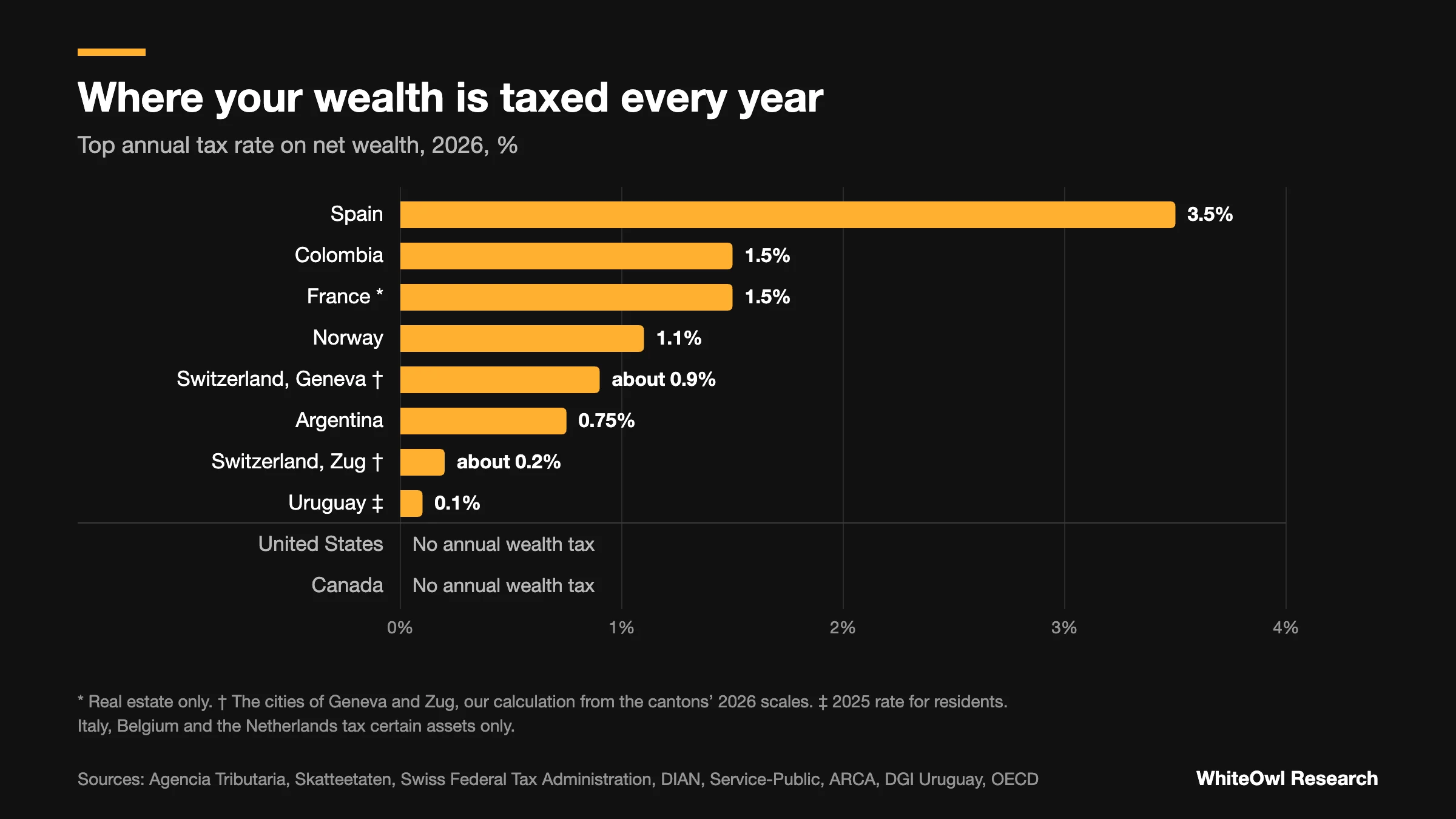
Top annual rates, with the United States and Canada at none.
Countries that tax some of what you own each year
Figures for 2026. Sources: each country's tax authority, listed below.
| Country | What is taxed | Who pays | Rate and threshold |
|---|---|---|---|
| France impôt sur la fortune immobilière (IFI) | Real estate, net of debt | Residents on property in France and abroad; non-residents on French property | 0.5% to 1.5% once net real estate exceeds 1,300,000 EUR on 1 January |
| Italy IVAFE and IVIE | Financial assets and property held abroad | Residents | 0.2% of foreign financial assets (0.4% in listed tax havens); 1.06% of foreign property; 34.20 EUR per foreign bank account |
| Belgium taxe annuelle sur les comptes-titres | Securities accounts | Residents on accounts anywhere; non-residents on Belgian accounts | 0.30% on an account averaging more than 1,000,000 EUR (up from 0.15% on 1 June 2026) |
| Netherlands box 3 | A deemed return on savings and investments | Residents; non-residents on Dutch real estate | 36% of a deemed return (6.00% on investments, 1.28% on savings) above 59,357 EUR per person |
What changes when you move from the United States or Canada
- The measuring date decides the year. Most of these taxes look at one day. Norway taxes you if you live there on 31 December; Spain values wealth on 31 December; France and Colombia look at 1 January. Arriving on 2 January or 30 December can move a whole year of tax.
- Your home-country assets usually count. In Spain, a resident is taxed on wealth held anywhere, including a US brokerage account or shares in a Canadian company, and Switzerland asks residents to declare their wealth worldwide. A tax treaty may give relief, but it is a question for each pair of countries.
- A US citizen keeps filing US returns. The United States taxes its citizens wherever they live, so a move adds a second country's rules rather than replacing the first. A wealth tax is not an income tax, so how much of it the US will recognize is a question to settle before the move, not after.
- Leaving Canada has its own tax. When you emigrate, Canada treats you as having sold most of your property at its market value on the day you leave, and taxes the gain. Canadian real estate, pensions, RRSPs and TFSAs are among the exceptions. How Canada and the United States decide where you are taxed.
- You can owe without moving. A holiday home in Spain or France, or property in Norway, Switzerland or the Netherlands, can bring a yearly tax on that property even if you never live there.
Proposals to watch, as of October 2026
- France. A 2% minimum tax on fortunes above 100,000,000 EUR was rejected again in the 2027 budget debate on 16 October 2026. A separate 2% yearly tax on investments held by family holding companies was adopted in committee on 8 October 2026 and is still being debated.
- Spain. The solidarity tax applies until wealth taxation is reviewed as part of the reform of regional financing, which the regions approved on 4 September 2026 and which still needs Parliament.
- Netherlands. A move to taxing actual returns, for financial investments from 2028, is before the Senate. None of it is law yet.
- United Kingdom. No wealth tax, but from April 2028 owners of homes in England worth 2,000,000 GBP or more will pay a yearly surcharge of 2,500 to 7,500 GBP.
- California. Proposition 40, a one-time 5% tax on billionaires who lived in California on 1 January 2026, is on the 3 November 2026 ballot.
How WhiteOwl helps
A move with significant wealth needs advice in two countries at once, and the two rarely sit with the same person. WhiteOwl matches you with an advisor whose specialties and countries fit your move. WhiteOwl gathers your documents, organizes your file, finds the issues and runs the numbers. A licensed advisor reviews, decides and files. See how it works.
FAQ
Which countries have a wealth tax in 2026?
Spain, Norway, Switzerland, Colombia and Argentina tax residents on their net wealth, and Uruguay taxes wealth held in Uruguay. France taxes real estate only, and Italy, Belgium and the Netherlands tax certain assets each year.
Does the United States or Canada have a wealth tax?
No. As of 2026 neither country taxes wealth each year. California's Proposition 40 would be a one-time state tax on billionaires if voters pass it on 3 November 2026.
Do I pay a wealth tax on a holiday home abroad?
It depends on the country. Spain taxes non-residents on assets in Spain, France on French real estate, and Norway and Switzerland on property there, so a holiday home in those countries can bring a yearly tax even if you never move.
When is my wealth measured?
On one date a year, which differs by country: 31 December in Spain and Norway, 1 January in France and Colombia. Where you live, and what you own, on that date is what counts.
Sources
- OECD, "The Role and Design of Net Wealth Taxes in the OECD" (2018)
- Agencia Tributaria, wealth tax scale · Law 38/2022, solidarity tax on large fortunes · non-residents
- Skatteetaten, wealth tax rates · 2026 changes
- Swiss Federal Tax Administration, wealth tax on individuals · Zug · Geneva
- DIAN, Law 2277 of 2022 (wealth tax) · Argentina, Law 27,743 · Uruguay DGI, 2025 wealth tax rates
- Service-Public, real estate wealth tax (IFI) · Assemblée nationale, vote of 16 October 2026
- Agenzia delle Entrate, IVAFE · IVIE
- Belgium, tax on securities accounts · Belastingdienst, Box 3 for 2026
- Canada Revenue Agency, dispositions of property when leaving Canada · HM Treasury, Budget 2025
This article is general information, not personalized tax advice. Consult a qualified cross-border tax professional about your situation.