
By WhiteOwl Research · October 23, 2026 · 9 min read
In short: As of 2026, when a Canadian resident sells a Florida home, the buyer withholds part of the price for the IRS: 15%, or less if the buyer will live there. A US return settles the actual tax, and Canada taxes half the gain, measured in Canadian dollars, with a credit for the US tax.
Why it matters
The amount withheld at closing is a share of the price, not of the gain, so it can be far more than the tax you owe, and getting the difference back takes a US return. In Canada, the exchange rate can make your gain much larger or smaller than the one the IRS sees. Your principal residence designation and the foreign tax credit then decide how much of the US tax you pay on top of the Canadian tax.
The worked example below is a retired Ontario couple, neither of them a US citizen, who spend their winters in Florida, in the United States. Most of the US rules are federal and apply in every state. If your winters make you a US resident for tax, see where you are a tax resident when you keep moving.
At closing: the buyer withholds part of the price
A sale of US real estate by a foreign person falls under the Foreign Investment in Real Property Tax Act (FIRPTA). The buyer, usually through the closing agent, must withhold 15% of the amount realized, in most cases the sale price, and pay it to the IRS. The rate drops to 10% for a price of 1,000,000 USD or less, and to zero up to 300,000 USD, when the buyer or a family member has definite plans to live there at least half of the days it is used in each of the first two years. Spouses who own the home together are treated as having contributed half each.
Lowering the withholding
Withholding is a prepayment, not the tax. Form 8288-B (the application for a withholding certificate) asks the IRS to reduce it to your maximum tax: for an individual, generally the gain multiplied by 20%, the top US rate on long-term gains, adjusted for items such as depreciation. The IRS normally acts within 90 days of a complete application.
The application needs a US taxpayer number. A Canadian without one applies for an individual taxpayer identification number (ITIN) on Form W-7, which the IRS accepts for this purpose only once there is a binding sale contract; filed with the application, it is processed within 10 days.
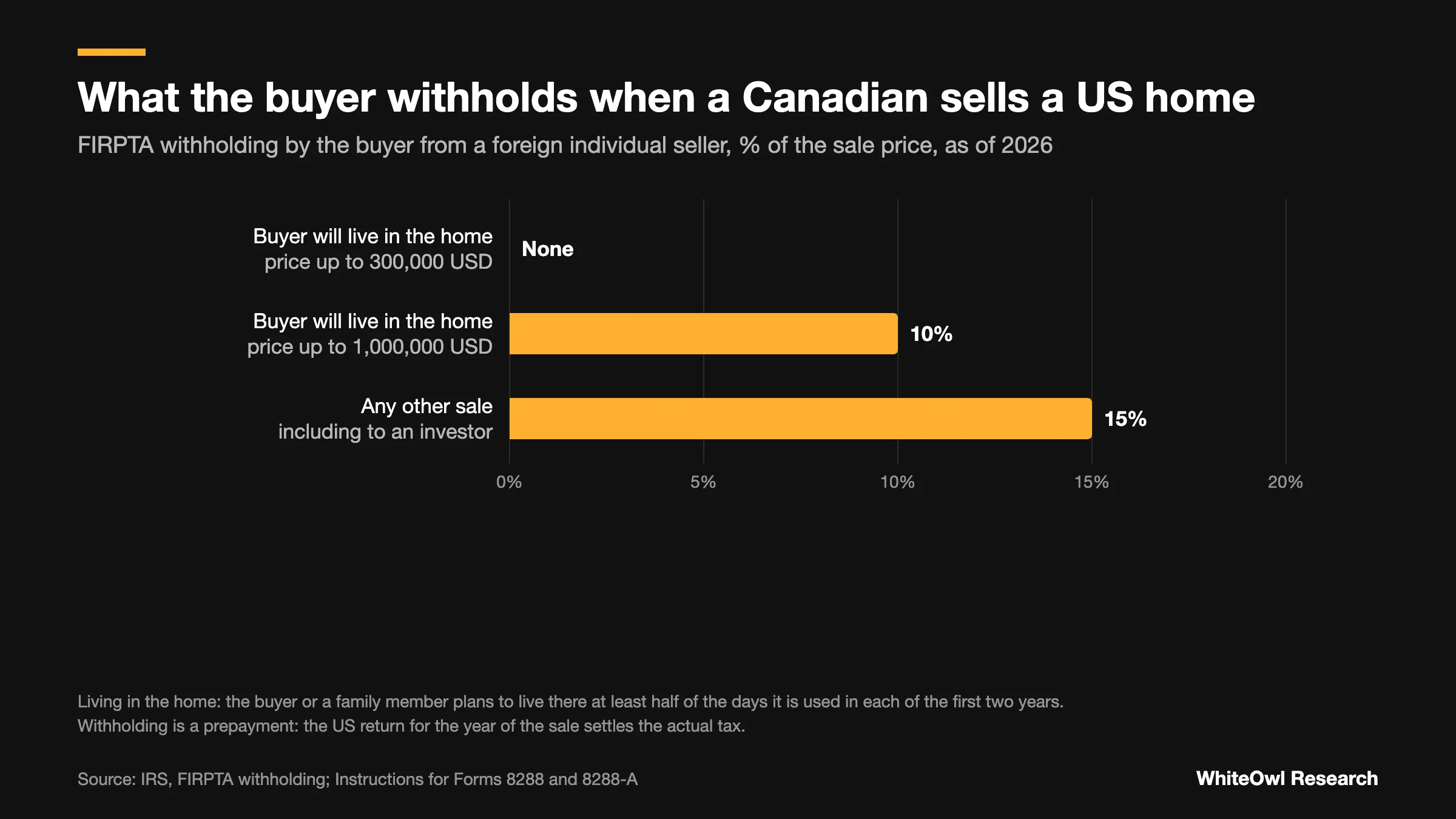
FIRPTA withholding by situation.
After the year ends: a US return settles the tax
Each seller files Form 1040-NR (the US income tax return for non-residents) for the year of the sale, attaching the withholding statement the IRS stamps and sends them; the amount withheld counts toward the tax. The gain is taxed at the rates that apply to US citizens: for a home held more than a year, 0%, 15% or 20% in 2026, depending on taxable income. Non-residents get no standard deduction, married non-residents generally use the married filing separately rates, and the 3.8% net investment income tax does not apply to them.
Florida has no income tax for individuals, so no state tax on the gain. Its documentary stamp tax on the deed is 0.70 USD per 100 USD of the price outside Miami-Dade, and all parties to the deed are liable for it, whoever agrees to pay. Other states differ: California, for example, generally has 3 1/3% of the sales price withheld at closing toward its own income tax, as of 2026.
The Ontario couple bought a Florida condo for 300,000 USD on 15 March 2013 and sell it for 450,000 USD on 1 October 2026 to a buyer who will live there. Leaving aside purchase and selling costs, their US gain is 150,000 USD, 75,000 USD each. The buyer withholds 10%, 45,000 USD; a withholding certificate would generally have lowered that to 30,000 USD, 20% of the gain. With no other US income or deductions, each spouse's first 49,450 USD is taxed at 0% and the other 25,550 USD at 15%: 3,832.50 USD each, 7,665 USD together. Their US returns recover the difference.
In Canada: the gain is measured in Canadian dollars
As residents of Canada, the couple report their worldwide income, this sale included, for 2026. Under Canada Revenue Agency guidance, the cost is converted at the exchange rate when the property was acquired and the proceeds at the rate when it was sold, generally the Bank of Canada rate for the day (its noon rate before March 2017). The exchange rate becomes part of the gain.
In this illustrative sale, the gain Canada taxes in 2026 is more than twice the US gain once converted, because the US dollar rose against the Canadian dollar after the purchase. Purchase and selling costs are left aside. Source: Bank of Canada exchange rates.
| Step | Date | Rate (CAD per USD) | Amount (USD) | Amount (CAD) |
|---|---|---|---|---|
| Cost | 15 March 2013 | 1.0193 | 300,000 | 305,790 |
| Proceeds | 1 October 2026 | 1.4243 | 450,000 | 640,935 |
| Gain | — | — | 150,000 | 335,145 |
At the sale-date rate, the 150,000 USD rise in price is worth 213,645 CAD. The other 121,500 CAD comes from the US dollar gaining on the Canadian dollar since 2013, applied to the 300,000 USD cost. Someone who bought when the US dollar was worth more than on the sale date sees the opposite: a smaller Canadian gain.
Canada taxes half of a capital gain. A proposed increase in that share was cancelled on 21 March 2025, and as of 2026 the Income Tax Act sets it at one half: each spouse includes 83,786.25 CAD, half of a 167,572.50 CAD gain, in income for 2026.
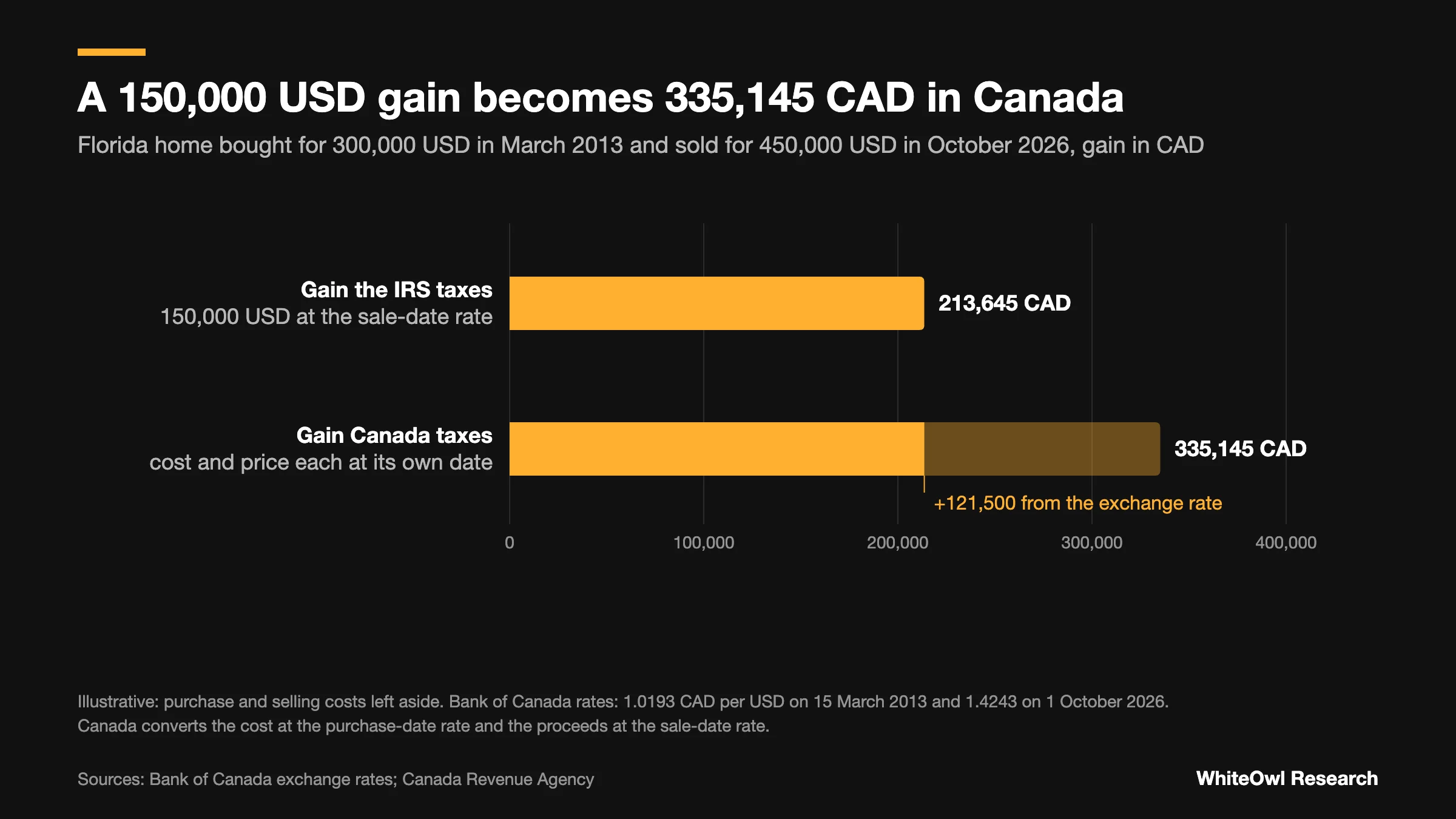
The exchange rate adds 121,500 CAD to the gain Canada taxes.
The credit for US tax, and its limits
The Canada-United States tax treaty lets the United States tax a gain on real estate located there, and has Canada deduct the US tax on that gain, within Canada's own rules. The federal credit is generally the lesser of the foreign income tax you actually paid and the Canadian tax otherwise payable on your income from that country; a provincial credit follows (in Quebec, on the Revenu Québec return). For a sale, this means:
- Credit the tax, not the withholding. Foreign tax paid cannot exceed the finally determined US tax, and an amount refunded is not tax paid. The couple's credit starts from 3,832.50 USD each, not the 45,000 USD withheld.
- Excess US tax is not carried over. US tax above the Canadian tax on the same income cannot be credited in another year.
- The exchange rate moves the limit. A larger Canadian gain raises the Canadian tax the credit can absorb; a smaller one lowers it.
Can the Florida home be your principal residence?
It can. The Canada Revenue Agency accepts that a property outside Canada can, depending on the facts, be a principal residence for a year you are resident in Canada, and a home lived in for only part of the year can count as ordinarily inhabited, unless you own it mainly to earn income. The limits:
- One home per family per year. Since 1982, a family unit can designate only one property for each year. Years given to the Florida home are taken from the Canadian home, whose gain for those years becomes taxable.
- The United States does not follow. Its exclusion of up to 250,000 USD per non-resident seller needs a main home owned and lived in for 24 months of the 5 years before the sale, and the most important factor in which home is main is where you spend the most time. For a snowbird who spends more of the year in Canada, that points to the Canadian home.
- The US tax stays. With the gain exempt in Canada, the credit has little or no Canadian tax to absorb it, so the US tax becomes a final cost.
The exempt share of a gain is one plus the years designated, divided by the years owned.
If the home was rented
- United States: depreciation counts even if you never claimed it. The cost of a rented home is reduced by the depreciation you deducted or could have deducted, and the part of a long-term gain due to depreciation is taxed at up to 25%.
- Canada: capital cost allowance is optional. You can claim any amount of this tax depreciation, from zero to the maximum. If you claimed it, a sale can bring some or all of it back into income, in full, in the year of the sale (a recapture).
- Canada: foreign property reporting. Form T1135 (the foreign income verification statement) is required when the total cost of your specified foreign property is more than 100,000 CAD at any time in the year. A vacation home used primarily, meaning more than half the time, for personal use is excluded; a home rented out with a reasonable expectation of profit is included.
The figures that matter
The rates and thresholds that decide the tax on a US home sale by a Canadian resident, as of the 2026 tax year. Sources: IRS, Florida Department of Revenue, Canada Revenue Agency and the Income Tax Act, listed below.
| Rule | Figure |
|---|---|
| FIRPTA withholding, general rate (% of the amount realized) | 15 |
| FIRPTA withholding, buyer will live in the home, price up to 1,000,000 USD (%) | 10 |
| FIRPTA withholding, buyer will live in the home, price up to 300,000 USD (%) | 0 |
| US long-term gain rate, married filing separately, taxable income up to 49,450 USD (%) | 0 |
| US long-term gain rate, married filing separately, taxable income up to 306,850 USD (%) | 15 |
| US long-term gain rate, married filing separately, taxable income above 306,850 USD (%) | 20 |
| US rate on the depreciation part of a real estate gain, maximum (%) | 25 |
| US main home exclusion, per non-resident seller, maximum (USD) | 250,000 |
| Florida documentary stamp tax on deeds, outside Miami-Dade (USD per 100 USD of the price) | 0.70 |
| Canadian capital gains inclusion rate (%) | 50 |
| Canadian foreign property reporting (Form T1135), total cost threshold (CAD) | 100,000 |
How WhiteOwl helps
One sale produces a gain in each currency, a return in each country and a credit that links them. WhiteOwl's figures are computed by a tax engine from each country's rules. WhiteOwl gathers your documents, organizes your file, finds the issues and runs the numbers. A licensed advisor reviews, decides and files. See how it works.
FAQ
Do Canadians pay capital gains tax on US property?
Usually to both. As of 2026, the United States taxes a non-resident's gain on a personal home held more than a year at up to 20%; Canada taxes half the gain in Canadian dollars and credits the US tax, up to the Canadian tax on that income.
How do I get the FIRPTA withholding back?
File a US non-resident return for the year of the sale with your ITIN, attaching the stamped withholding statement the IRS sends you; the amount withheld is credited against your US tax, and any excess comes back.
What if I sell my Florida home at a loss?
The buyer still withholds on the price unless the IRS issues a withholding certificate, which it can when withholding would exceed your maximum tax. As of 2026, neither country usually allows a deduction for a loss on a home held for personal use, such as a cottage or vacation home.
I am a US citizen living in Canada. Does FIRPTA apply?
Generally not. A seller who certifies to the buyer, under penalties of perjury, that they are not a foreign person (a valid Form W-9, the US taxpayer certification, counts) avoids the withholding. Both countries still tax the gain; see dual citizenship taxes.
Sources
- IRS, FIRPTA withholding (including its questions and answers) · exceptions from FIRPTA withholding · Instructions for Forms 8288 and 8288-A · withholding certificates · reporting and paying tax on US real property interests · ITIN guidance for foreign property buyers and sellers
- US Treasury regulations, section 1.1445-3 (withholding certificates and maximum tax liability)
- IRS Publication 519, US tax guide for aliens · Topic 409, capital gains and losses · Revenue Procedure 2025-32 (2026 inflation adjustments) · net investment income tax · US citizens and resident aliens abroad
- IRS Publication 523, selling your home · Topic 701, sale of your home · Publication 551, basis of assets · Publication 544, sales and other dispositions of assets
- Florida Department of Revenue, does Florida have a capital gains tax? · documentary stamp tax
- California Franchise Tax Board, Publication 1016, real estate withholding guidelines
- Canada Revenue Agency, Capital Gains 2025 (T4037) · Income Tax Folio S5-F4-C1, income tax reporting currency · definitions for capital gains · reporting worldwide income
- Income Tax Act, section 38 (taxable capital gains) · Canada Revenue Agency, note on the cancelled inclusion rate increase
- Canada Revenue Agency, federal foreign tax credit · Income Tax Folio S5-F2-C1, foreign tax credit · Department of Finance Canada, Canada-United States tax convention (consolidated text)
- Income Tax Folio S1-F3-C2, principal residence
- Canada Revenue Agency, how much capital cost allowance you can claim · questions and answers about Form T1135
- Bank of Canada, daily exchange rates · legacy noon and closing rates
This article is general information, not personalized tax advice. Consult a qualified cross-border tax professional about your situation.
Related reading
TFSA for non-residents: what happens to your account when you leave Canada
You can keep a TFSA after leaving Canada and it stays tax-free there. As of 2026, contributing as a non-resident costs 1% a month, and the United States taxes the account.
By WhiteOwl Research · Oct 23, 2026
Do you have to pay US taxes if you live abroad? The rules for a US citizen working in Canada (2026)
Yes: the United States taxes its citizens wherever they live. For a US citizen working in Canada, how the foreign tax credit and the foreign earned income exclusion compare, who taxes first under the treaty, and the deadlines.
By WhiteOwl Research · Jul 2, 2026
Behind on US filings while living abroad: the IRS streamlined filing compliance procedures
Behind on US filings while living abroad? Who qualifies for the IRS streamlined filing compliance procedures, what you file and pay, which penalties are waived, and the domestic version.
By WhiteOwl Research · Jun 30, 2026