
By WhiteOwl Research · October 23, 2026 · 8 min read
In short: As of 2026, you can keep your TFSA after leaving Canada, and Canada does not tax its income or your withdrawals. You earn no new room for a full year as a non-resident, and a contribution made while non-resident is taxed at 1% a month. Your new country may tax the account; the United States does.
Why it matters
If you are leaving Canada for work or a new life abroad, your TFSA keeps its Canadian shelter, but the rules for adding to it change the day you leave, and a contribution made out of habit is taxed every month it stays. In the United States, the income inside it is taxable and the account brings yearly reporting, with more forms if it counts as a foreign trust, a question the IRS has not answered.
What stays the same when you leave
Canada treats you as a non-resident once you live abroad without significant residential ties, such as a home, a spouse or dependants, in Canada. Keep those ties and you remain a factual resident under the ordinary TFSA rules; see digital nomad taxes.
Take Maya, a Toronto software engineer who moves to Seattle in August 2026 with 60,000 CAD in a self-directed TFSA of Canadian exchange-traded funds and a few US shares. As a non-resident, as of 2026:
- She keeps the account. A non-resident may continue to hold an existing TFSA.
- Canada does not tax it. Interest, dividends and capital gains inside it, and her withdrawals, are free of Canadian tax.
- No departure tax on it. On leaving, Canada treats you as selling most property you own at fair market value; the Income Tax Act excludes a TFSA, as it does an RRSP.
What changes: contributions and room
- Contribute before you go. Contributions are tax-free up to the date you become a non-resident, and the year you leave brings the full annual limit, 7,000 CAD in 2026.
- No new room while away. None accrues for a year in which you are a non-resident throughout. Unused room from earlier years is kept.
- Contributions while non-resident cost 1% a month. Any contribution made as a non-resident, other than a qualifying transfer or an exempt contribution, is taxed at 1% of its amount for each month it stays, until you withdraw all of it or become resident again. A partial withdrawal does not reduce the tax, and if the contribution also exceeds your room, a second 1% monthly tax can apply to the excess.
- Withdrawals come back later. Amounts withdrawn while non-resident are added back to your room, usable without the 1% tax once you are resident again.
The tax is 1% of the contribution, not of the account's value: a 7,000 CAD contribution made while non-resident costs 70 CAD a month, 840 CAD a year, and after 100 months the tax equals the contribution.
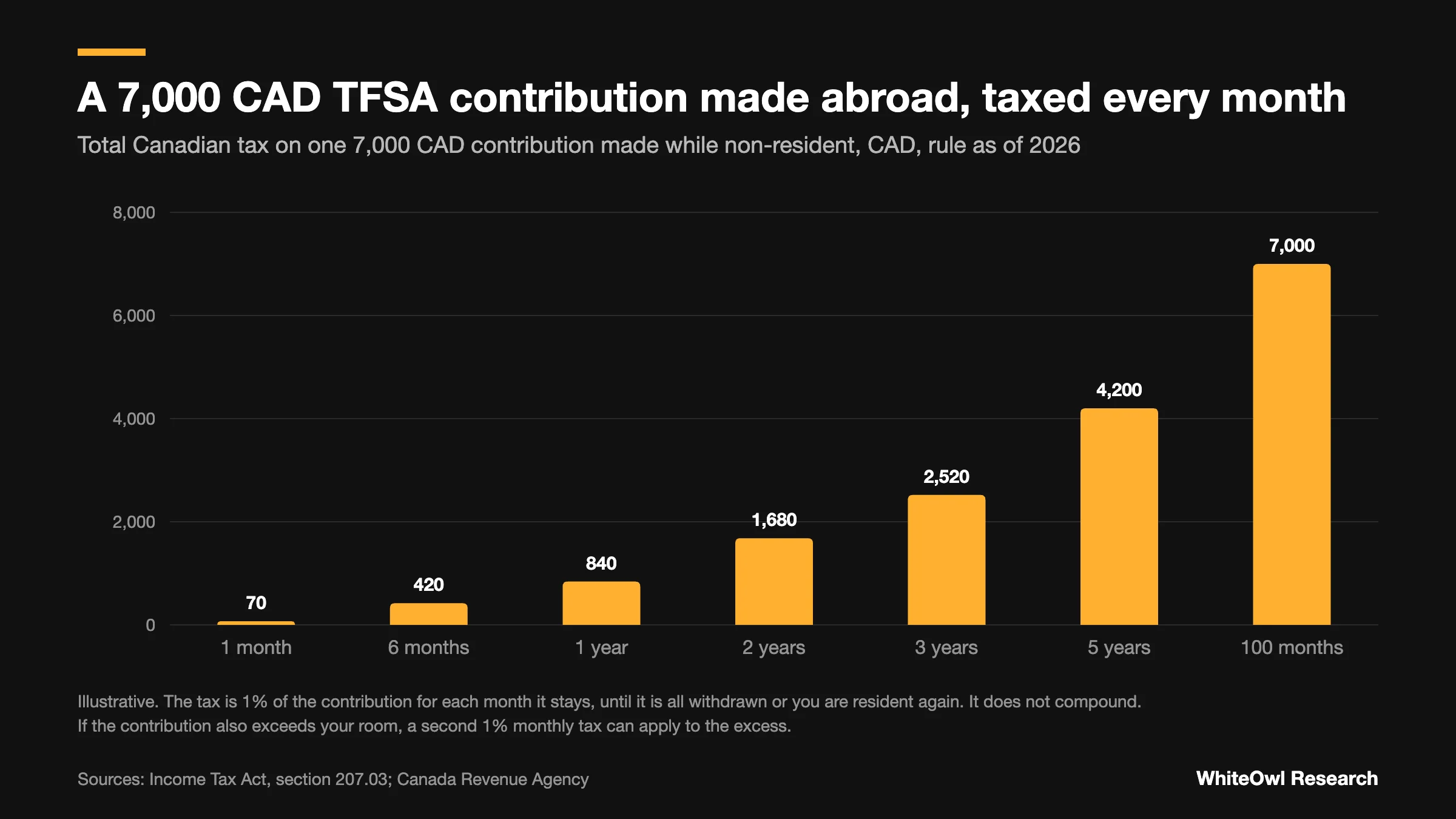
The 1% a month tax on a contribution made from abroad.
The TFSA dollar limit since 2009
The limit is indexed to inflation, rounded to the nearest 500 CAD, and adds room only for a year in which you are 18 or older and resident in Canada at some point. Maya's full years in Seattle from 2027 add nothing.
For someone eligible every year, the TFSA dollar limit added 109,000 CAD of room from 2009 to 2026, between 5,000 CAD and 10,000 CAD a year. Source: Canada Revenue Agency.
| Years | Limit each year (CAD) | Total for the period (CAD) |
|---|---|---|
| 2009 to 2012 | 5,000 | 20,000 |
| 2013 and 2014 | 5,500 | 11,000 |
| 2015 | 10,000 | 10,000 |
| 2016 to 2018 | 5,500 | 16,500 |
| 2019 to 2022 | 6,000 | 24,000 |
| 2023 | 6,500 | 6,500 |
| 2024 to 2026 | 7,000 | 21,000 |
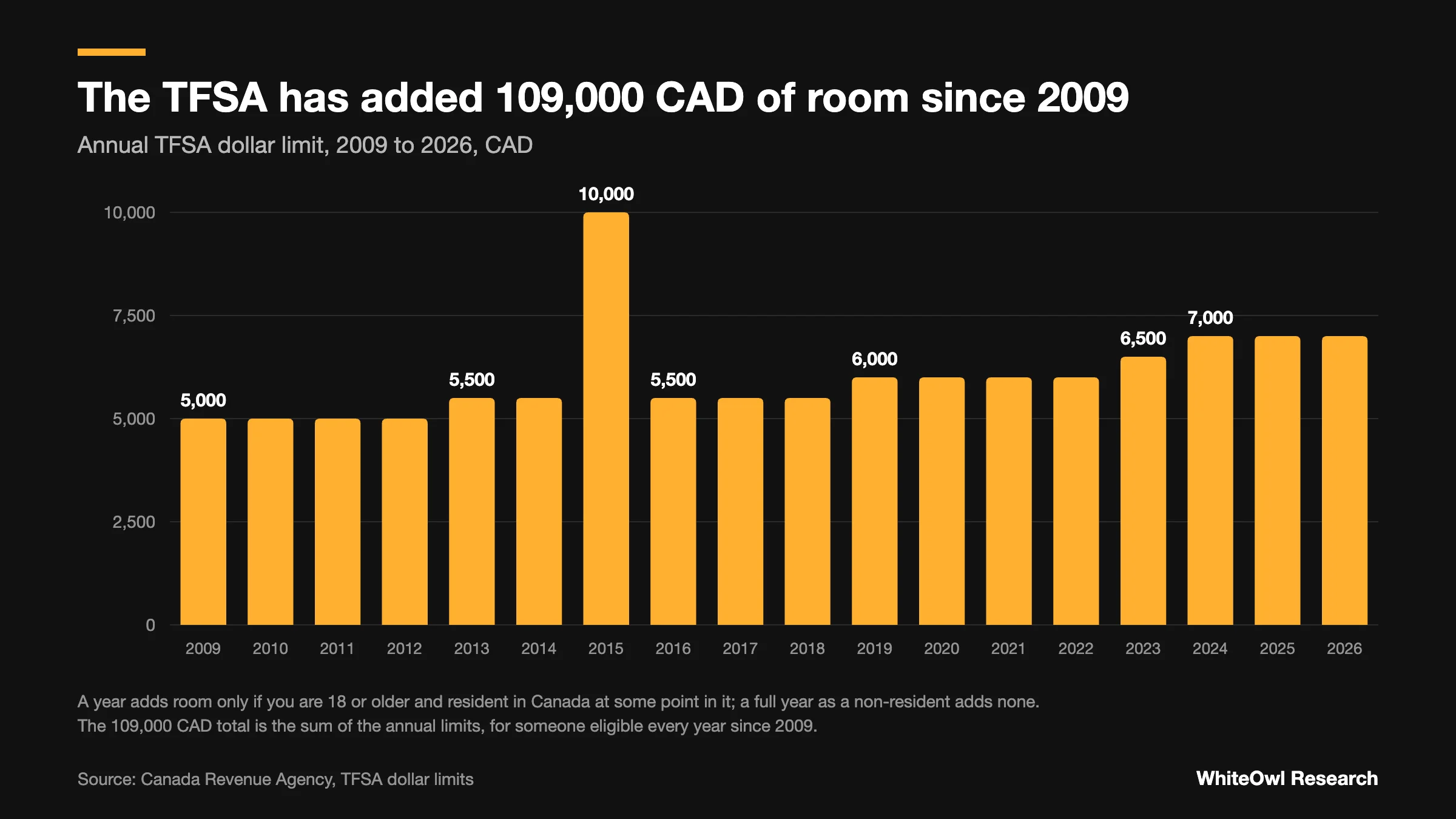
109,000 CAD of room since 2009 for someone eligible every year.
Moving to the United States: the worked example
The income inside the account is taxable
Once Maya is a US resident for tax, by green card or by days of presence, she is taxed on income from everywhere. The IRS has described the mismatch for Canadian retirement plans: under US domestic law, a US citizen or resident is generally taxed each year on income accruing inside the plan, although Canada taxes it only when paid out. The Canada-United States tax treaty lets the holder defer that US tax only for arrangements operated exclusively to provide pension or employee benefits, such as the RRSP and RRIF the IRS names. As of October 2026, the IRS has published no guidance that names the TFSA, so the interest, dividends and gains inside it are generally reported on Maya's US return as they arise. A US citizen living in Canada with a TFSA is in the same position; see dual citizenship taxes.
Reporting the account each year
- The FBAR (the report of foreign bank and financial accounts, filed with the Treasury's Financial Crimes Enforcement Network) is required once your foreign accounts together exceed 10,000 USD at any time in the year, whether or not they produce taxable income.
- Form 8938 (a statement of foreign financial assets attached to the tax return) is required, for an unmarried taxpayer living in the United States, above 50,000 USD on the last day of the year or 75,000 USD at any time; on a joint return, 100,000 USD and 150,000 USD.
Maya's TFSA alone is above the FBAR threshold; Form 8938 depends on the exchange rate and her other foreign accounts.
Is a TFSA a foreign trust?
Under the Income Tax Act, a TFSA can be an arrangement in trust, a deposit or an annuity contract; your contract says which. A US person treated as the owner of a foreign trust files Form 3520 (the annual return for transactions with foreign trusts), and the trust files Form 3520-A (its information return), or the owner attaches a substitute. The penalty for a missed return is the greater of 10,000 USD or a percentage: 5% of the trust assets you are treated as owning, or 35% of an unreported transfer or distribution.
The IRS has not said whether a TFSA is a foreign trust. Beyond the RRSP and RRIF, its published exemption (Rev. Proc. 2020-17) covers trusts for retirement, medical, disability or educational benefits whose withdrawals are tied to those purposes; a TFSA can generally be withdrawn at any time. Proposed regulations of May 8, 2024 would exempt eligible individuals for a tax-favored foreign savings trust reported yearly to its own country's tax authority and worth no more than 50,000 USD at any point in the year, counting all such trusts in that country. A TFSA under that value may fit, but the proposal does not name it. As of October 2026 they are still proposed, and the IRS allows reliance on them if applied in full and consistently.
Canadian funds inside the account: the PFIC rules
A foreign corporation is a passive foreign investment company (PFIC) when 75% or more of its income is passive or at least half of its assets produce passive income. A Canadian mutual fund or exchange-traded fund treated as a corporation for US tax generally meets the income test, since its income comes from investments. The account exceptions in the IRS instructions cover US tax-exempt accounts and arrangements treated as pension funds under a tax treaty; none names the TFSA. Each PFIC generally needs its own annual return, Form 8621, unless all your PFIC shares are worth 25,000 USD or less (50,000 USD joint) and you had no gain on a sale and no unusually large distribution that year. By default, the part of a gain on sale that falls in earlier years of ownership is taxed at the highest rate for each year, plus an interest charge.
US stocks in a TFSA
While you live in Canada, US dividends paid into a TFSA can be subject to US withholding tax, which the treaty caps at 15% for a Canadian resident. Canada gives no foreign tax credit for it: the CRA leaves both TFSA income and the foreign tax on it out of the credit. The treaty's full exemption for US dividends is reserved for arrangements operated exclusively to provide pension, retirement or employee benefits. After the move, Maya reports those dividends to the IRS, and shares of US companies are not PFICs, because those rules apply only to foreign corporations.
Before you leave: points to weigh
- Automatic deposits that keep running after you leave are non-resident contributions, taxed at 1% a month.
- Keeping the account preserves its Canadian shelter; in the United States it means yearly tax on its income, the account reports, and possibly the trust and fund returns.
- Withdrawing is not taxed in Canada, before or after you leave, and returns as room once you are resident again.
The figures that matter
The figures that decide what a TFSA costs after a move, as of 2026. Sources: Canada Revenue Agency, Income Tax Act, Canada-United States tax convention, IRS and FinCEN, listed below.
| Rule | Figure | As of |
|---|---|---|
| TFSA annual dollar limit (CAD) | 7,000 | 2026 |
| TFSA room since 2009, if eligible every year (CAD) | 109,000 | 2026 |
| Tax on a non-resident contribution (% of it per month) | 1 | 2026 |
| US withholding on US dividends to a Canadian resident, treaty cap (%) | 15 | 2026 |
| FBAR threshold, all foreign accounts at any time (USD) | 10,000 | 2026 |
| Form 8938 threshold, unmarried, in the United States, year end (USD) | 50,000 | 2026 |
| Form 8938 threshold, unmarried, in the United States, any time (USD) | 75,000 | 2026 |
| Foreign trust return penalty, minimum (USD) | 10,000 | 2026 |
| Form 8621 exception, all PFIC shares, single return (USD) | 25,000 | 2026 |
| Proposed exemption for small foreign savings trusts, maximum (USD) | 50,000 | Proposed, not final, as of October 2026 |
How WhiteOwl helps
A TFSA that moves with you sits under two sets of rules, and an advisor who knows Canadian registered accounts may know little about US foreign trust and fund reporting. WhiteOwl matches you with an advisor whose specialties and countries fit your case. WhiteOwl gathers your documents, organizes your file, finds the issues and runs the numbers. A licensed advisor reviews, decides and files. See how it works.
FAQ
Can a non-resident open a TFSA?
No. As of 2026, opening a TFSA requires being a resident of Canada, 18 or older, with a valid social insurance number. A non-resident who already holds one may keep it, but cannot contribute to it tax-free.
Do I lose my TFSA room when I leave Canada?
No. Unused room carries forward, and the year you leave brings the full limit, 7,000 CAD in 2026. No new room accrues for a year in which you are a non-resident throughout, and your room is usable without the 1% monthly tax once you are resident again.
What happens to my TFSA when I move back to Canada?
The 1% monthly tax on a non-resident contribution stops in the month you become resident again, the year you return brings the full limit, and withdrawals made while away are added back. In the Canada Revenue Agency's example, a holder who moved to the United Kingdom in 2020, withdrew 5,000 CAD and 3,000 CAD while abroad and returned in 2025 had 15,000 CAD of room: the 7,000 CAD limit for 2025 plus the 8,000 CAD withdrawn.
Is there a TFSA equivalent in the United States?
The account that works most like it is the Roth IRA: contributions are not deductible and qualified withdrawals are tax-free. It is a retirement account, so you need taxable compensation to contribute and income limits can reduce what you may put in. For 2026 the limit across all your IRAs is 7,500 USD, or 8,600 USD at age 50 or older.
Sources
- Canada Revenue Agency, how non-residency affects your TFSA · if you owe tax on non-resident TFSA contributions · opening a TFSA · withdrawing from a TFSA
- Canada Revenue Agency, before you contribute to a TFSA · calculate your TFSA contribution room · TFSA dollar limits by year
- Canada Revenue Agency, Income Tax Folio S5-F2-C1, foreign tax credit (paragraph 1.69)
- Income Tax Act, section 207.03 (non-resident contributions) · section 207.01 (unused TFSA contribution room) · section 146.2 (qualifying arrangement) · section 128.1 (emigration, excluded right or interest)
- Department of Finance Canada, Canada-United States tax convention (consolidated text), Articles X, XVIII and XXI
- IRS, US citizens and resident aliens abroad · determining an individual's tax residency status · Rev. Proc. 2014-55 (Canadian retirement plans) · Rev. Proc. 2020-17 (tax-favored foreign trusts)
- IRS, Report of Foreign Bank and Financial Accounts (FBAR) · do I need to file Form 8938
- IRS, Instructions for Form 3520 · Instructions for Form 3520-A · Federal Register, proposed regulations on foreign trusts (May 8, 2024)
- IRS, Instructions for Form 8621 (passive foreign investment companies)
- IRS, Roth IRAs · IRA contribution limits
This article is general information, not personalized tax advice. Consult a qualified cross-border tax professional about your situation.
Related reading
Canadian snowbirds selling a Florida home: the tax in both countries
Selling a Florida home as a Canadian resident: the FIRPTA withholding at closing, the US return that settles the tax, and the gain Canada taxes in Canadian dollars.
By WhiteOwl Research · Oct 23, 2026
What happens to your RRSP when you leave Canada
You can keep your RRSP after you leave Canada. What the departure tax, 25% non-resident withholding, RRIF treaty rates and the US deferral mean for it, as of 2026.
By WhiteOwl Research · Oct 23, 2026
Do you have to pay US taxes if you live abroad? The rules for a US citizen working in Canada (2026)
Yes: the United States taxes its citizens wherever they live. For a US citizen working in Canada, how the foreign tax credit and the foreign earned income exclusion compare, who taxes first under the treaty, and the deadlines.
By WhiteOwl Research · Jul 2, 2026