
By WhiteOwl Research · October 23, 2026 · 9 min read
In short: You can keep your RRSP after you leave Canada. As of 2026, it is excluded from the departure tax, Canada generally taxes it only when money comes out, withholding 25% from a non-resident's withdrawal unless a treaty lowers the rate, and the United States lets its residents defer tax on the plan's growth until withdrawal.
Why it matters
For many people who move abroad, the RRSP is the largest account they leave behind, and it now sits under two countries' rules. How you take the money out decides how much Canada keeps, whether part of it comes back, and how your new country taxes the same withdrawal. One choice has to be made by the end of the year you turn 71.
Leaving Canada does not cash in your RRSP
When you become a non-resident, Canada treats you as having sold most of what you own at market value on the day you leave, and you report any gain. This deemed disposition, often called the departure tax, does not apply to registered retirement savings plans, registered retirement income funds (RRIFs), pension plans or tax-free savings accounts. RRSPs are also left off the list of property that an emigrant with more than 25,000 CAD of assets must report.
The plan can stay invested: the Canada Revenue Agency's rules cover non-residents' withdrawals and contributions, and income inside the plan is usually not taxed while the funds stay there. Three things change:
- The issuer needs to know. Emigrants are required to tell Canadian payers and financial institutions that they are no longer resident.
- A Home Buyers' Plan balance comes due. If you used the plan to buy a home, what you still owe is repaid by the earlier of filing the return for the year you leave and 60 days after you become a non-resident. Any amount not repaid is added to that year's income.
- No new plan withdrawals. Non-residents cannot withdraw under the Home Buyers' Plan or the Lifelong Learning Plan.
Contributions and room after you leave
Each year adds RRSP room of 18% of the previous year's earned income, up to 33,810 CAD for 2026, and unused room carries forward indefinitely. Once you leave, your limit is based on Canadian-source income reported on Canadian returns, so a salary earned abroad as a non-resident adds no room. You can still contribute against unused room, but the deduction only reduces income taxed in Canada. Contributions more than 2,000 CAD over your limit are generally taxed at 1% per month, and the year you turn 71 is the last year you can contribute to your own RRSP.
RRSP withdrawals as a non-resident
When a non-resident takes money out of an RRSP, the issuer withholds non-resident tax at 25% unless a tax treaty lowers the rate. That is usually the final Canadian tax on the payment, unless you file a section 217 return, described below.
For a resident, outside Quebec, the issuer withholds 10% on withdrawals up to 5,000 CAD, 20% above 5,000 CAD up to 15,000 CAD, and 30% above 15,000 CAD; in Quebec the federal rates are 5%, 10% and 15%, plus Quebec tax. That is only a prepayment: the withdrawal is added to income on the return and taxed at the person's own rates.
What a treaty changes, and what it does not
Some treaties, including the Canada-United States treaty, lower the rate only for periodic pension payments, a term defined in Canadian law. It excludes an RRSP payment made before the plan matures, and it covers RRIF payments only up to a yearly ceiling: the greater of twice the year's minimum payment (as the law computes it) and 10% of the fund's value at the start of the year. Under such a treaty, a lump-sum RRSP withdrawal is withheld at the full 25%, while regular RRIF payments within the ceiling get the treaty rate. Rates differ by country; the Canada Revenue Agency's Part XIII tax calculator gives each one.
As of 2026, Canada withholds more from a non-resident's lump-sum RRSP withdrawal than from a resident's, and only RRIF payments within the ceiling get the treaty rate for a US resident. Here, on a 10,000 CAD payment. Sources: Canada Revenue Agency, Income Tax Conventions Interpretation Act and the Canada-United States tax convention, listed below.
| Who receives it | Type of payment | Rate (%) | Withheld (CAD) |
|---|---|---|---|
| Resident of Canada, outside Quebec | RRSP lump sum | 20 | 2,000 |
| Non-resident, no treaty reduction | RRSP lump sum | 25 | 2,500 |
| Resident of the United States | RRSP lump sum | 25 | 2,500 |
| Resident of the United States | RRIF payment within the yearly ceiling | 15 | 1,500 |
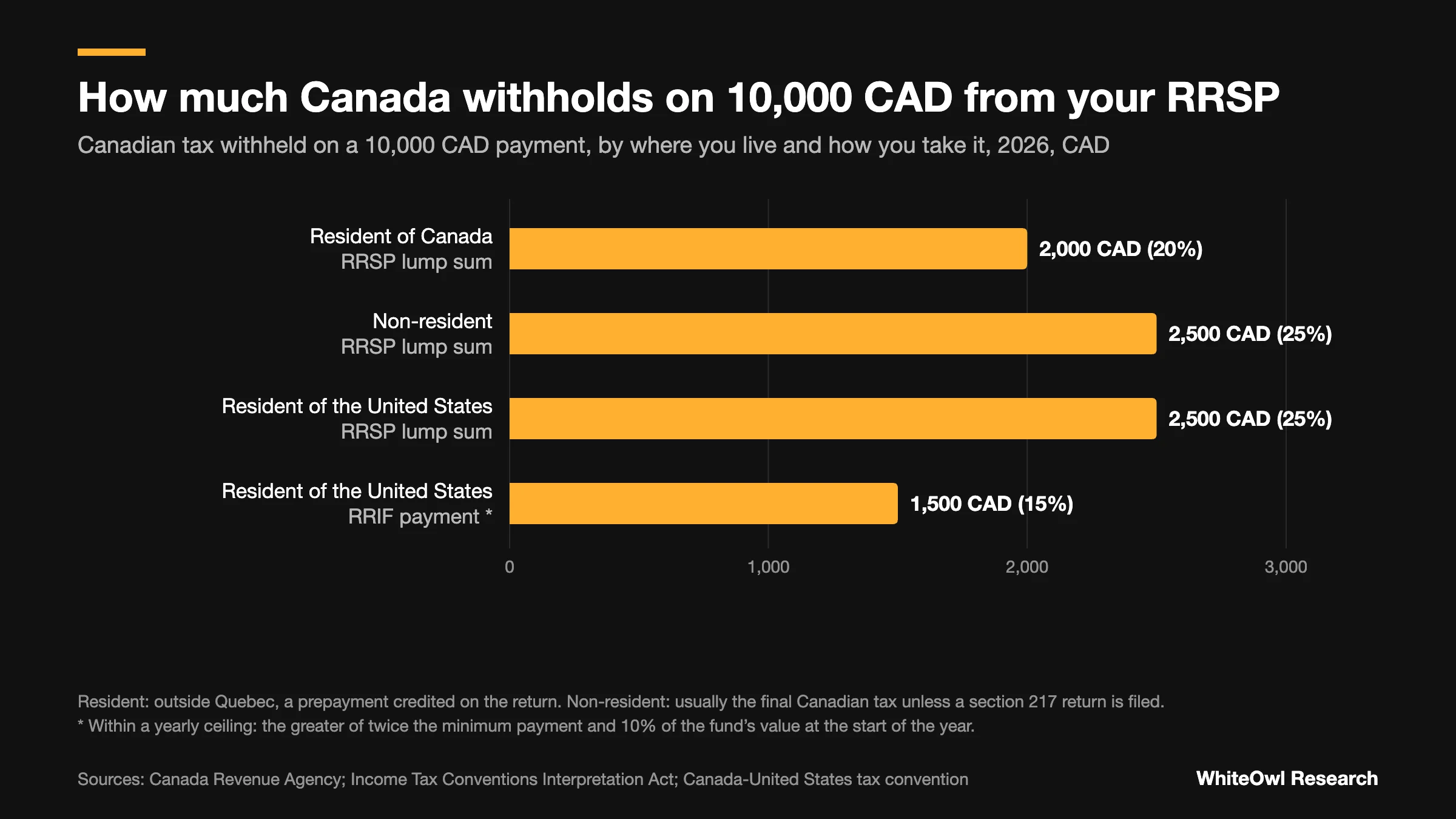
A non-resident's lump sum is withheld at 25%; only RRIF payments get the US treaty's 15%.
The section 217 election: filing to get part of it back
A non-resident can choose to file a Canadian return for most RRSP, RRIF and pension income under section 217 of the Income Tax Act. That income is then taxed at the rates residents pay, and the Canada Revenue Agency refunds any withholding above that tax. The return also reports your income from everywhere, which is used to limit your tax credits and adjust the tax; the agency applies the election only when it is beneficial.
The return is due by June 30 of the year after the payment; filed later, the amount withheld stands as the final tax. An application to lower the withholding in advance (Form NR5) is valid for five tax years, with a section 217 return filed for each.
Turning 71: convert to a RRIF, buy an annuity or withdraw
Generally, an RRSP must mature by the last day of the year you turn 71: the funds are withdrawn, transferred to a RRIF, or used to buy an annuity. A direct transfer has no immediate tax, and a non-resident completes an authorization (Form NRTA1) beforehand so that none is withheld. A RRIF pays a yearly minimum from the year after it is set up, and its payments are taxable.
An RRSP can also be moved into a RRIF before 71. Where a treaty lowers the rate on periodic pension payments, regular RRIF income within the ceiling is then withheld at the treaty rate instead of 25%.
The United States as the worked example
Take a Canadian engineer who moves to Seattle in 2026, becomes a resident of the United States and keeps her RRSP. US residence for tax comes from a green card or a count of days (see digital nomad taxes), and the treaty settles a year both countries claim (see dual citizenship taxes).
Growth inside the plan: deferred automatically
Without a deferral, the United States generally taxes income accruing inside an RRSP each year. Article XVIII(7) of the Canada-United States tax convention lets a US citizen or resident defer that tax until money comes out. Since an IRS revenue procedure issued in 2014 (Revenue Procedure 2014-55), the deferral is automatic for someone who has filed every required US return, has not reported the plan's undistributed earnings as income and has reported any withdrawals as if the deferral applied. The old election form, Form 8891, is obsolete, and the IRS no longer asks for its foreign trust returns (Forms 3520 and 3520-A) on these plans. The same rules cover a US citizen living in Canada; see US taxes when you live abroad.
Reporting the account
The IRS says two other filings may still apply to an RRSP:
- The FBAR (Report of Foreign Bank and Financial Accounts), filed with the Financial Crimes Enforcement Network, lists your foreign accounts when their combined value exceeds 10,000 USD at any time in the year.
- Form 8938 (statement of specified foreign financial assets) is filed with the US return above a threshold: for an unmarried person living in the United States, more than 50,000 USD on the last day of the year or more than 75,000 USD at any time; for a married couple filing jointly, 100,000 USD and 150,000 USD.
Withdrawals: taxed in both countries, with a credit
When the engineer withdraws 10,000 CAD as a lump sum, the Canadian issuer withholds 2,500 CAD, and the United States taxes the withdrawal on her federal return under its rules for annuities (section 72 of the Internal Revenue Code), including income that built up in the plan without US tax. In the IRS's own example, a US citizen who saved in an RRSP while living in Canada is taxed on the entire withdrawal. The guidance does not spell out how money contributed before someone became a US resident is treated, a point to settle with an advisor before a large withdrawal.
Under the treaty, the Canadian tax withheld can generally be credited against US tax on the same withdrawal, within the limits of the US foreign tax credit.
States: California does not follow the deferral
The treaty deferral is federal. California's Franchise Tax Board states, in its guidelines for 2025 returns, that it does not apply for California income tax and that California residents must include their RRSP earnings in taxable income in the year earned, so a Canadian who settles there pays state tax on the plan's yearly income.
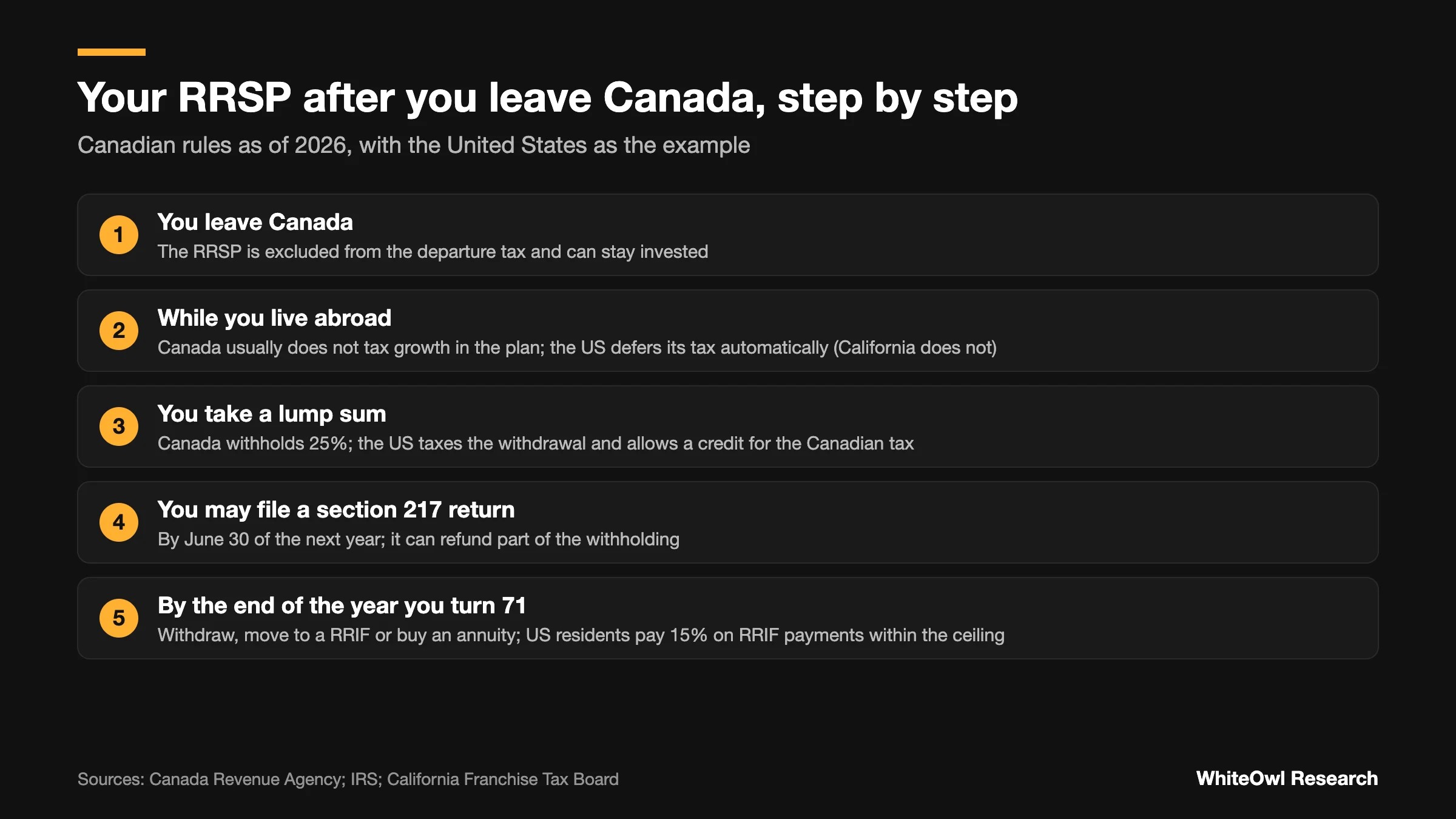
The five moments that decide what the RRSP costs.
The figures that matter
The rates and thresholds that decide what an RRSP costs after a move, as of the 2026 tax year. Sources: Canada Revenue Agency, Department of Finance Canada, IRS and FinCEN, listed below.
| Rule | Figure |
|---|---|
| Canadian withholding, non-resident's RRSP withdrawal, no treaty reduction (%) | 25 |
| Canadian withholding, resident's lump sum up to 5,000 CAD, outside Quebec (%) | 10 |
| Canadian withholding, resident's lump sum over 5,000 CAD up to 15,000 CAD, outside Quebec (%) | 20 |
| Canadian withholding, resident's lump sum over 15,000 CAD, outside Quebec (%) | 30 |
| Canada-United States treaty cap on periodic pension payments (%) | 15 |
| New RRSP room, share of the previous year's earned income (%) | 18 |
| RRSP dollar limit (CAD) | 33,810 |
| Age in the year an RRSP must mature, by December 31 | 71 |
| FBAR threshold, all foreign accounts at any time (USD) | 10,000 |
| Form 8938 threshold, unmarried, living in the United States, year end (USD) | 50,000 |
| Form 8938 threshold, unmarried, living in the United States, any time (USD) | 75,000 |
How WhiteOwl helps
An RRSP held from abroad sits under two countries' rules at once, and an advisor who knows Canadian retirement plans may know little about how the United States taxes a foreign pension. WhiteOwl matches you with an advisor whose specialties and countries fit your case. WhiteOwl gathers your documents, organizes your file, finds the issues and runs the numbers. A licensed advisor reviews, decides and files. See how it works.
FAQ
Can a non-resident keep an RRSP?
Yes. As of 2026, an RRSP is excluded from the departure tax when you leave Canada, and Canada usually taxes it only when money comes out, at the non-resident rate once you have left.
Can I contribute to my RRSP after I leave Canada?
Yes, up to your unused room, which carries forward indefinitely. New room comes only from Canadian-source income reported on Canadian returns, and as of 2026, contributions more than 2,000 CAD over your limit are generally taxed at 1% per month.
How much tax is withheld on an RRSP withdrawal for a non-resident?
As of 2026, 25% unless a tax treaty lowers it. Where a treaty lowers the rate only for periodic pension payments, as the Canada-United States treaty does, a lump-sum RRSP withdrawal stays at 25%. A section 217 return, filed by June 30 of the following year, can refund part of it.
What is the withholding tax on my RRSP if I live in the United States?
The withholding is Canadian: as of 2026, 25% on a lump-sum RRSP withdrawal and 15% on RRIF payments within the yearly ceiling. The United States taxes the withdrawal on your federal return and generally allows a credit for the Canadian tax, within limits.
What happens if I withdraw before I leave Canada?
It is added to that year's income and taxed at your own rates, with 10%, 20% or 30% withheld in advance outside Quebec. After you leave, the 25% non-resident withholding usually settles the Canadian tax instead.
Sources
- Canada Revenue Agency, dispositions of property for emigrants · leaving Canada (emigrants)
- Canada Revenue Agency, tax rates on withdrawals · Information Circular IC76-12R8, applicable rate of Part XIII tax · payments to non-residents of Canada
- Canada Revenue Agency, Guide T4040, RRSPs and other registered plans for retirement · RRSP dollar limits · important dates for RRSPs · options for your own RRSPs
- Canada Revenue Agency, Guide T4058, non-residents and income tax · Guide T4145, electing under section 217 · repaying the Home Buyers' Plan
- Justice Laws, Income Tax Conventions Interpretation Act, section 5
- Department of Finance Canada, Canada-United States tax convention (consolidated text)
- IRS, Publication 597, the United States-Canada income tax treaty · Revenue Procedure 2014-55 · Publication 514, foreign tax credit for individuals
- IRS, comparison of Form 8938 and FBAR requirements · FinCEN, Report of Foreign Bank and Financial Accounts
- California Franchise Tax Board, Publication 1001 (2025), supplemental guidelines to California adjustments
This article is general information, not personalized tax advice. Consult a qualified cross-border tax professional about your situation.