
By WhiteOwl · November 11, 2026 · 9 min read
In short: The jock tax is the income tax a state or country charges a visiting athlete or performer on pay earned there. As of 2026, New Jersey divides a team player's pay by duty days, California credits its residents for that tax, and in Canada a payer withholds 15% of a visiting performer's fee unless the Canada Revenue Agency waives it.
Why it matters
For a player whose team travels, or a musician on tour, one year of pay can be taxed in many places, each counting its own share by days or by shows. The home country, and the home state if it has an income tax, then tax all of it and decide how much credit to give. Withholding taken on the road is generally a payment on account, so the returns filed afterwards decide what is finally owed.
What the jock tax is
"Jock tax" is a common name, not a legal one, for the ordinary income tax charged to non-residents on pay for work done in a place, as it applies to athletes and entertainers who work from city to city. In the United States, as of 2026, the IRS treats pay for services performed in the country as US-source income, and divides an employee's pay for work inside and outside it by the days worked in each. In Canada, the Income Tax Act taxes a non-resident on income from employment duties performed in Canada and from a business carried on there.
States apply the same idea to people from other states. New Jersey, for example, taxes a non-resident athlete or entertainer on income sourced to the state whenever the person's income from everywhere meets the filing threshold, with no exception for small amounts.
Duty days: how a state divides a team salary
A team athlete is paid for a season, not for each game, so a state needs a way to find its share. New Jersey's rule, as published in 2026, uses duty days: a non-resident team member's New Jersey income is based on the ratio of duty days spent in New Jersey to all duty days in and outside the state during the tax year.
- Duty days are all days from the start of the team's official preseason training through the final scheduled game, plus other days on which the member renders services to the team.
- Days in the state that count include games, practices, team meetings, promotional appearances and rehabilitation at team facilities.
- A spectator's days do not count: a player who attends a game in New Jersey only to watch has no New Jersey duty days for it, though those days may still count in the player's total.
The division's regulation, N.J.A.C. 18:35-5.1, holds the full definitions.
A worked example: two road trips to New Jersey
Take a player who lives in California and is paid 4,000,000 USD for a season whose 200 duty days all fall in 2026. Two road trips put the player in New Jersey for 6 of those days, for practices, meetings and two games. The figures are illustrative.
Six of 200 duty days spent in New Jersey in 2026 make 3% of a 4,000,000 USD salary, or 120,000 USD, New Jersey income. Sources: New Jersey Division of Taxation, listed below.
| Step | Figure |
|---|---|
| Salary for the season (USD) | 4,000,000 |
| Duty days in the season | 200 |
| Duty days in New Jersey | 6 |
| New Jersey share of duty days (%) | 3 |
| Salary sourced to New Jersey (USD) | 120,000 |
| Salary sourced outside New Jersey (USD) | 3,880,000 |
New Jersey taxes the 120,000 USD as the player's New Jersey income; the tax itself is not shown here. California, the player's home state, taxes the full 4,000,000 USD and allows its credit for the New Jersey tax on that income. Every other state on the schedule that taxes wages runs its own count.
The home state: a credit, or no state tax at all
California taxes its residents on all income regardless of source, road games included. To avoid taxing that pay twice, California gives residents a credit for net income tax paid to another state on income with a source there, and its list of qualifying states includes New Jersey and New York. Two limits matter on the road: California measures the income earned in the other state by its own sourcing rules, and tax paid to a foreign country, such as Canada, does not count toward this credit.
A player whose home state does not tax wages has no home-state tax to set the road taxes against. As of 2026, the official sites of Alaska, Florida, Nevada, South Dakota, Texas, Washington and Wyoming confirm that each has no individual income tax. Tennessee's Hall income tax reached only interest and dividends and was repealed from 2021; New Hampshire repealed its interest and dividends tax from 2025, and its revenue department lists no tax on wages among those it collects. Washington is changing: a law passed in 2026 creates a 9.9% tax on annual adjusted gross income above 1,000,000 USD from January 1, 2028, and the state has not yet said who must file.
Games in Canada: league players and the treaty
The Canada-United States tax convention treats a player on a team in a league with regularly scheduled games in both countries differently: Article XVI, on entertainers and athletes, does not apply, and the player's pay falls under Article XV, on employment.
- A US team's player who lives in the United States: pay for games in Canada is taxable only in the United States when the player is in Canada no more than 183 days in any 12-month period and the pay is neither paid by a resident of Canada nor borne by a permanent establishment there. Pay for work in Canada of no more than 10,000 CAD is also taxable only at home.
- A Canadian team's player who lives in the United States: the employer is a resident of Canada, so that exemption does not apply. Canada taxes the player on income from employment duties performed in Canada, and the team withholds at the graduated rates used for any employee. The United States taxes citizens and residents on worldwide income and, under Article XXIV of the treaty, allows a credit for the Canadian tax.
- A US team's player who lives in Canada and is not a US resident for tax: the United States taxes the pay for days worked there, and Canada, which taxes the player as a resident, deducts that US tax, within limits, from the Canadian tax on the same income.
On the pages reviewed, the Canada Revenue Agency has not published a duty-days formula for team athletes. A player who sets up a home in Canada for the season, with a spouse or children there, may become a resident rather than a visitor, because the agency decides residence from ties such as these. A US citizen in that position stays taxable in the United States (see US taxes when you live abroad). One Article XVI rule does reach team athletes: a signing bonus paid by a team in one country to a player resident in the other may be taxed in the team's country, at no more than 15% of the gross payment.
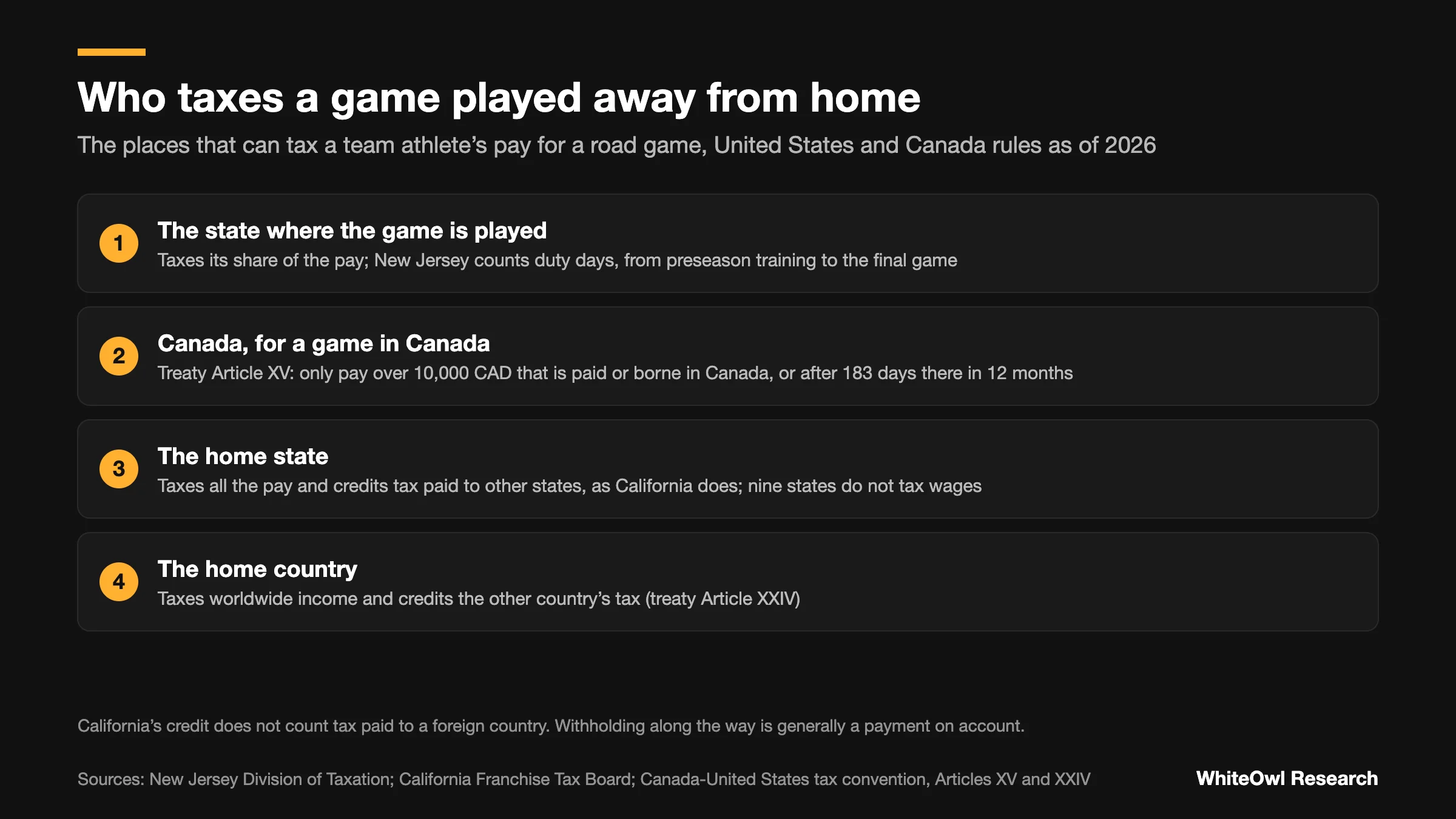
The places that can tax one road game.
Golfers, racing drivers and touring performers: the 15,000 threshold
Athletes outside a league team, such as golfers, rodeo riders and racing drivers, and entertainers, such as actors and musicians, fall under Article XVI. The country where they perform may tax that income, except when their gross receipts from it, including expenses reimbursed or paid for them, are no more than 15,000 in that country's currency for the calendar year: 15,000 CAD in Canada, 15,000 USD in the United States. It is a threshold, not an allowance: once gross receipts pass 15,000, the exception does not apply to any of them, as the Canada Revenue Agency's own example of an actor shows. Income paid to a performer's company may also be taxed where the show takes place, unless it is established that neither the performer nor related persons share in that company's profits.
In Canada, as of 2026, a payer withholds 15% of a fee paid to a non-resident for services, other than employment, rendered in Canada, under section 105 of the Income Tax Regulations, and a show in Quebec adds a 9% Quebec withholding on payments to persons not resident in Canada. The Canada Revenue Agency treats the 15% as a payment on account, not a final tax; the Canadian return settles it. To reduce it in advance, the performer applies for a waiver at least 30 days before the services begin or the first payment, based on the treaty or on estimated income and expenses.
Self-employed artists and athletes who expect to earn no more than 15,000 CAD in Canada in the calendar year can instead give the payer Form R105-S (the simplified waiver application), with no advance approval. A US resident who uses it has nothing withheld; a resident of another country has 23% withheld on net income after reasonable expenses. It is not open to incorporated performers or to employees.
Performing in the United States
In the United States, as of 2026, a payer withholds 30% from payments to a foreign artist or athlete for independent services, or graduated rates from an employee, unless an exception or a treaty claim applies. A touring performer can ask the IRS for a central withholding agreement, which bases withholding on estimated net income; the IRS does not consider a request received less than 45 days before the first event it covers. The performer files a US non-resident return for any year with business in the United States, even when no tax is due.
California, for example, requires payers to withhold 7% from California-source payments to non-resident entertainers once the calendar year's total passes 1,500 USD, and generally treats endorsement pay as California income when an athlete or entertainer performs for a sponsor at a California event, such as by wearing the sponsor's logo.
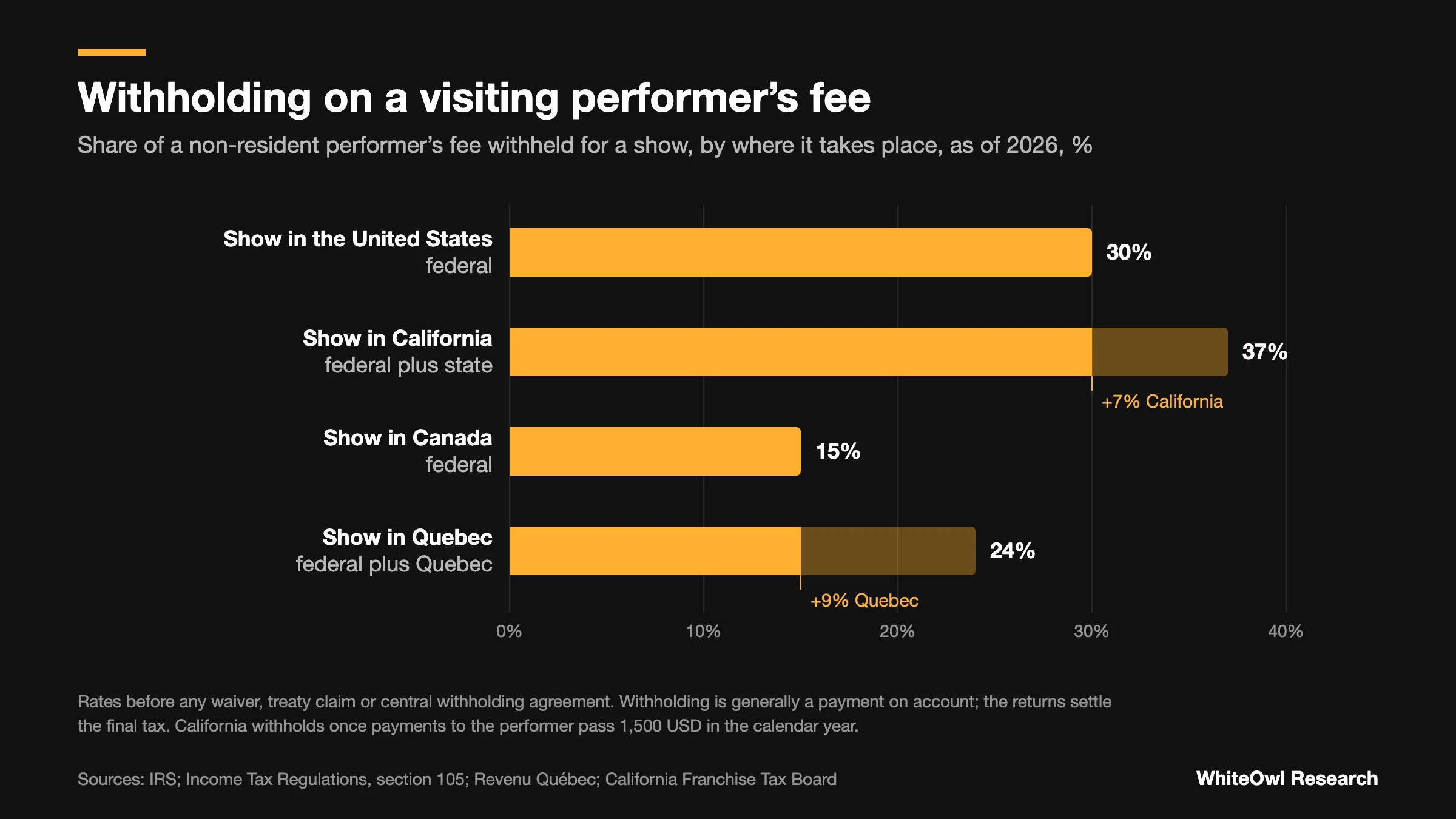
What is withheld from a visiting performer’s fee.
The figures that matter
The thresholds and withholding rates that decide where a visiting athlete or performer is taxed, as of the 2026 tax year. Sources: Canada-United States tax convention, Canada Revenue Agency, Revenu Québec, IRS and state revenue departments, listed below.
| Rule | Figure |
|---|---|
| Treaty threshold for performers, performances in Canada (CAD) | 15,000 |
| Treaty threshold for performers, performances in the United States (USD) | 15,000 |
| Treaty threshold for employment pay, work in Canada (CAD) | 10,000 |
| Most days in the other country in any 12 months for the employment exemption | 183 |
| Most tax on an athlete's signing bonus in the payer's country (%) | 15 |
| Canadian withholding on a non-resident's fee for services in Canada (%) | 15 |
| Quebec withholding on top, services in Quebec (%) | 9 |
| Most Canadian earnings in the year for the simplified waiver (CAD) | 15,000 |
| Simplified waiver withholding on net income, residents outside the United States (%) | 23 |
| Days before services or first payment to apply for a Canadian waiver | 30 |
| US withholding on a foreign performer's independent services (%) | 30 |
| Days before the first event to request a US central withholding agreement | 45 |
| California withholding on payments to non-resident entertainers (%) | 7 |
| California payments in a calendar year before withholding begins (USD) | 1,500 |
| Washington tax on adjusted gross income above 1,000,000 USD, from 2028 (%) | 9.9 |
How WhiteOwl helps
A season on the road can mean returns in several states and in Canada, and an advisor who knows duty-day rules may know little about Canadian waivers or the treaty. WhiteOwl matches each athlete and performer with an advisor whose specialties and countries fit their schedule. WhiteOwl gathers your documents, organizes your file, finds the issues and runs the numbers. A licensed advisor reviews, decides and files. See how it works.
FAQ
What is the jock tax?
It is the common name for the income tax a state or country charges a non-resident athlete or entertainer on pay earned there, not a separate tax. As of 2026, New Jersey, for example, taxes a visiting team member on the share of pay matching their duty days in the state.
Do athletes pay the jock tax in states with no income tax?
Not on wages. As of 2026, Alaska, Florida, Nevada, New Hampshire, South Dakota, Tennessee, Texas, Washington and Wyoming do not tax wages, although Washington has passed a 9.9% tax on annual adjusted gross income above 1,000,000 USD from January 1, 2028.
Do US players pay tax in Canada when they play a game there?
Not if they play for a US team, live in the United States, spend no more than 183 days in Canada in any 12 months and are not paid by a Canadian resident or a permanent establishment in Canada (Article XV of the treaty). A player paid by a Canadian team is taxable in Canada on pay for duties performed there, and the United States credits that tax.
Sources
- New Jersey Division of Taxation, nonresident athletes, entertainers and performers
- California Franchise Tax Board, other state tax credit · 2025 instructions for the other state tax credit · Publication 1100, taxation of nonresidents (2025) · Publication 1017, resident and nonresident withholding guidelines
- Alaska Department of Revenue · Florida Department of Revenue · Nevada Department of Taxation · New Hampshire Department of Revenue Administration, repeal · 2026 filing guidance · South Dakota Department of Revenue · Tennessee Department of Revenue · Texas Constitution, article 8 · Washington Department of Revenue, income tax · questions about the new income tax · State of Wyoming
- IRS, Publication 519, US tax guide for aliens · withholding on payments to foreign artists and athletes · questions about foreign artist and athlete withholding
- Department of Finance Canada, Canada-United States tax convention (consolidated text)
- Canada Revenue Agency, non-residents who perform services in Canada · Information Circular IC75-6R2 · simplified waiver for non-resident artists and athletes · treaty-based waiver guidelines · Article XVI of the Canada-United States convention · determining your residency status
- Justice Laws, Income Tax Act section 2 · section 115 · Income Tax Regulations section 105
- Revenu Québec, payments to persons not resident in Canada for services in Québec
This article is general information, not personalized tax advice. Consult a qualified cross-border tax professional about your situation.
Related reading
The Canada-United States tax treaty: who taxes what when you live, work or retire across the border
How the Canada-United States tax treaty splits the tax on residence, pensions, social security, gains, wages and estates, and what it leaves to US citizens and states, as of 2026.
By WhiteOwl · Nov 11, 2026
Renting out your home in Canada after you leave: the 25% tax, section 216 and NR6 in 2026
Renting out your Canadian home after you move abroad? Canada takes 25% of the gross rent unless you file a section 216 return. NR6, depreciation, a sale and the US side, as of 2026.
By WhiteOwl · Nov 11, 2026
Inheritance tax in Canada: what is taxed when someone dies, and across the US border
Canada has no inheritance tax: the final return taxes the gains at death. What changes when an heir lives in the US or a parent owns a Florida condo or US shares, as of 2026.
By WhiteOwl Research · Oct 29, 2026