
By WhiteOwl · November 11, 2026 · 10 min read
In short: As of 2026, when a non-resident rents out a home in Canada, 25% of the gross rent is withheld for the Canada Revenue Agency as the final tax. You can instead file a separate section 216 return and be taxed on the net rent; with Form NR6, an undertaking to file that return, withholding follows the net during the year.
Why it matters
For a family who kept their Toronto condo when they moved to the United States, 25% of the gross rent can take most or all of what the rent leaves after expenses. Filing the section 216 return is a choice made each year. The depreciation claimed on it, and the home's value on the day the renting began, also decide the tax when the condo is sold, in Canada and in the United States.
The default: 25% of the gross rent, withheld and final
Once you are a non-resident of Canada, Canada taxes rent from real property in Canada at 25% of the gross rent, before any expense. When you became a non-resident, and why your home was not treated as sold when you left, are in Canada's departure tax. A home rented at arm's length may not count as a significant tie to Canada, the Canada Revenue Agency says, except together with other ties.
Whoever pays or collects the rent for you, usually a property manager resident in Canada, withholds the 25% and sends it to the agency by the 15th of the following month, and gives you an NR4 slip (a statement of amounts paid to a non-resident). An amendment enacted in March 2026, which applies from August 12, 2024, removed the duty to withhold for an individual tenant who rents the home to live in it. When no agent collects the rent, the landlord must send the 25% to the agency directly.
The tax withheld is generally the final Canadian tax on the rent. The Canada-United States tax convention lets Canada tax income from real property in Canada and sets no lower rate for rent.
The choice: a section 216 return on the net rent
Section 216 lets a non-resident file a separate Canadian return, Form T1159 (the return for electing under section 216), and pay tax on the net rent instead. You deduct the expenses a resident landlord would, such as property taxes, condominium fees, insurance, mortgage interest, repairs and management fees. All your Canadian rental properties go on one return, and a loss on it cannot be used on any other return or in another year.
The net rent is taxed at the federal rates, with no personal tax credits and no provincial tax; instead, a non-resident surtax adds 48% of the federal tax. For 2026, the first federal rate is 14% up to 58,523 CAD of taxable income, so that bracket costs 20.72% with the surtax. The 25% already withheld counts as a payment, and any excess is refunded.
The return is due within two years after the end of the year, so a 2026 return can be filed until December 31, 2028, and any balance owing is due April 30 of the following year. After that, the 25% stands, unless the agency accepts the late return under its one-time policy: it does so once, if it has not already raised the tax on the rent with you, with no penalties but possibly interest.
Form NR6: withholding on the net during the year
Form NR6 (an undertaking to file a section 216 return) lets the lower tax apply during the year instead of as a refund. You and your agent in Canada sign it and send it by January 1, or before the first rent payment is due, with an estimate of rent and expenses that leaves out capital cost allowance. Once the agency approves it in writing, the agent withholds 25% of the rent left after paying the expenses. A new form is needed each year.
In exchange, the return becomes compulsory and due by June 30 of the following year, even when no tax is owing. The agency does not process a late one; it can assess 25% of the gross rent, minus the tax already withheld, plus interest, and the agent signed to pay that amount. Its one-time late-filing policy does not apply once an NR6 was approved.
The form needs an agent resident in Canada to whom the rent is paid, so a landlord who collects rent directly pays 25% of the gross and recovers the excess through the return.
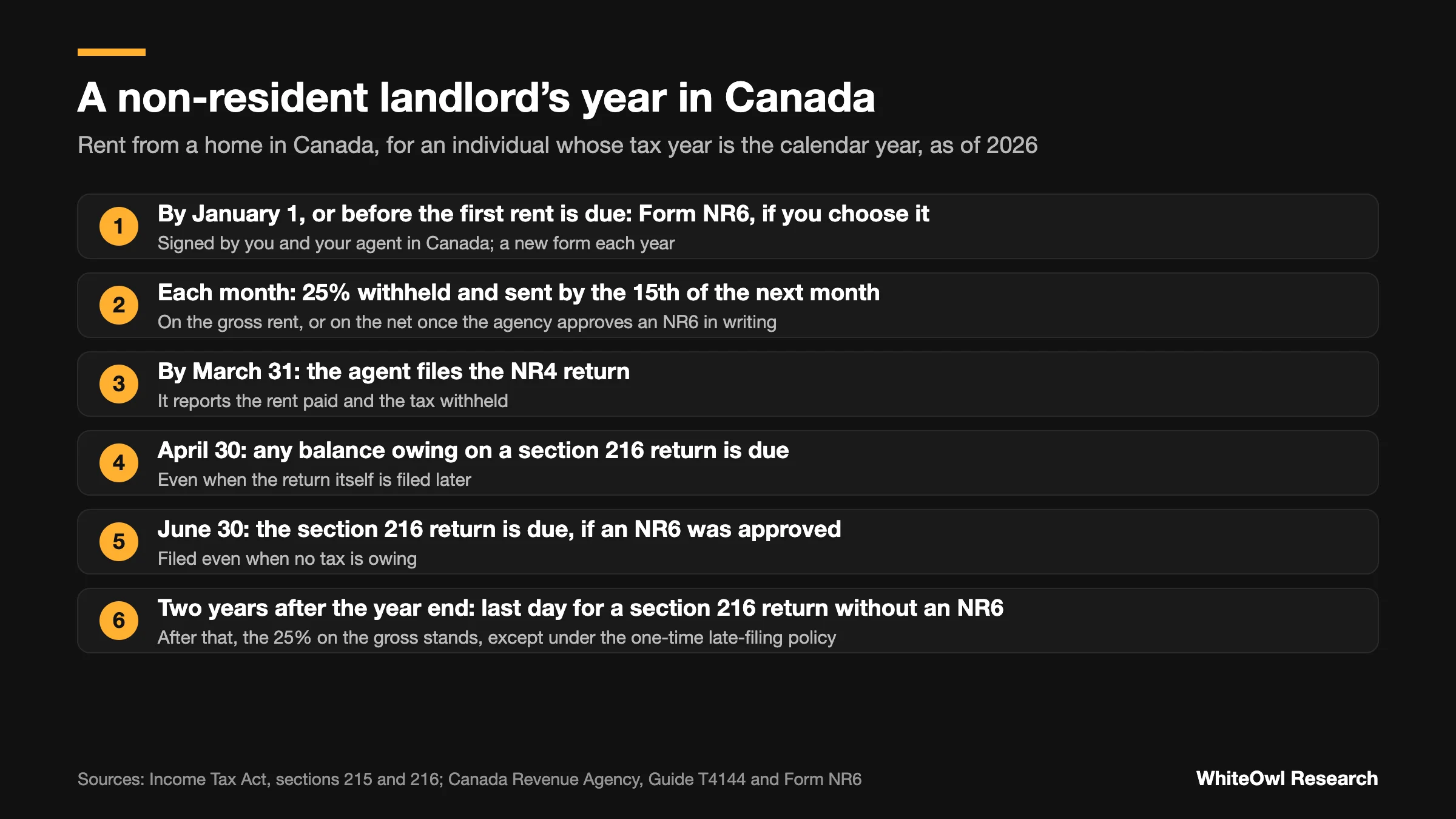
The dates in a non-resident landlord’s year.
A worked example: a Toronto condo rented out from the United States
A couple leave Toronto for Denver in 2025 and rent out the condo they own together through a property manager. For 2026, the gross rent is 36,000 CAD and the expenses are 24,000 CAD: property taxes 3,600, condominium fees 7,200, insurance 600, mortgage interest 8,400, management fees 2,880 and repairs 1,320. They claim no capital cost allowance, and each spouse reports half on a section 216 return.
For this couple in 2026, section 216 returns bring Canada's tax on the rent from 9,000 CAD to 2,486.40 CAD. Sources: Income Tax Act and Canada Revenue Agency, listed below.
| Step | Amount (CAD) |
|---|---|
| Gross rent for 2026 | 36,000 |
| Expenses | 24,000 |
| Net rent | 12,000 |
| Tax at 25% of the gross rent, with no election | 9,000 |
| Federal tax at 14% on the net rent | 1,680 |
| Non-resident surtax at 48% of the federal tax | 806.40 |
| Tax on the two section 216 returns | 2,486.40 |
| Refund if 25% of the gross was withheld | 6,513.60 |
| Withheld during the year with an approved NR6 | 3,000 |
Each spouse's 6,000 CAD falls inside the first federal bracket, so the total matches what a single owner would pay. With an approved NR6 and the manager paying every expense out of the rent, 3,000 CAD is withheld and 513.60 CAD comes back. With no election, Canada keeps 75% of the net rent.
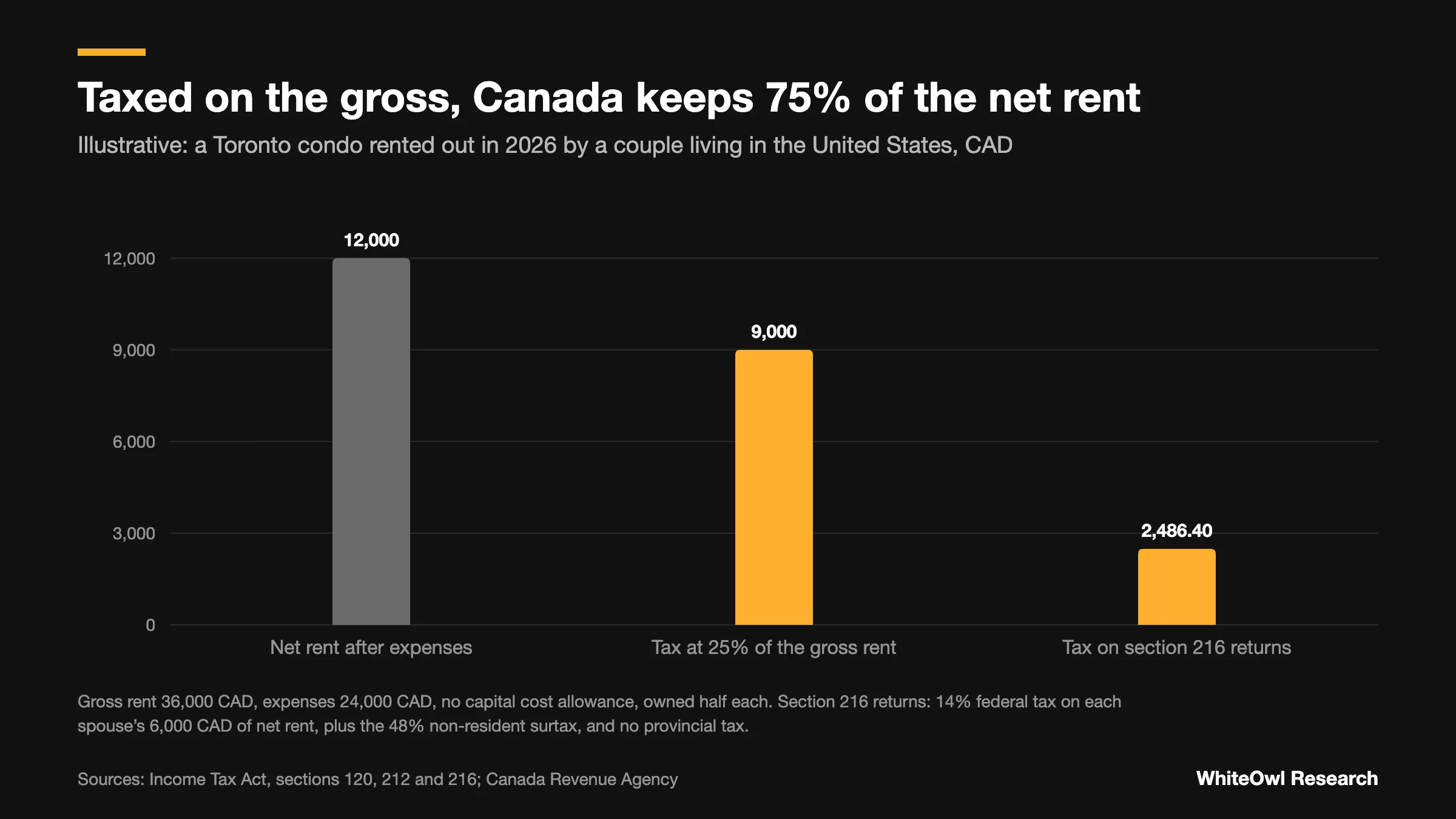
Tax on the gross rent against tax on the net.
Capital cost allowance now, recapture when you sell
Capital cost allowance is Canada's tax depreciation. A building acquired after 1987 is usually in class 1, at up to 4% a year of the remaining balance and half that in the first year; land is not depreciable. You may claim any amount from zero to the maximum, but not to create or increase a rental loss.
When you sell for more than the remaining balance, the allowance you claimed comes back into income as recapture. A non-resident who claimed it reports the recapture on a section 216 return for the year of the sale, due by April 30 of the following year.
The home you lived in: the change in use and your principal residence years
When you start renting the home you lived in, Canada treats it as sold and bought back at fair market value that day. The gain up to then may be eliminated or reduced by the principal residence exemption, and that value becomes your cost for the later sale. Real estate in Canada is left out of the deemed sale on departure, so it is this change in use that can fix the home's value.
You can instead elect, by a signed letter filed with the return for the year the renting began, to be treated as not having changed its use. The gain is then deferred, and claiming capital cost allowance ends the election.
Either way, the exemption counts only years when you were resident in Canada: the exempt part is the gain times one plus the years designated while resident, divided by the years owned, with the extra year only if you were resident when you bought. Which route leaves less tax depends on how much of the gain built up before the move.
Selling while non-resident: the certificate of compliance
Real estate in Canada stays taxable in Canada after you leave. A non-resident seller notifies the agency before the sale or within 10 days after it, on Form T2062 (a request for a certificate of compliance), with payment or security for the tax. Without a certificate, the buyer can become liable for the tax and is entitled to hold back 25% of the price, or 50% for certain property. As of 2026, half of the capital gain is taxable, on a non-resident return due April 30 of the following year. Under a 2026 law, no underused housing tax is payable for 2025 and later years.
The United States side: the same rent on the US return
In the United States, as of 2026, a resident alien is taxed on worldwide income, so the couple report the Canadian rent on their US return, in US dollars, and claim a foreign tax credit for the Canadian tax. The credit is limited to the US tax on foreign income of the same category, generally the passive category for rent, and unused Canadian tax can be carried back one year and forward ten.
Only the legal and actual foreign tax liability counts, not tax that it is reasonably certain would be refunded if you made a claim. When a section 216 return refunds part of the 25%, the credit is for what Canada keeps. IRS Publication 514 does not say whether the part of the 25% that a section 216 return would have refunded, when none is filed, counts as creditable tax.
Depreciation differs. Rental property used mainly outside the United States must be depreciated straight line over 30 years if it is residential and placed in service after 2017, and the IRS reduces your basis by the depreciation you were entitled to even if you did not claim it. Canada allows up to 4% of a declining balance and lets you skip it, so the net rent differs between the two returns each year.
On a later sale, for a former resident of Canada who is not a US citizen, the treaty sets the basis used for the US gain on a principal residence in Canada, owned when they left, at no less than its fair market value on that day. For US citizens, see dual citizenship taxes.
The figures that matter
The rates and periods that decide a non-resident landlord's tax, as of the 2026 tax year. Sources: Income Tax Act, Canada Revenue Agency and IRS, listed below.
| Rule | Figure |
|---|---|
| Non-resident tax on gross rent from real property in Canada (%) | 25 |
| Non-resident surtax on federal tax, section 216 return (%) | 48 |
| First federal rate, 2026 (%) | 14 |
| Taxable income where the first federal rate ends, 2026 (CAD) | 58,523 |
| Time to file a section 216 return without NR6 (years after the year end) | 2 |
| Time to file it with an approved NR6 (months after the year end) | 6 |
| Capital cost allowance, class 1 buildings (%) | 4 |
| Time to notify the agency after a sale (days) | 10 |
| Buyer's holdback without a certificate (%) | 25 |
| Buyer's holdback without a certificate, certain types of property (%) | 50 |
| Taxable share of a capital gain (%) | 50 |
| US recovery period, residential rental property outside the United States placed in service after 2017 (years) | 30 |
| US foreign tax credit carryback (years) | 1 |
| US foreign tax credit carryforward (years) | 10 |
How WhiteOwl helps
A home rented from abroad builds a file over many years: each year's slips and returns, the capital cost allowance claimed, and the home's value when you left and when the renting began, which both countries look at again when you sell. WhiteOwl keeps your actual documents from one year to the next, so those figures are on file when the sale comes. WhiteOwl gathers your documents, organizes your file, finds the issues and runs the numbers. A licensed advisor reviews, decides and files. See how it works.
FAQ
How much tax does a non-resident pay on rental income in Canada?
As of 2026, it is 25% of the gross rent, withheld by the property manager or sent by the landlord when no one withholds. It is the final tax unless you file a section 216 return, which taxes the net rent at federal rates plus a 48% surtax and refunds any excess.
What is a section 216 return?
It is a separate Canadian return a non-resident files to be taxed on net Canadian rent instead of 25% of the gross. It is due within two years after the end of the year, or by June 30 of the following year if an NR6 was approved.
What is Form NR6?
It is an undertaking, signed by the non-resident and an agent in Canada, to file a section 216 return within six months after the year, so that the agent withholds 25% of the net instead of the gross. If the return is late, 25% of the gross becomes payable, minus what was withheld, plus interest.
Can I still file a section 216 return for past years?
Yes, within two years after the end of each year. After that, the agency's late-filing policy may accept a late return once, if the agency has not already raised the tax on the rent with you and no NR6 was approved. It charges no penalties under that policy, but interest may apply.
Do I report Canadian rent on my US tax return?
Yes, if you are a US citizen or resident alien, since both are taxed on worldwide income. You can usually claim a foreign tax credit for the Canadian tax, limited to the US tax on that income.
Sources
- Canada Revenue Agency, Guide T4144, electing under section 216 · Form NR6 · Form T1159
- Canada Revenue Agency, rental income and non-resident tax · reminder about Form NR6 · subsection 216(1) late-filing policy
- Canada Revenue Agency, tax rates and income brackets (2026) · Guide T4036, rental income · Guide T4058, non-residents and income tax
- Canada Revenue Agency, Income Tax Folio S1-F3-C2, principal residence · Folio S5-F1-C1, residence status · disposing of or acquiring certain Canadian property
- Justice Laws, Income Tax Act section 212 · section 215 · section 216 · section 120 · section 45 · section 38 · section 116 · section 128.1 · Budget 2025 Implementation Act, No. 1
- Department of Finance Canada, Canada-United States tax convention (consolidated text)
- IRS, Publication 514, foreign tax credit for individuals · Publication 519, US tax guide for aliens · Publication 527, residential rental property · Publication 946, how to depreciate property
This article is general information, not personalized tax advice. Consult a qualified cross-border tax professional about your situation.
Related reading
The jock tax in 2026: how athletes and performers are taxed where they play
How the jock tax works in 2026: duty days in a state like New Jersey, the home-state credit, the Canada-United States treaty for league players, and withholding on touring performers.
By WhiteOwl · Nov 11, 2026
The Canada-United States tax treaty: who taxes what when you live, work or retire across the border
How the Canada-United States tax treaty splits the tax on residence, pensions, social security, gains, wages and estates, and what it leaves to US citizens and states, as of 2026.
By WhiteOwl · Nov 11, 2026
Inheritance tax in Canada: what is taxed when someone dies, and across the US border
Canada has no inheritance tax: the final return taxes the gains at death. What changes when an heir lives in the US or a parent owns a Florida condo or US shares, as of 2026.
By WhiteOwl Research · Oct 29, 2026