
By WhiteOwl Research · October 29, 2026 · 9 min read
In short: Canada has no inheritance tax. As of 2026, the person who died is taxed instead: their final return reports the gains on their property as if it were sold at death, unless it goes to a spouse, and the heir pays nothing on what they receive. The United States taxes estates, including a Canadian's US property.
Why it matters
For a family with property or children on both sides of the border, one death can bring a Canadian final return, a US estate tax return and a US reporting form for an heir, each with its own threshold. Which country taxes which part decides how much of the estate reaches the heirs, and the value each heir starts from when they later sell.
Four situations follow: heirs in Canada, a Canadian heir of a parent in the United States, a Canadian retiree with a Florida condo or US shares, and a US heir of a parent in Canada. The rules are federal unless a province is named.
In Canada, the tax falls on the final return
At death, the Income Tax Act treats a person as having sold each capital property, such as shares, a cottage or a rental property, at its fair market value. The gain goes on their final return, and half of it is taxed. What changes the bill:
- A spouse defers the tax. Property left to a spouse or common-law partner living in Canada, or to a trust for them, passes at its cost, so the gain waits until the survivor sells or dies. It must generally vest in them within 36 months, and the executor can choose to report the gain instead.
- The family home. The principal residence exemption can shelter some or all of the gain on the home, designated on the final return.
- RRSPs and RRIFs. The plan's full value at death is income on the final return. The amount can be reduced when it is paid to a spouse or common-law partner, who can move it into their own RRSP or RRIF, or to a financially dependent child or grandchild.
- TFSAs. The account's value at death is not taxed; earnings after the death are taxed to the beneficiaries.
The heir pays no tax on what they receive; the Canada Revenue Agency lists most inheritances among amounts that are not taxed. Outside a spousal rollover, the heir's cost is the property's fair market value immediately before the death, the starting point for any later gain.
Probate is provincial. Ontario, for example, charges Estate Administration Tax when an estate certificate (formerly letters probate) is issued: as of 2026, nothing on the first 50,000 CAD of the estate and 15 CAD for every 1,000 CAD, or part of it, above that, so a 1,000,000 CAD estate pays 14,250 CAD. Real estate outside Ontario, and registered plans and TFSAs with a named beneficiary, are left out.
Who taxes what across the border
How Canada and the United States tax an inheritance in each of the four situations, for deaths in 2026. Sources: Canada Revenue Agency, Income Tax Act, IRS and the Canada-United States tax convention, listed below.
| Situation | Canada | United States |
|---|---|---|
| Canadian parent, Canadian heir | Tax on the gains deemed realized at death, on the final return | No tax, unless the parent owned US property or was a US citizen |
| US parent, Canadian heir | No tax on the heir; their cost is the value at death | Estate tax only above 15,000,000 USD; no income tax on the heir |
| Canadian parent, not a US citizen, with US property | Tax on the gains at death, reduced by US estate tax on the US gains | Estate tax on the US property, reduced by the treaty's credits |
| Canadian parent, US citizen or resident heir | Tax on the gains at death, on the final return | No income tax on the heir; a report above 100,000 USD |
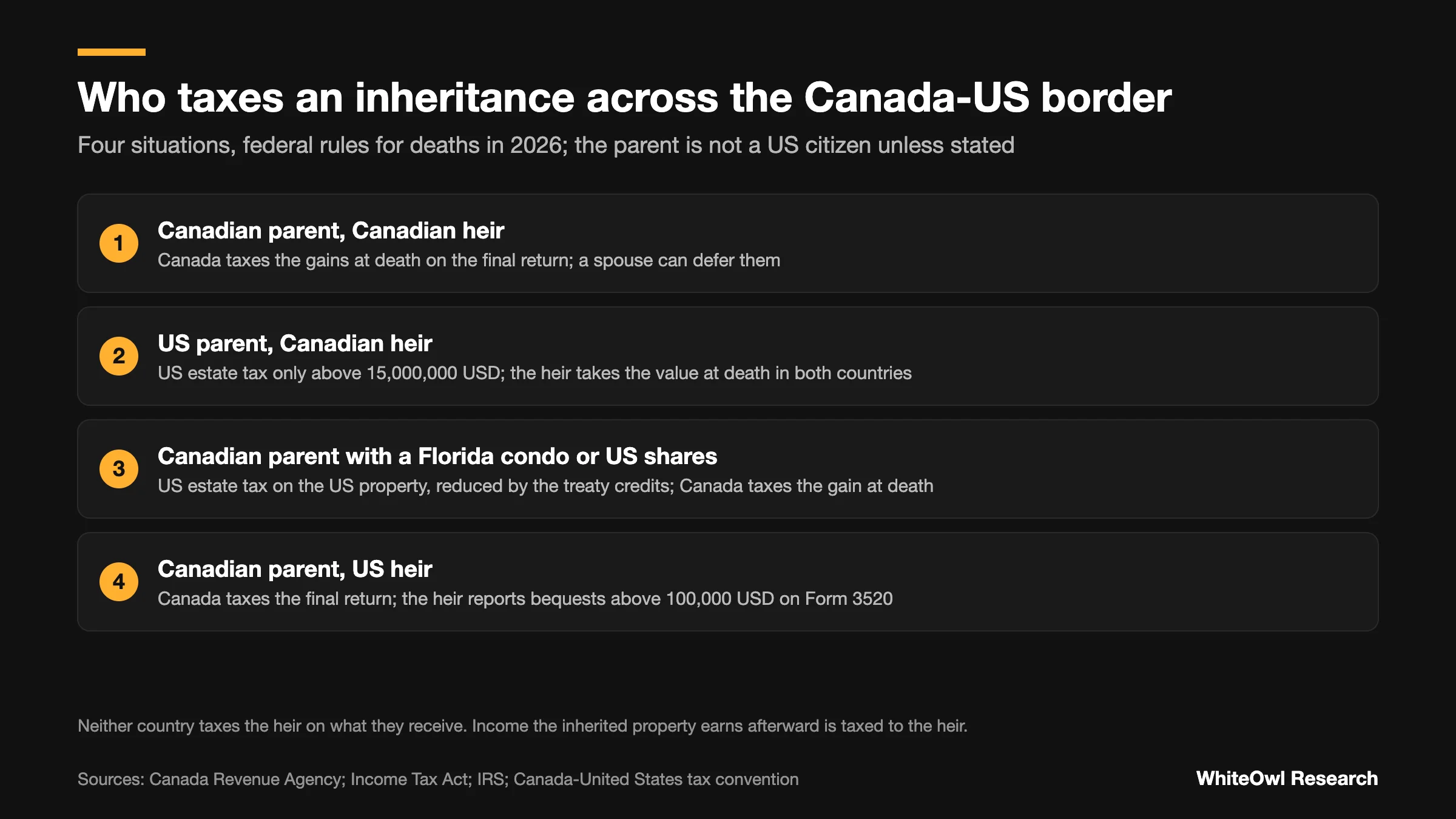
Who taxes what, in the four cross-border cases.
A Canadian heir of a parent in the United States
When a parent who is a US citizen or resident dies, the United States taxes the estate, not the heir. For a death in 2026, no federal estate tax is due unless the taxable estate, plus taxable gifts made during life, exceeds a basic exclusion of 15,000,000 USD, set by a law signed on July 4, 2025 (Public Law 119-21); the excess is taxed at 40%.
The heir owes no US income tax on the inheritance: US regulations exclude property received under a will from income, though not the income it earns afterward. The heir's US cost basis is generally the fair market value at the date of death.
Canada does not tax the heir on receipt either, and the Income Tax Act sets their cost at the property's fair market value immediately before the death. If the heir's foreign property, such as US shares, costs more than 100,000 CAD in total at any time in the year, they file Form T1135 (the foreign income verification statement); inherited property counts at its value when received, and a vacation home used mainly for personal use is excluded. Selling an inherited US home brings the US withholding and return described in selling a Florida home as a Canadian.
A Canadian resident who owns US property
A Canadian retiree who is not a US citizen and dies owning a Florida condo or US shares meets both systems. For estate tax, the IRS decides residence by domicile, not by the day count used for income tax.
The United States taxes only property situated there, such as US real estate and shares of US corporations, even if the certificates are held abroad or in a nominee's name. The executor files Form 706-NA (the US estate tax return for a nonresident who is not a citizen) when that property, with certain lifetime gifts, is worth more than 60,000 USD at death. Without a treaty, the estate's credit is 13,000 USD, the tax on the first 60,000 USD. The Canada-United States tax treaty (Article XXIX B) gives a resident of Canada more:
- A prorated credit. The estate gets the larger of 13,000 USD and a US citizen's estate credit, 5,945,800 USD for a death in 2026, multiplied by the US property's share of the worldwide estate. Claiming it means disclosing the whole estate.
- A small-estate rule. When the worldwide estate is worth 1,200,000 USD or less, the United States can tax only property whose gain it could tax under the treaty, such as US real estate, so most US shares fall outside its estate tax.
- A marital credit. Property left to a spouse can earn a second credit, up to the same amount, if the executor elects it and gives up the US marital deduction.
The estate owes the tax, and the IRS can collect it from anyone who received the property if it goes unpaid. Canada still taxes the gain at death on the condo or the shares, in Canadian dollars. Inheritance and estate taxes generally do not qualify for Canada's usual foreign tax credit, but the treaty lets US estate tax on US property reduce the Canadian tax for the year of death on income and gains arising in the United States, such as a gain on US real estate, and, for a worldwide estate above 1,200,000 USD, on gains from other US property such as US shares.
Worked example: a Florida condo
A widowed Ontario retiree, not a US citizen, dies in 2026 owning a Florida condo worth 500,000 USD, in a worldwide estate worth the equivalent of 5,000,000 USD, and leaves the condo to her children. Leaving aside debts, expenses and lifetime gifts, the condo is 10% of her estate, so the treaty credit is 10% of 5,945,800 USD.
The treaty's prorated credit removes the US estate tax on this condo, for a death in 2026. Sources: IRS Instructions for Form 706 and Form 706-NA, and the Canada-United States tax convention, listed below.
| Step | Amount (USD) |
|---|---|
| US estate tax on 500,000 USD, before credits | 155,800 |
| Credit without the treaty | 13,000 |
| US estate tax without the treaty | 142,800 |
| Treaty credit, 10% of 5,945,800 USD | 594,580 |
| US estate tax with the treaty | 0 |
The executor still files Form 706-NA, because the condo is worth more than 60,000 USD, and the condo's gain since she bought it is on her Canadian final return. Her children take it at its value at death in both countries.
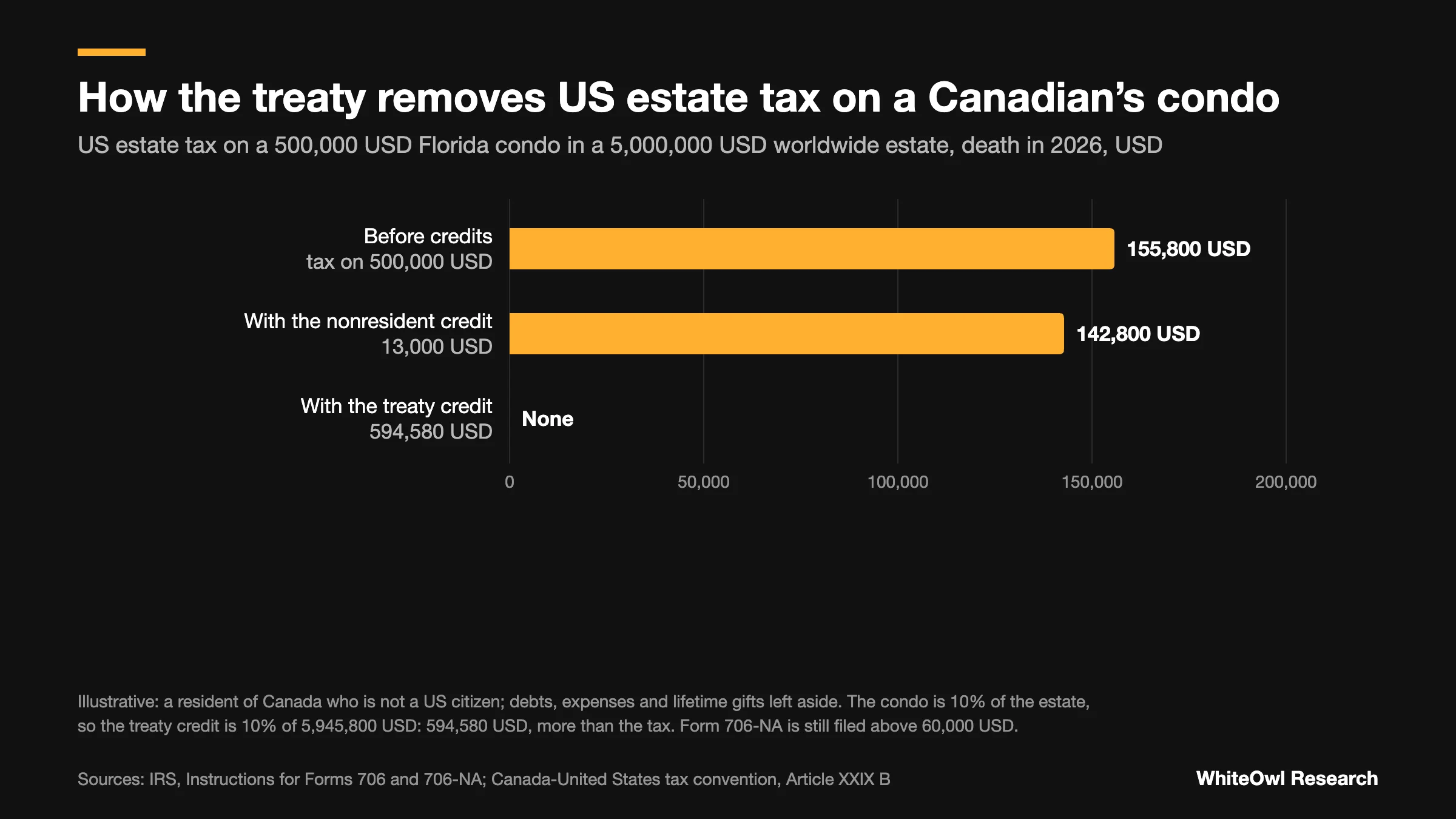
The treaty credit removes the US estate tax in this example.
A US heir of a parent in Canada
When the parent lived in Canada, the estate pays the Canadian tax on the final return. A child who is a US citizen or resident owes no US income tax on the inheritance itself, though income it earns afterward is taxable, and their US cost basis is generally the fair market value at the date of death.
The IRS does require a report. A US person who receives more than 100,000 USD in a year from a nonresident individual or a foreign estate, counting related people together, files Form 3520 (the return that reports large foreign gifts and bequests) separately from their income tax return. A late or incomplete report can cost 5% of the inheritance for each month it goes unreported, up to 25%, unless there is reasonable cause.
Registered plans follow Canada's rules first. An RRSP or RRIF left to an adult child who was not financially dependent is taxed on the parent's final return. A TFSA's value at death is not taxed in Canada; later earnings are, with non-resident tax withheld when a TFSA trust pays them to a non-resident beneficiary. As of October 2026, the IRS has published no guidance on how a US heir is taxed on a payout from a Canadian parent's RRSP or TFSA. For the US treatment while the owner is alive, see your RRSP when you leave Canada and the TFSA for non-residents.
The figures that matter
The rates and thresholds that decide the tax when a death or an inheritance crosses the Canada-United States border, as of 2026. Sources: Income Tax Act, Canada Revenue Agency, Ontario Ministry of Finance, IRS and the Canada-United States tax convention, listed below.
| Rule | Figure |
|---|---|
| Canada, share of a gain at death that is taxed (%) | 50 |
| Ontario Estate Administration Tax above 50,000 CAD of estate value (CAD per 1,000 CAD) | 15 |
| Canada, Form T1135 foreign property threshold, total cost (CAD) | 100,000 |
| US basic exclusion amount, deaths in 2026 (USD) | 15,000,000 |
| US credit of a citizen's estate, deaths in 2026 (USD) | 5,945,800 |
| US estate tax, top rate (%) | 40 |
| US estate tax return for a nonresident, filing threshold (USD) | 60,000 |
| US credit for a nonresident, without a treaty (USD) | 13,000 |
| Treaty small-estate rule, worldwide estate up to (USD) | 1,200,000 |
| Form 3520, foreign bequests received in a year, above (USD) | 100,000 |
How WhiteOwl helps
An estate that crosses the border involves a Canadian final return, US estate tax and the treaty between them, and an advisor who knows one well may know little about the others. WhiteOwl matches your family with an advisor whose specialties and countries fit the estate. WhiteOwl gathers your documents, organizes your file, finds the issues and runs the numbers. A licensed advisor reviews, decides and files. See how it works.
FAQ
Do you pay tax on an inheritance in Canada?
No. As of 2026, Canada does not tax the heir on what they receive. Instead, the final return of the person who died reports the gains on their property as if it were sold at fair market value at death, and the heir takes it at that value; property left to a spouse can defer the gain.
Do I pay tax in Canada on an inheritance from the United States?
Not on the inheritance itself. Canada does not tax what you receive, and the United States taxes the estate, for a death in 2026 only above 15,000,000 USD. Income the property earns afterward is yours to report, and US shares or accounts costing more than 100,000 CAD in total bring Form T1135.
Does a US citizen pay tax on a foreign inheritance?
The United States does not tax a citizen or resident on an inheritance from abroad, though income the property earns afterward is taxable. As of 2026, the heir reports bequests from a nonresident individual or a foreign estate above 100,000 USD in a year on Form 3520. The country where the person lived may tax the estate, as Canada does on the final return.
I am a US citizen living in Canada. Which country taxes my estate?
Both can. As of 2026, the United States taxes a citizen's worldwide estate above the 15,000,000 USD exclusion, and Canada taxes the gains deemed realized at death on the final return. The treaty gives a US credit for Canadian income tax payable because of the death on property outside the United States; see dual citizenship taxes.
Sources
- Income Tax Act, section 70 (death of a taxpayer) · section 38 (taxable capital gains)
- Canada Revenue Agency, capital gains on the final return · RRSP on the final return · RRSPs and other registered plans for retirement (T4040) · TFSA on the final return · designated beneficiary of a TFSA
- Canada Revenue Agency, amounts that are not reported or taxed · questions and answers about Form T1135 · Income Tax Folio S5-F2-C1, foreign tax credit
- Ontario Ministry of Finance, Estate Administration Tax
- Department of Finance Canada, Canada-United States tax convention (consolidated text), Article XXIX B · IRS, Canada-United States treaty and protocols
- IRS, estate tax · recent changes to estate and gift tax · Instructions for Form 706 · frequently asked questions on estate taxes
- IRS, some nonresidents with US assets must file estate tax returns · Instructions for Form 706-NA · estate tax questions for nonresidents not citizens
- US Treasury regulations, section 1.102-1 (gifts and inheritances) · IRS Publication 525, taxable and nontaxable income · Publication 551, basis of assets · gifts and inheritances questions
- IRS, gifts from foreign persons · Instructions for Form 3520
This article is general information, not personalized tax advice. Consult a qualified cross-border tax professional about your situation.
Related reading
United States exit tax: who owes it when you give up citizenship or a green card in 2026
As of 2026, the US exit tax falls on covered expatriates. Who they are, how the deemed sale and the 910,000 USD exclusion work, and what Canada does when you renounce.
By WhiteOwl Research · Oct 29, 2026
Canada's departure tax: what happens to your shares and investments when you leave
Leaving Canada? Most of what you own is treated as sold on the day you leave. What is taxed, what is excluded, how deferral works and the US treaty election, as of 2026.
By WhiteOwl Research · Oct 29, 2026
Canadian snowbirds selling a Florida home: the tax in both countries
Selling a Florida home as a Canadian resident: the FIRPTA withholding at closing, the US return that settles the tax, and the gain Canada taxes in Canadian dollars.
By WhiteOwl Research · Oct 23, 2026