
By WhiteOwl Research · October 29, 2026 · 9 min read
In short: When you stop being a resident of Canada, it treats you as having sold most of what you own at market value on the day you leave. As of 2026, half of that gain is taxable on your departure-year return. Canadian real estate, RRSPs, TFSAs and pensions are excluded, and the tax can be deferred, with security above a threshold.
Why it matters
For a founder holding shares of her own company, or a family with a large portfolio, the departure tax falls on growth that was never cashed, in the year of the move. The values fixed that day also set your cost for later, in Canada and possibly in your new country. Each way to reduce or delay the bill comes with conditions and dates.
What Canada treats as sold when you leave
When you emigrate, Canada treats you as having sold most of your property at fair market value just before you stop being resident, and as having bought it back at the same price. The Canada Revenue Agency calls this the deemed disposition, and the tax on the gain the departure tax. Several other countries tax people who leave in their own ways; see exit taxes around the world.
You usually become a non-resident on the latest of the day you leave, the day your spouse or common-law partner and dependants leave, and the day you become resident in your new country. Someone who keeps residential ties usually stays a factual resident (see digital nomad taxes); someone a tax treaty makes resident of the other country is a deemed non-resident and follows the emigrant rules.
Treated as sold at fair market value:
- Shares and funds outside registered plans, listed or private, including shares of a company you founded.
- Real estate outside Canada, such as a vacation home abroad.
- Valuables: the agency names jewellery, paintings and collections.
Not treated as sold:
- Real estate in Canada, and Canadian resource and timber property.
- Property of a business carried on through a permanent establishment in Canada.
- Registered plans and pensions: RRSPs, RRIFs, TFSAs, first home savings accounts, pension plans and annuities, among others in the law's list.
- Employee stock options subject to Canadian tax.
- What a short-term resident brought: if you were resident 60 months or less in the 10 years before leaving, property you owned when you last became resident, or inherited afterward.
So an engineer who first moved to Calgary in 2023 with a portfolio bought abroad and leaves in 2026 keeps that portfolio out of the deemed sale; shares she bought in Canada are in it.
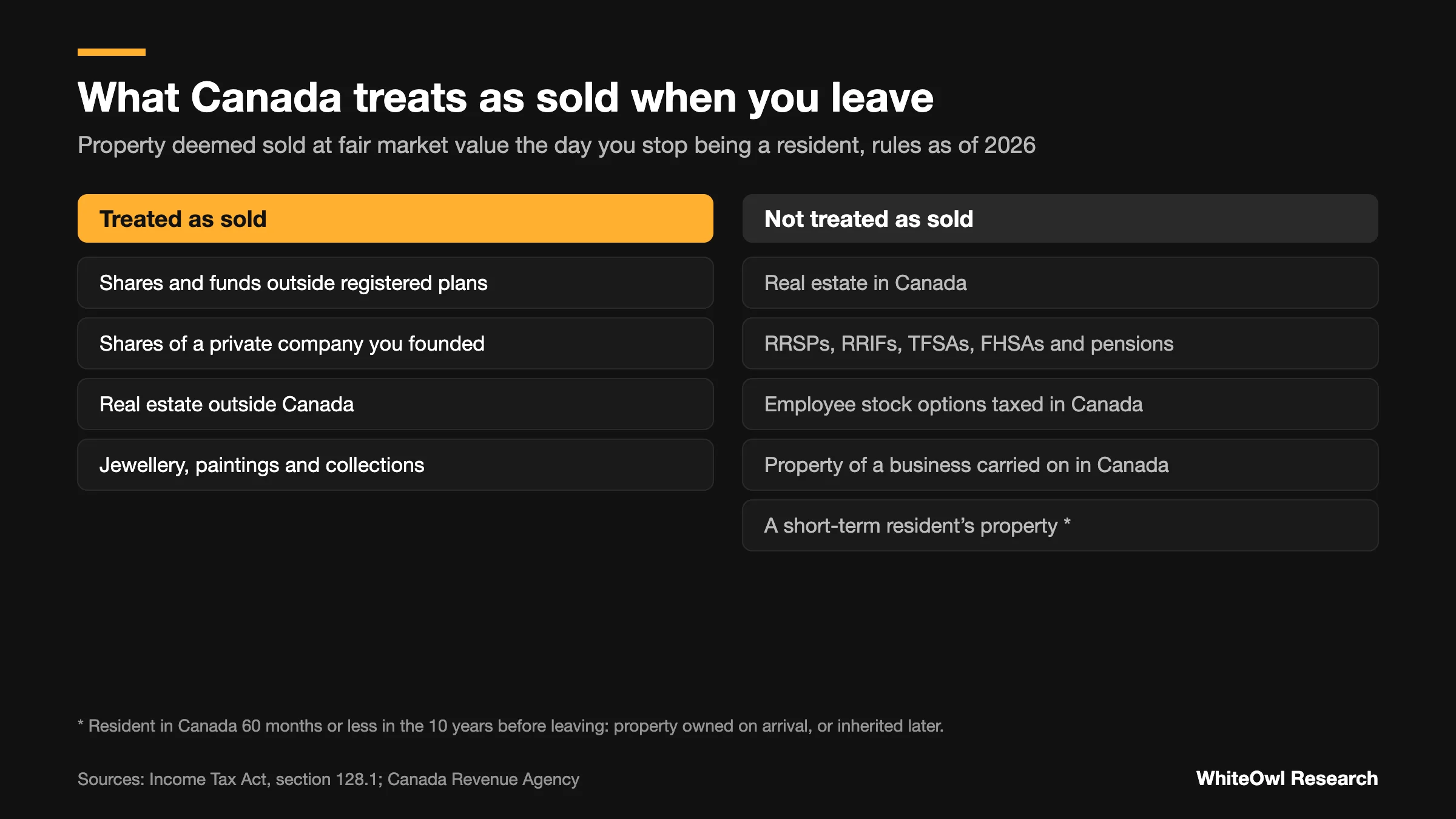
What is and is not treated as sold on the day you leave.
Reporting it on the return for the year you leave
The departure year is split in two: income from everywhere while you were resident, then only Canadian-source income, with tax credits limited to each part. The return records your departure date, and the deemed sale is calculated on Form T1243 (an emigrant's deemed disposition).
If everything you owned when you left was worth more than 25,000 CAD, you also file Form T1161, a list of your properties inside and outside Canada, including your home in Canada. Cash, registered plans and pensions, a short-term resident's excluded property (other than taxable Canadian property), and personal items worth less than 10,000 CAD each are left off. The list is due by your filing due date even if you have no return to file; a late list costs 25 CAD a day, from 100 CAD to 2,500 CAD.
Paying the tax, or deferring it against security
The departure tax is part of the balance for the year you leave, due by April 30 of the following year. By that date you can instead elect, on Form T1244 (the election to defer payment), to pay it without interest when you actually sell the property. You then tell the Canada Revenue Agency of each sale, and the tax on it is due by April 30 of the following year.
When the federal tax on the deemed sale is more than 16,500 CAD (13,777.50 CAD for former residents of Quebec), you provide adequate security for the tax above that amount, and possibly for provincial or territorial tax. The 16,500 CAD is the federal tax at the top rate of 33% on 50,000 CAD of taxable gain, which is 100,000 CAD of gain at the one-half inclusion rate.
A worked example: a 200,000 CAD gain on a portfolio
Take an investor who leaves Vancouver for Seattle in 2026. Her portfolio outside registered plans cost 300,000 CAD and is worth 500,000 CAD on her departure date, and her other taxable income for 2026 is above 258,482 CAD, where the top federal rate of 33% starts. Her Vancouver condo, RRSP and TFSA are not part of the deemed sale.
A 200,000 CAD gain on leaving Canada in 2026 adds 33,000 CAD of federal tax, half of which needs security if she defers it. Sources: Income Tax Act and Canada Revenue Agency, listed below.
| Step | Amount (CAD) |
|---|---|
| Value of the portfolio on the departure date | 500,000 |
| Cost of the portfolio | 300,000 |
| Gain on the deemed sale | 200,000 |
| Taxable capital gain, one half of the gain | 100,000 |
| Federal tax on it at 33% | 33,000 |
| Federal tax that needs no security | 16,500 |
| Federal tax that needs security if she defers | 16,500 |
British Columbia tax comes on top and is not shown. She also files the list of properties, condo included, and her cost for Canadian purposes is now 500,000 CAD.
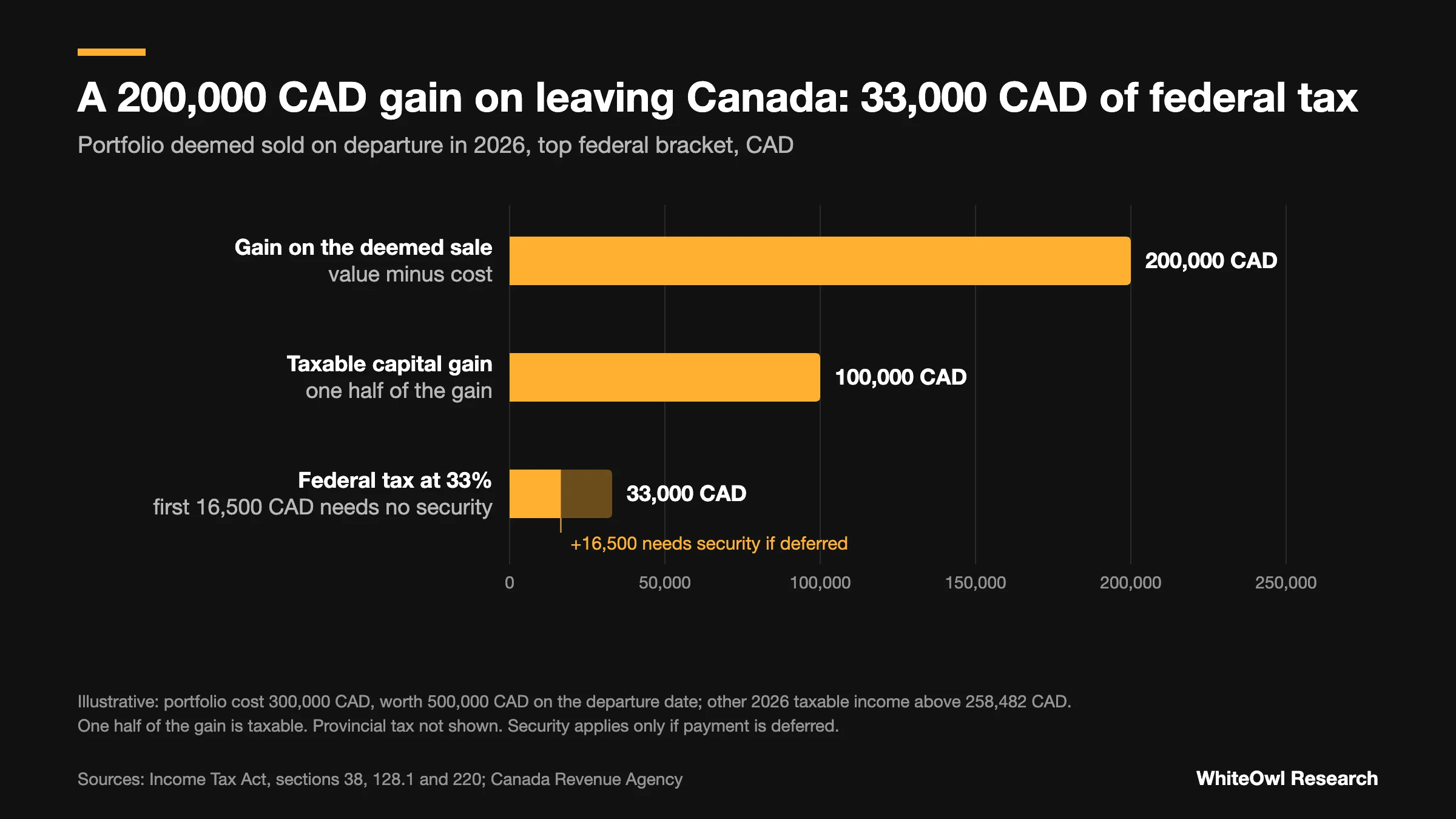
A 200,000 CAD gain at the top federal rate.
Founders: shares of your own company
Shares of a Canadian-controlled private corporation are not excluded, so you need a fair market value for a company that has no market price.
The lifetime capital gains exemption can apply. It requires residence throughout the year, but someone resident for part of the year and throughout the year before is treated as resident all year, so a founder resident throughout 2025 who leaves in 2026 can claim it. The shares must qualify at the moment of the deemed sale as qualified small business corporation shares: broadly, shares of a Canadian-controlled private corporation with 90% or more of its assets used mainly in an active business carried on primarily in Canada, held only by you or related persons for the 24 months before. For 2025 dispositions the exemption covered up to 1,250,000 CAD of gains, and the limit is indexed to inflation.
Leaving can also change the company's own tax: a corporation controlled by non-residents is not a Canadian-controlled private corporation, and the Canada Revenue Agency notes that a change of corporation type may have significant tax consequences.
Moving to the United States: the treaty election on your cost
Canada taxes the deemed sale whatever your destination. In the United States, as of 2026, the basis of property you buy is usually its cost, so without an election, a later sale would measure the gain from what you originally paid, including growth Canada already taxed.
Article XIII(7) of the Canada-United States tax convention lets you elect to be treated, for US purposes, as having sold and bought back the property at fair market value just before the Canadian deemed sale. The US Treasury's explanation of the 2007 protocol says that for someone not subject to US tax at that moment, the effect is a US cost equal to the departure-date value, so only later growth is taxed on an actual sale. For the investor in the example, that is the portfolio's value on her departure date. For a US citizen leaving Canada, the election instead brings the US tax forward to the same year, so the Canadian tax can be credited against it (see dual citizenship taxes).
Canadian law has a second route: if you later sell while resident in a treaty country, Canada can reduce your departure-year tax by that country's tax on the part of the gain that built up while you lived in Canada, within limits. And for a principal residence in Canada sold later by someone living in the United States who is not a US citizen, the treaty sets its US cost at no less than its value on departure.
Coming back: unwinding the deemed sale
If you left after October 1, 1996, become resident again and still own the property, you can elect to unwind the deemed sale for it. For most property, the departure-year proceeds are reduced by up to the lesser of the gain you reported and the property's value when you return. The election is made in writing, with a list of the properties and their value, by the filing due date for the year you return; it can reduce or remove the departure tax, and posted security may be returned. Without it, tax you deferred may become payable when you return.
After you leave: what Canada still taxes
As a non-resident, you pay Canadian tax only on Canadian-source income. Payers withhold 25% on income such as dividends, rent and pensions, usually as the final tax, unless a treaty lowers it: the Canada-United States treaty limits it to 15% on dividends paid to an individual living in the United States. You are required to tell Canadian payers and financial institutions that you have left. For registered plans, see your RRSP after leaving Canada and the TFSA as a non-resident.
The figures that matter
The rates and thresholds that decide the departure tax, as of the 2026 tax year. Sources: Income Tax Act, Canada Revenue Agency and the Canada-United States tax convention, listed below.
| Rule | Figure |
|---|---|
| Share of a capital gain that is taxable (%) | 50 |
| Total value above which the list of properties is required (CAD) | 25,000 |
| Late list penalty per day (CAD) | 25 |
| Late list penalty, maximum (CAD) | 2,500 |
| Federal tax on the deemed sale that needs no security (CAD) | 16,500 |
| Same, former residents of Quebec (CAD) | 13,777.50 |
| Top federal rate (%) | 33 |
| Taxable income where the top federal rate starts (CAD) | 258,482 |
| Short-term resident: most months resident in the 10 years before leaving | 60 |
| Lifetime capital gains exemption, 2025 dispositions (CAD) | 1,250,000 |
| Non-resident withholding with no treaty reduction (%) | 25 |
How WhiteOwl helps
The values fixed on the day you leave decide the tax years later, when you sell, come back or claim a credit for tax paid in your new country. WhiteOwl keeps your actual documents from one year to the next, so those departure values are on file when they matter. WhiteOwl gathers your documents, organizes your file, finds the issues and runs the numbers. A licensed advisor reviews, decides and files. See how it works.
FAQ
What is the departure tax in Canada?
It is the income tax on the gain from the deemed disposition that applies when you stop being a resident of Canada. As of 2026, half of the gain is taxable on that year's return, and the tax can be deferred without interest.
When do I become a non-resident of Canada?
Usually on the latest of the day you leave, the day your spouse or common-law partner and dependants leave, and the day you become resident in your new country. If you keep residential ties in Canada, you usually remain a factual resident.
Do I pay departure tax on my house in Canada?
No. As of 2026, real estate in Canada is excluded from the deemed sale, though it goes on the list of properties when one is required. Canada can tax the gain when you later sell it as a non-resident, and that sale has its own reporting rules.
Are RRSPs and TFSAs subject to departure tax?
No. RRSPs, RRIFs, TFSAs and pension plans are excluded and left off the list of properties. After you leave, Canada taxes them under their own rules, such as 25% withholding on an RRSP withdrawal unless a treaty lowers it.
Can I avoid the departure tax?
Not once you become a non-resident, but the law limits it through the exclusions, the short-term resident rule, the exemption for qualifying small business shares, interest-free deferral and unwinding on return. If you move to the United States and are not a US citizen, the treaty election keeps the growth Canada taxed from being taxed again there.
Sources
- Canada Revenue Agency, dispositions of property for emigrants of Canada · leaving Canada (emigrants) · Form T1161, list of properties by an emigrant of Canada
- Canada Revenue Agency, filing due dates · tax rates and income brackets (2026)
- Canada Revenue Agency, Guide T4037, capital gains 2025 · type of corporation · Guide T4058, non-residents and income tax
- Justice Laws, Income Tax Act section 128.1 · section 220 · section 110.6 · section 38 · section 126 · section 122
- Department of Finance Canada, Canada-United States tax convention (consolidated text)
- US Department of the Treasury, technical explanation of the 2007 protocol · IRS, Canada tax treaty documents · IRS, Publication 551, basis of assets
This article is general information, not personalized tax advice. Consult a qualified cross-border tax professional about your situation.
Related reading
Why governments tax what cannot move: six economic theories of mobile and captive taxpayers
Six economic theories of why governments tax what cannot move, from the Ramsey rule to Leviathan, tax competition and electoral incentives, each with its critique.
By WhiteOwl Research · Oct 29, 2026
Inheritance tax in Canada: what is taxed when someone dies, and across the US border
Canada has no inheritance tax: the final return taxes the gains at death. What changes when an heir lives in the US or a parent owns a Florida condo or US shares, as of 2026.
By WhiteOwl Research · Oct 29, 2026
TFSA for non-residents: what happens to your account when you leave Canada
You can keep a TFSA after leaving Canada and it stays tax-free there. As of 2026, contributing as a non-resident costs 1% a month, and the United States taxes the account.
By WhiteOwl Research · Oct 23, 2026