
By WhiteOwl Research · October 29, 2026 · 12 min read
In short: As of 2026, nine of the ten countries compared here tax unrealized gains when you leave or give up your status. Canada and Australia treat most of what you own as sold; Germany, France, Spain, the Netherlands, Norway and Japan reach mainly large shareholdings; the United States taxes giving up citizenship. The United Kingdom does not tax leaving.
Why it matters
If you are a founder with shares in your own company, or a family with a large portfolio, the country you leave may tax growth you never cashed, in the year you move. Whether it does turns on how long you lived there and what you own; the same rules decide whether you can pay later, and whether returning cancels the tax.
What triggers an exit tax: leaving, or giving up citizenship
In eight of the ten countries, the tax applies when you stop being a tax resident. The United States is the exception. It taxes its citizens wherever they live, so moving abroad changes nothing; its exit tax applies when a citizen gives up citizenship, or a long-term green card holder gives up residency, whether or not they move. It is the only one of the ten triggered by a change of status rather than a move.
Some countries first require years of residence: as of 2026, Spain 10 of the 15 tax years before your final Spanish return, Germany 7 of the last 12, France 6 of the last 10 and Japan more than 5 of the last 10. Norway applies its tax however long you lived there.
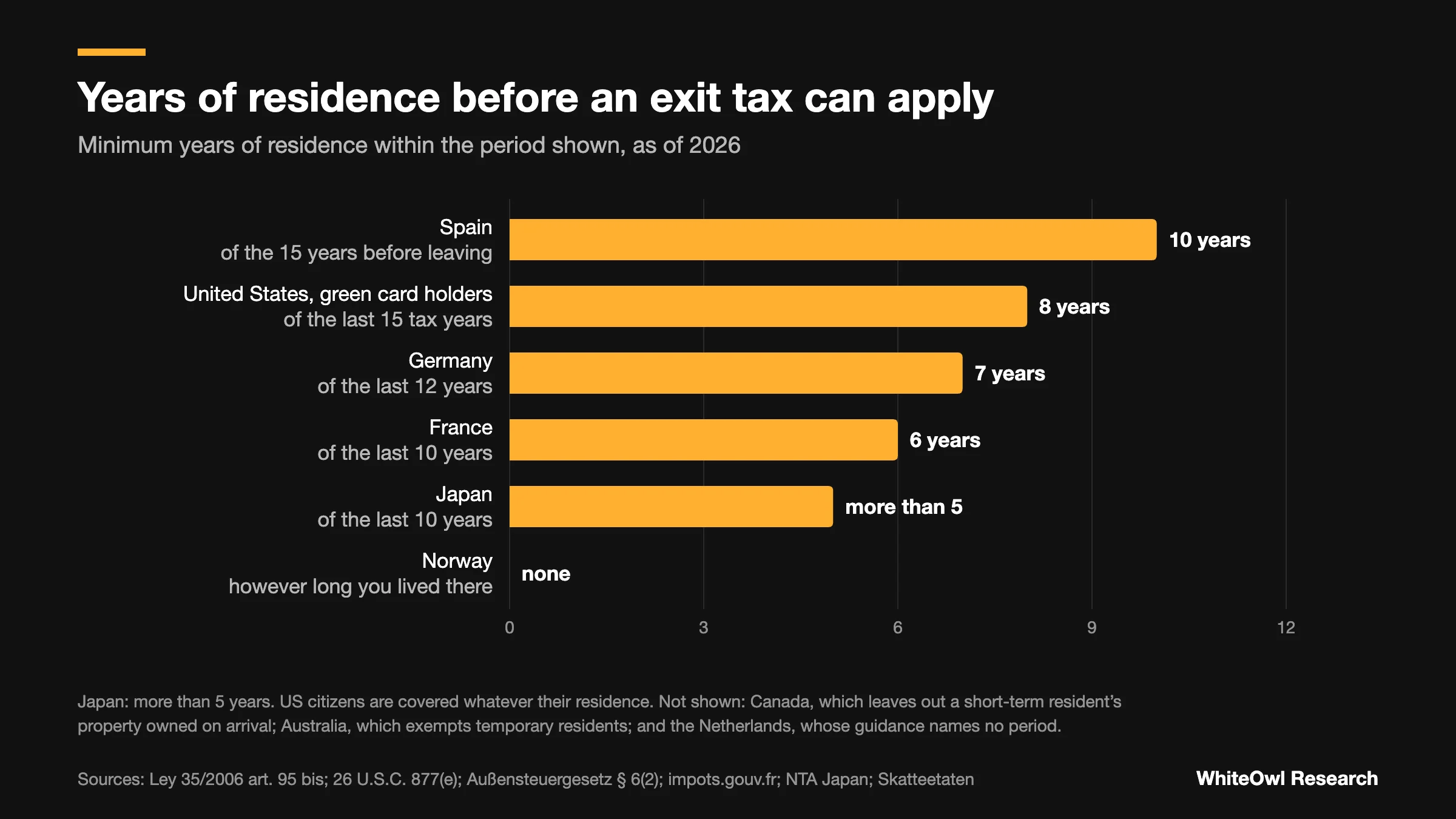
How long you must have lived there before the tax applies.
What it reaches: most of what you own, or only large holdings
Canada, Australia and, for covered expatriates, the United States treat nearly everything you own as sold. Canada and Australia leave out real estate in their own country, and Canada also leaves out RRSPs, TFSAs and pensions.
Germany, France, Spain, the Netherlands, Norway and Japan reach shares and similar investments only, above a size: a stake of 1% or 5%, a portfolio above a set value, or net gains above one. The Netherlands adds pension and annuity savings that received tax relief. A founder's shares in her own company count in all of them, and a private company needs a value on the departure date.
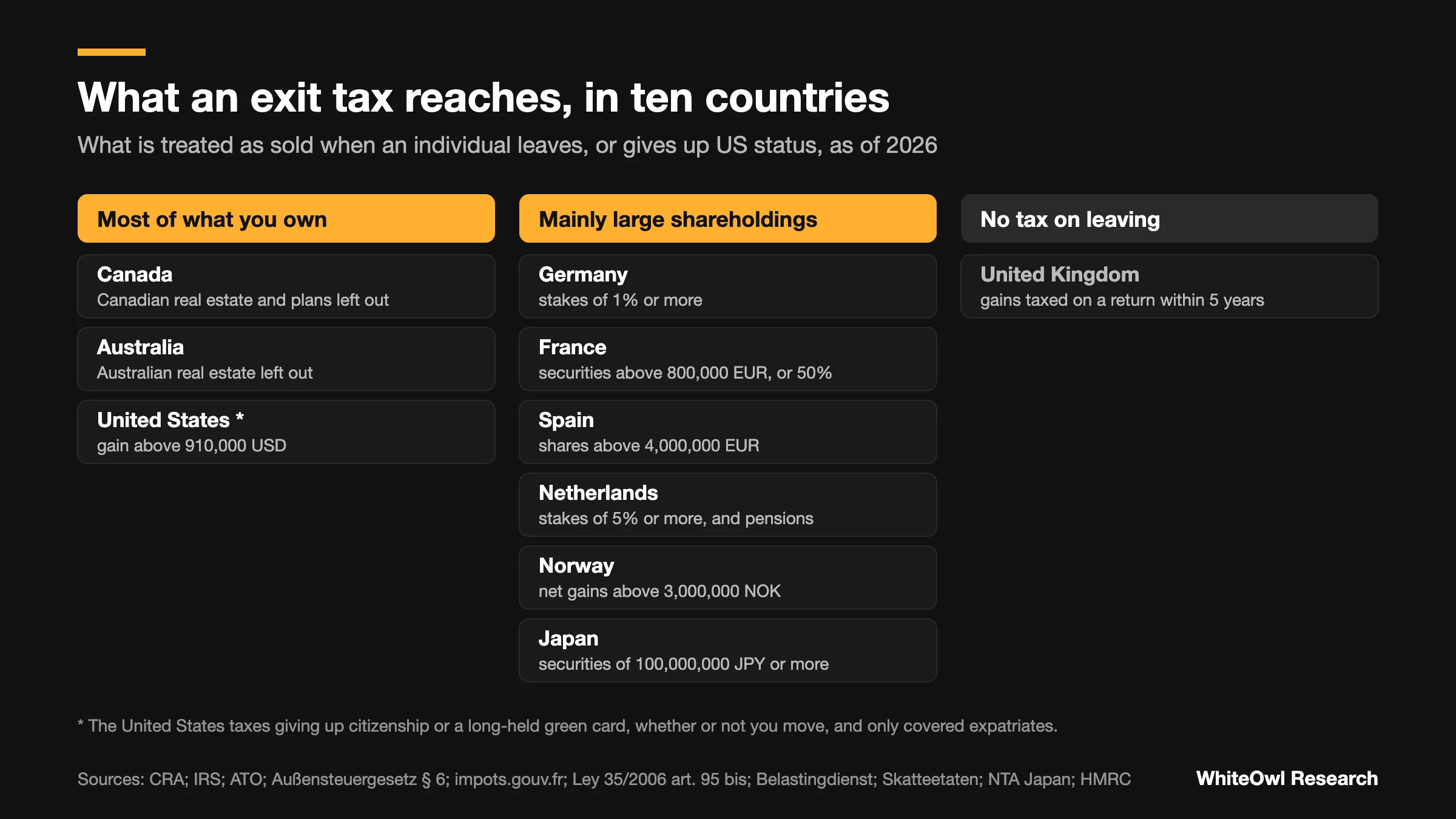
What an exit tax reaches, in ten countries.
The deemed sale
All of them use a deemed sale: the law treats you as having sold at market value on leaving and taxes the gain over your cost, so you owe tax without the cash from a sale. The gain follows the country's usual rules; in Canada, half of it is taxable as of 2026.
Paying later: deferral, security and the European Union
Most countries let you pay later, on terms that differ in length, interest and security, such as a bank guarantee. Canada defers without interest until you sell, and Germany and Norway spread the tax over seven and 12 yearly instalments without interest; the United States and Japan charge interest. For moves within the European Union and the European Economic Area (EEA), the Netherlands defers automatically and Spain taxes only if certain events occur within 10 years; France defers automatically for the EU and a list of treaty countries. Germany, for departures from 2022, treats every destination alike. Australia lets you choose to be taxed only when you sell.
Coming back, and arriving somewhere new
Most of these countries undo the tax if you return still owning the assets, within a set window in Germany, Norway and Japan. The United Kingdom works the other way: nothing is taxed on leaving, but some gains made while away are taxed if you return within five years.
On arrival, Canada and Australia give new residents a cost equal to market value for most assets; the United States and Norway do so only for their own exit tax calculations, and Germany takes as the cost of shares the value a comparable exit tax abroad used. Elsewhere, a later sale can tax growth the old country already taxed, and relief depends on the treaty: the Canada-United States treaty, for example, lets you elect to be treated by the other country as having sold and bought back at market value.
Exit taxes by country
How the exit taxes of ten countries work for individuals as of 2026, with the thresholds in the figures table below. Sources: the tax authorities and law texts listed below.
| Country | What starts it | What it reaches | Paying later | If you come back |
|---|---|---|---|---|
| Canada | Ending residence | Most property; Canadian real estate, registered plans and pensions excluded | Without interest until sale, with security above a threshold | An election unwinds it for property still owned |
| United States | Giving up citizenship or a long-held green card | All property of covered expatriates, gain above an exclusion | With interest until sale, against security | — |
| Australia | Ending residence, temporary residents excepted | Most assets; Australian real estate excluded | Choice to be taxed on sale instead | — |
| Germany | Ending residence after 7 of the last 12 years | Stakes of at least 1%; large fund holdings since 2025 | Seven yearly instalments without interest, usually against security | Lapses on a return within 7 years, extendable by up to 5 |
| France | Ending residence after 6 of the last 10 years | Stakes of at least 50% of profits, or securities above a value | Automatic for the EU and listed treaty countries; on request with guarantees elsewhere | Cancelled on return, or after 2 or 5 years, if the shares are still held |
| Spain | Ending residence after 10 of the 15 years before | Shares and fund units above a value, or stakes above 25% | Within the EU and EEA, taxed only if certain events occur within 10 years | Refunded or cancelled if the shares were not sold |
| Netherlands | Ending residence | Stakes of at least 5%; pension and annuity savings | Automatic within the EU and EEA, without interest; security may be required elsewhere | The assessment can be reduced |
| Norway | Ending residence | Shares, share savings accounts and options, net gains above a threshold | Twelve yearly instalments without interest | Lapses on a return within 12 years |
| Japan | Ending residence after more than 5 of the last 10 years | Securities and derivatives worth at least a threshold | Five years, extendable to ten, against security | Cancelled on a return within 5 years, or 10 with an extended deferral |
| United Kingdom | No tax on leaving | — | — | Gains made while away taxed on a return within 5 years |
Country by country
Canada: the departure tax
When you stop being resident, Canada treats you as having sold most of your property at fair market value, and as of 2026 half of the gain is taxable. If you were resident 60 months or less in the 10 years before leaving, property you owned on arrival or inherited is left out. You can defer the tax without interest until you sell, with security for federal tax above 16,500 CAD. Founders' shares and the United States treaty election are covered in Canada's departure tax.
United States: giving up citizenship or a green card
The expatriation tax reaches covered expatriates: citizens who renounce, and long-term residents (a green card in at least 8 of the last 15 tax years) who end residency, with a net worth of 2,000,000 USD or more, average yearly US income tax above 211,000 USD over five years for 2026, or five years of compliance they cannot certify. For 2026, the deemed-sale gain above 910,000 USD is taxed. See the United States exit tax.
Australia: CGT event I1
When you stop being an Australian resident, capital gains tax (CGT) event I1 treats you as having disposed of your assets at market value, except taxable Australian property, such as real estate in Australia. Temporary residents are exempt. You can instead choose to treat your assets as taxable Australian property until you sell them or become resident again. On an asset bought after 8 May 2012 and sold as a foreign resident, the 50% capital gains discount can apply only to the part of your ownership while resident.
Germany: Wegzugsbesteuerung
Germany's Wegzugsbesteuerung (taxation on moving away), section 6 of the Außensteuergesetz (Foreign Tax Act), applies after 7 of the last 12 years of full tax liability. It reaches shares in a company where you held at least 1% of the capital in the last five years and, for departures from 2025, fund units if you held 1% of a fund or units costing at least 500,000 EUR. For departures from 2022, it can be paid in seven yearly instalments without interest. It lapses if a temporary absence ends within seven years, extendable by up to five, with the shares unsold and distributions below a quarter of their value.
France: the exit tax of article 167 bis
France's exit tax, article 167 bis of the Code général des impôts (General Tax Code), applies after 6 of the last 10 years of residence if your household holds at least 50% of a company's profits or securities worth more than 800,000 EUR; it covers income tax and social levies. The sursis de paiement (deferral of payment) is automatic for moves to the EU or listed treaty countries, which for 2025 moves include the United States, the United Kingdom, Australia, Japan and Norway; elsewhere you request it at least 90 days ahead, with guarantees. For moves from 2019, a dégrèvement (relief) cancels the tax if you still hold the shares after 2 years, or after 5 years when they were worth more than 2,570,000 EUR, or if you return holding them.
Spain: the impuesto de salida
Spain's impuesto de salida (exit tax), article 95 bis of the Ley del Impuesto sobre la Renta de las Personas Físicas (personal income tax law), applies after 10 of the 15 tax years before your last Spanish return. It reaches shares and fund units worth more than 4,000,000 EUR together, or a stake above 25% worth more than 1,000,000 EUR. On a move within the EU or EEA, you can opt to be taxed, without interest, only if within 10 years you sell, leave the EU and EEA, or stop reporting. Spain and Norway also tax net wealth each year: see countries with a wealth tax.
Netherlands: the conserverende aanslag
On emigration, the Netherlands treats an aanmerkelijk belang (substantial interest: at least 5% of a company's shares, with your fiscal partner) as sold and issues a conserverende aanslag (protective assessment); pension and annuity savings built up with tax relief get one too. Payment is deferred automatically, without collection interest, within the EU and EEA; elsewhere security may be required. A pension assessment can be remitted after 10 years if you keep to the rules; for a substantial interest, after an emigration from 15 September 2015, the deferral lasts for life and the tax falls due when you sell, pay out dividends or the company stops.
Norway: the utflyttingsskatt
Norway's utflyttingsskatt (exit tax) treats shares, share savings accounts, options and some capital insurance as sold on the last day of your tax residence. Under rules changed significantly from 20 March 2024, only the part of your total net gain above 3,000,000 NOK is taxed, payable at once, in yearly instalments without interest over 12 years, or at the end of 12 years with interest; outside the EEA you give security. A return within 12 years cancels the tax on assets still owned. The old rule that cancelled the tax when the shares were not sold within five years applies only to departures before 29 November 2022.
Japan: kokugai tenshutsu-ji kazei
Japan's kokugai tenshutsu-ji kazei (taxation on departure from Japan), in force since 1 July 2015, applies after more than 5 of the last 10 years of residence if you hold securities, such as shares and investment trusts, and certain derivative positions worth 100,000,000 JPY or more in total. With a tax agent appointed before leaving and security for the tax and interest, payment can wait five years, or ten with an extension. A return within five years, or ten with an extended deferral, still holding the assets, cancels the tax.
United Kingdom: no tax on leaving, a rule for returning
As of 2026, HMRC says someone who leaves to live abroad and stops being UK resident is not charged on later gains, apart from UK land and property and assets of a UK branch, unless the absence is temporary. If you had sole UK residence in at least 4 of the 7 tax years before leaving and return within five years, gains made while away on assets held before leaving are taxed in the year you return.
The figures that matter
The thresholds that decide whether an exit tax applies, each in its country's currency, as of 2026 unless shown. Sources: the tax authorities and law texts listed below.
| Rule | Figure | As of |
|---|---|---|
| Canada, share of a capital gain that is taxable (%) | 50 | 2026 |
| Canada, federal tax on the deemed sale that needs no security if deferred (CAD) | 16,500 | 2026 |
| United States, net worth that makes you a covered expatriate (USD) | 2,000,000 | 2026 |
| United States, average yearly income tax above which you are covered (USD) | 211,000 | 2026 |
| United States, gain excluded from the deemed sale (USD) | 910,000 | 2026 |
| Germany, smallest stake in a company that is reached (%) | 1 | 2026 |
| Germany, cost of fund units from which they are reached (EUR) | 500,000 | Departures from 2025 |
| France, value of securities above which the tax applies (EUR) | 800,000 | 2026 |
| France, value above which cancellation takes 5 years instead of 2 (EUR) | 2,570,000 | Moves from 2019 |
| Spain, total value of shares above which the tax applies (EUR) | 4,000,000 | 2026 |
| Spain, value of a stake above 25% above which the tax applies (EUR) | 1,000,000 | 2026 |
| Netherlands, smallest substantial interest (%) | 5 | 2026 |
| Norway, total net gain left untaxed (NOK) | 3,000,000 | 2026 |
| Japan, value of covered assets at which the tax applies (JPY) | 100,000,000 | 2026 |
| United Kingdom, longest absence the temporary non-residence rule covers (years) | 5 | 2025 to 2026 tax year |
How WhiteOwl helps
An exit tax is settled between two countries: the one you leave fixes the value and the tax, and the one you join decides whether you start from that value. An advisor who knows one side well may know little about the other, so WhiteOwl matches you with an advisor whose specialties and countries fit your move. WhiteOwl gathers your documents, organizes your file, finds the issues and runs the numbers. A licensed advisor reviews, decides and files. See how it works.
FAQ
Which countries have an exit tax?
Of the ten countries compared here, as of 2026, Canada, Australia, Germany, France, Spain, the Netherlands, Norway and Japan tax unrealized gains when you stop being resident, and the United States when you give up citizenship or a long-held green card.
Does the UK have an exit tax?
Not for individuals, as of 2026. Leaving does not trigger a tax, but if you return within five years, gains made while away on assets held before leaving are taxed in the year you return.
What is Australia's departure tax?
It is CGT event I1: when you stop being an Australian resident, assets other than taxable Australian property, such as Australian real estate, are treated as disposed of at market value. As of 2026, you can choose instead to pay when you sell them.
Does moving within the European Union avoid an exit tax?
It usually changes when you pay, not whether. As of 2026, the Netherlands and France defer automatically within the EU and Spain taxes only if certain events occur within 10 years, while Germany, for departures from 2022, offers the same instalments wherever you move.
Do US citizens pay an exit tax when they move abroad?
No. The United States taxes its citizens wherever they live, so moving does not trigger its exit tax. As of 2026, it applies only when a covered expatriate gives up citizenship or a long-held green card.
Sources
- Canada: Canada Revenue Agency, dispositions of property for emigrants of Canada · Income Tax Act, section 128.1 · section 38 · Department of Finance Canada, Canada-United States tax convention (consolidated text)
- United States: IRS, expatriation tax · Instructions for Form 8854 · Rev. Proc. 2025-32 · 26 U.S.C. 877A · IRS, US citizens and resident aliens abroad
- Australia: Australian Taxation Office, how changing residency affects CGT · Guide to capital gains tax 2025, summary of CGT events
- Germany: Außensteuergesetz § 6 · § 21 · Einkommensteuergesetz § 17 · Investmentsteuergesetz § 19 · § 57 · Deutscher Bundestag, Drucksache 19/28652 (ATAD implementation bill)
- France: impots.gouv.fr, do I have to pay an exit tax? · je quitte la France, suis-je concerné par l'exit tax ? · Notice 2074-ETD (transfers in 2025)
- Spain: Ley 35/2006 del Impuesto sobre la Renta de las Personas Físicas, artículo 95 bis (consolidated text) · Agencia Tributaria, ganancias patrimoniales por cambio de residencia (IRPF 2025 manual) · Impuesto sobre el Patrimonio, escala estatal
- Netherlands: Belastingdienst, conserverende aanslag bij emigratie · Fiscale informatie 2025, aanmerkelijk belang · te conserveren inkomen
- Norway: Lovdata, skatteloven § 10-70 · Skatteetaten, Skatte-ABC U-10 (gains on shares on emigration) · net wealth tax
- Japan: National Tax Agency, Tax Answer No. 1478 (国外転出をする場合の譲渡所得等の特例)
- United Kingdom: HMRC, HS278 temporary non-residents and Capital Gains Tax (2026) · Capital Gains Manual CG26500
This article is general information, not personalized tax advice. Consult a qualified cross-border tax professional about your situation.
Related reading
Why governments tax what cannot move: six economic theories of mobile and captive taxpayers
Six economic theories of why governments tax what cannot move, from the Ramsey rule to Leviathan, tax competition and electoral incentives, each with its critique.
By WhiteOwl Research · Oct 29, 2026
United States exit tax: who owes it when you give up citizenship or a green card in 2026
As of 2026, the US exit tax falls on covered expatriates. Who they are, how the deemed sale and the 910,000 USD exclusion work, and what Canada does when you renounce.
By WhiteOwl Research · Oct 29, 2026
Countries with a wealth tax in 2026: what changes if you move abroad
Neither the United States nor Canada taxes wealth each year, but Spain, Norway, Switzerland and others do. Rates, thresholds and who pays in 2026, and what changes when you move abroad.
By WhiteOwl Research · Oct 23, 2026