
By WhiteOwl Research · October 29, 2026 · 11 min read
In short: As of 2026, economists give several reasons why governments lean on what cannot move: a tax on something people cannot avoid raises money with the least change in behavior, mobile income and capital can leave for lower-tax countries, and people who cannot vote where they are taxed resist least. Each theory has evidence against it.
Why it matters
If you are deciding where to live or where to hold your assets, these theories explain which taxes follow you and which you can leave behind. A home, a business that serves a local market and, for Americans, citizenship itself stay within a government's reach; a salary or a portfolio can often move. Governments respond to that difference with taxes on leaving, taxes on non-residents and, between countries, a minimum tax on large companies. The theories describe incentives; none of them explains why a particular government adopted a particular tax, and governments give their own reasons.
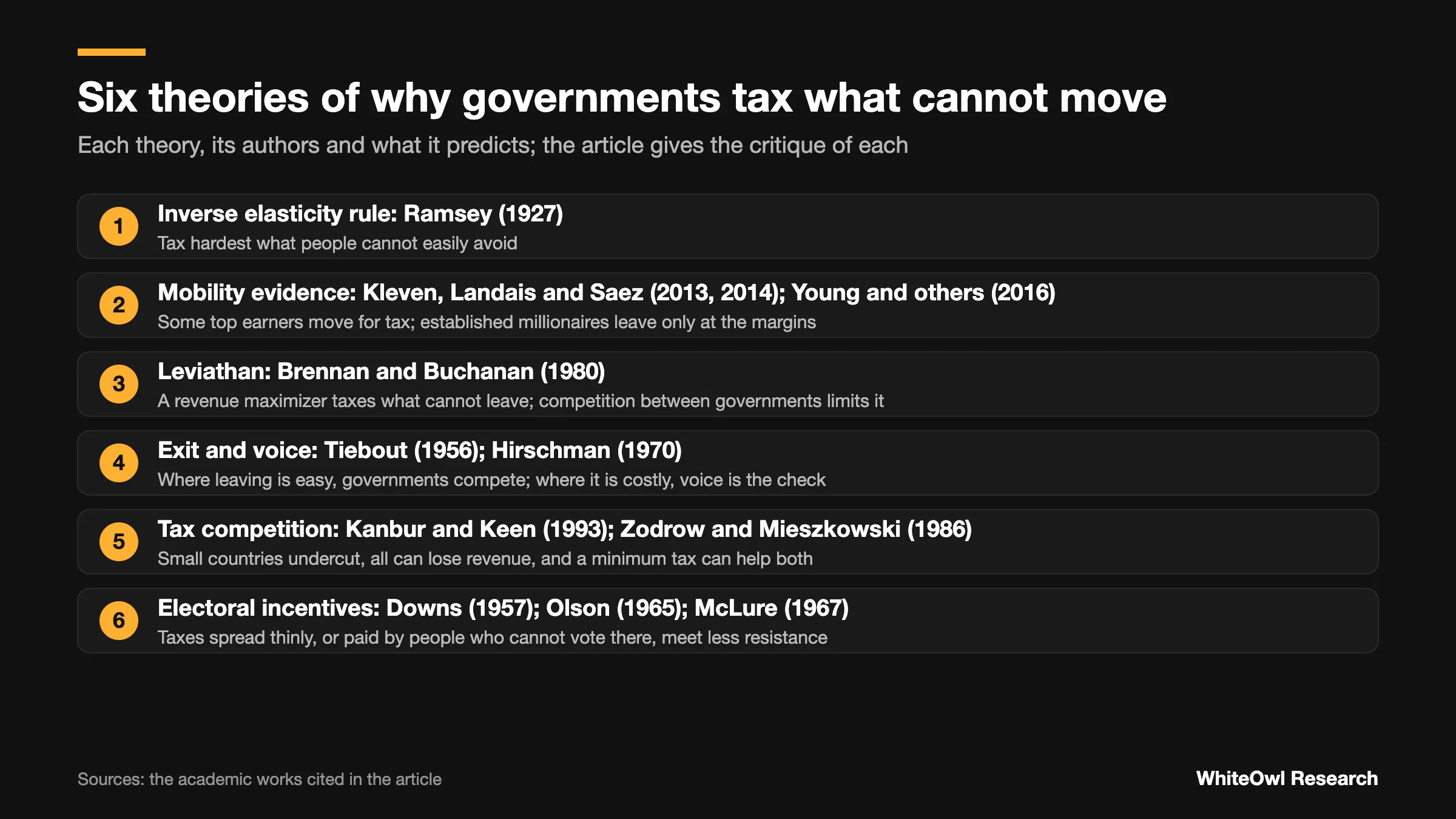
The six theories and what each predicts.
The inverse elasticity rule: tax what people cannot easily avoid
In 1927, Frank Ramsey asked how a government should raise a fixed sum from taxes on goods while doing the least harm. His answer, now called the Ramsey rule, is that taxes should reduce the use of every taxed good in the same proportion. In its simplest case, with small taxes and straight-line demand and supply, it becomes the inverse elasticity rule: the rate on each good should be inversely related to how strongly buyers and sellers respond to its price. What people cannot easily avoid is taxed hardest, because taxing it changes behavior least.
Applied to people and assets, the rule predicts the heaviest taxes on what cannot leave: land, buildings and people tied to one place. Australia's exit rule shows the difference. As of 2026, when you stop being an Australian resident, most of your assets are treated as sold at market value, but not real estate in Australia, because foreign residents still pay capital gains tax on it, the Australian Taxation Office explains. Other countries' rules are compared in countries with an exit tax.
The critique is fairness. Ramsey assumed everyone was identical, so the question of who pays never arose. The goods people respond to least are often necessities, so the rule taken literally makes taxes regressive, falling hardest on those with the least. Peter Diamond (1975) extended the rule to people who differ, taking into account who buys each good, and Anthony Atkinson and Joseph Stiglitz (1976) showed that, under certain conditions, a well-designed income tax makes different rates on different goods unnecessary.
Millionaire migration: how much do people move for tax?
Every theory here turns on one question of fact: how many people move when taxes change. The answer depends on whom you measure.
Henrik Kleven, Camille Landais and Emmanuel Saez (2013) studied football players in 14 European countries since 1985 and found strong responses to top tax rates among foreign players, and much weaker ones among players in their home country. With Esben Schultz (2014), they studied a scheme in Denmark, introduced in 1991, that taxes newly arrived high earners at a preferential flat rate for three years: it doubled the number of highly paid foreigners in Denmark compared with slightly less paid foreigners who did not qualify.
Cristobal Young, Charles Varner, Ithai Lurie and Richard Prisinzano (2016) looked at established earners: the tax records of every person in the United States with income of 1,000,000 USD or more, over 13 years. They found that millionaires do leave higher-tax states, but only at the margins of statistical and socioeconomic significance, a picture closer to "embedded elites" than to "transitory millionaires". The studies measure different groups: footballers and newly arrived high earners choosing a country, and earners already settled in one place.
Governments weigh mobility too. The OECD counted 12 countries with a net wealth tax in 1990 and four OECD countries still levying one on individuals in 2017; it notes that repeals were often justified by efficiency and administrative concerns and, where such a tax sits beside taxes on capital income, advises low rates to prevent capital flight. Which countries tax wealth each year as of 2026 is covered in countries with a wealth tax.
The Leviathan model: government as a revenue maximizer
Geoffrey Brennan and James Buchanan, in The Power to Tax (1980), modelled government as a single body that seeks the most revenue it can raise, limited only by constitutional rules, and called it Leviathan. One limit they counted is competition: when people and capital can move between governments, each government's power to tax shrinks.
Two predictions follow. A revenue maximizer taxes hardest the bases that cannot leave, and government should be smaller where taxing power is split among many competing governments. Taxes on leaving are where the first prediction meets practice: as of 2026, Canada treats most of what an emigrant owns as sold at fair market value on the day residence ends, so the gain is taxed as the owner leaves (Canada Revenue Agency).
The critique is the evidence. Wallace Oates (1985) tested the second prediction by comparing the size of government with the share of revenue and spending handled by state and local governments, and found no empirical support for it. A 2004 World Bank working paper by Jean-Philippe Meloche, François Vaillancourt and Serdar Yilmaz describes the empirical support for the Leviathan model as limited.
Voting with your feet: exit and voice
Charles Tiebout (1956) argued that when people can choose among many local governments, each offering its own mix of taxes and services, moving to the one that suits them matches public services to what residents want. Albert Hirschman (1970) named the two responses to an organization in decline: exit, which is leaving, and voice, which is pressing for change from inside. In his account, loyalty slows exit and gives voice time to work.
The prediction: where exit is cheap, governments compete for residents; where exit is costly, voice is the main check. The United States shows how a tax can follow people who leave. As of 2026, it taxes its citizens on their worldwide income wherever they live (IRS), so moving abroad does not end US tax. Giving up citizenship does, and for covered expatriates it can bring the expatriation tax: see the United States exit tax and accidental Americans.
The critique: Truman Bewley (1981) showed that Tiebout's result rests on very special assumptions and that, in more general settings, it can fail. Critics add that moving is costly and slow. Work, family, language and, for some, a tax that follows them hold people in place, so the discipline exit provides is weak for most people, as the millionaire study above suggests.
Tax competition: the game between countries
When profits and capital can move, countries play a game. In game theory terms it resembles a prisoner's dilemma: each country gains by cutting its rate to draw tax base from the others, but when all cut, all can end up with less revenue than if none had.
Ravi Kanbur and Michael Keen (1993) showed that size matters. In their model of two countries whose shoppers can cross the border, the smaller country sets the lower tax and, if it is small enough, collects more revenue than with a closed border, while the larger country collects less; both gain from a minimum tax set between the two rates they would otherwise choose. George Zodrow and Peter Mieszkowski (1986) gave the race-to-the-bottom view: local governments that tax mobile capital and compete for it provide fewer public services than they would with taxes that do not drive capital away.
The OECD's figures show the fall in rates. The average combined corporate income tax rate across the jurisdictions it covers (145 in 2025) was 28.0% in 2000, 24.6% in 2005, 22.3% in 2010 and 2015, 21.7% in 2019 and 21.2% in 2025, and 114 of them had a lower rate in 2025 than in 2000. Those who doubt a race to the bottom point to the same report: rates have been stable since 2021, 14 jurisdictions had a rate below 10% in 2025 against 16 in 2000, and corporate tax rose by nearly two percentage points as a share of total tax revenue in 2022, to 17.8% on average across 131 jurisdictions.
The cooperative answer is a floor. In October 2021, 137 members of the OECD/G20 Inclusive Framework agreed a two-pillar plan. Under its second pillar, whose model rules were released on 20 December 2021, multinational groups with consolidated revenue of 750 million EUR or more pay a top-up tax, in countries that adopt the rules, wherever their effective tax rate in a jurisdiction is below 15%. It began to apply in 2024. In January 2026, the Inclusive Framework agreed a side-by-side package that adds simplifications and, for groups based in countries whose own minimum tax rules qualify, exemptions from parts of the system.
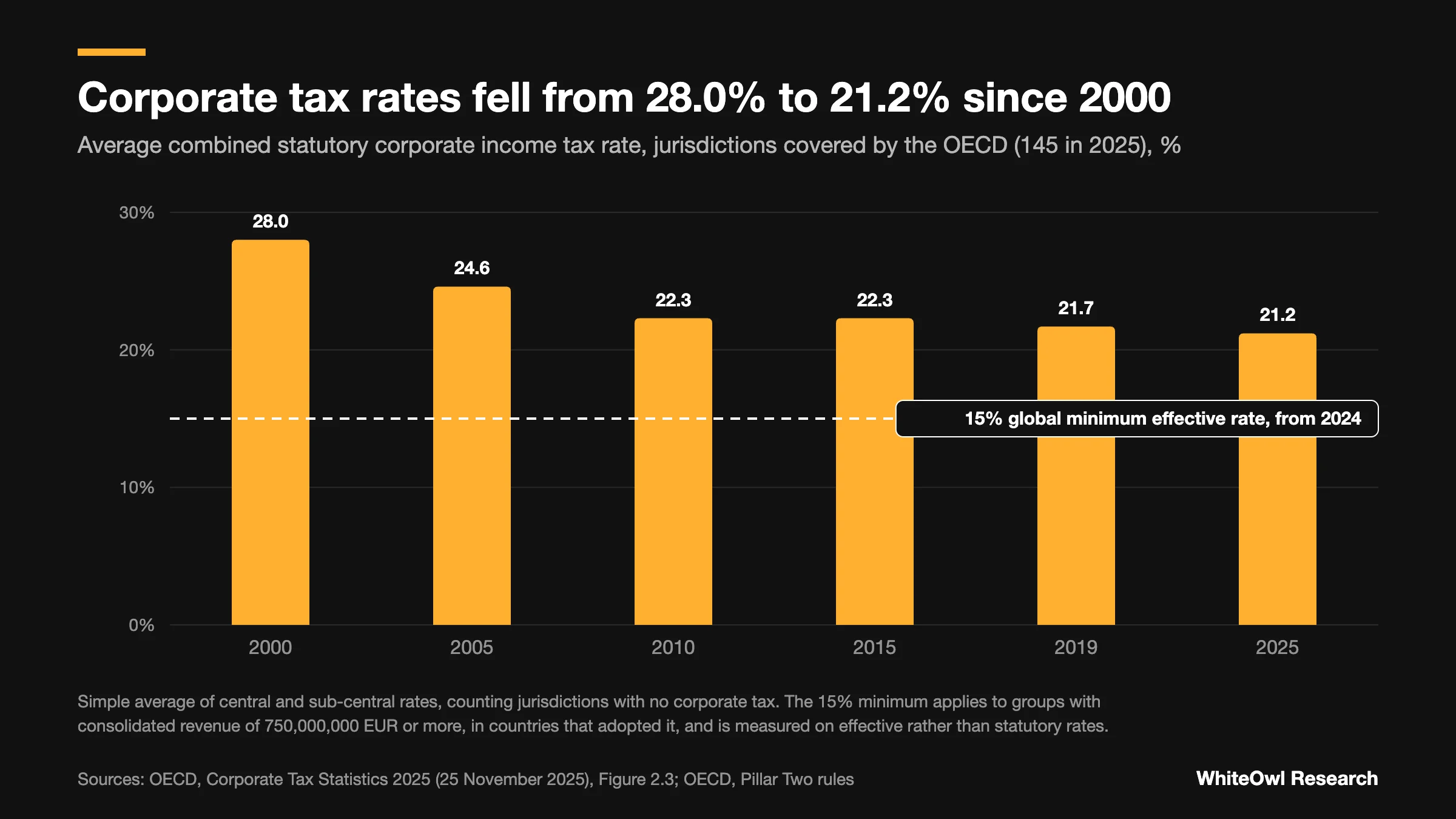
Corporate tax rates since 2000, and the 15% minimum.
Electoral incentives: who pays and who votes
Public choice theory applies economics to politics. Anthony Downs (1957) modelled parties as teams that set policies to win elections, rather than winning elections to carry out policies. Mancur Olson (1965) showed that small groups with a shared interest organize far more easily than large ones whose interest is spread thin. Together they predict that a tax whose cost is spread across many voters, or falls on people who cannot vote, meets less resistance than one that falls heavily on a small, organized group.
Charles McLure (1967) estimated one version of this, tax exporting: how much of US state and local taxes in 1962 fell on residents of other states. Applied to a mobile family, the theory predicts that a country finds it easier to tax people who own property or earn income there but vote elsewhere. Taxes that fall mainly on non-residents and foreign owners exist in many countries; Canada has had two. As of 2026, Canada withholds 25% of many payments to non-residents, such as dividends, interest, rents, royalties and pensions, before any treaty relief (Canada Revenue Agency). From 1 January 2022, it also charged an annual 1% tax on vacant or underused housing that applied generally to foreign national owners; a law that received Royal Assent on 26 March 2026 removed the obligation to file or pay for 2025 and later years, while returns and tax for 2022 to 2024 remain due.
The critique: Donald Green and Ian Shapiro (1994) argued that the evidence for rational choice models in political science, including models of parties and of collective action, is much weaker than their reputation. The theory also leaves out other reasons for such taxes, such as collecting at the source from someone a country cannot otherwise reach, and the limits on them: a tax treaty can reduce Canada's 25% withholding or exempt a payment, and the housing tax above lasted three calendar years.
What the theories agree on and where they disagree
They agree on one point: what can move limits what can be taxed, and what cannot move stays within reach. Land, a local business and, in the United States, citizenship are taxed where they are; income and capital that can leave push rates down or meet rules that tax them on the way out.
They disagree on three questions: how many people actually move (the footballers and the Danish scheme against the millionaire records), whether competition between governments protects taxpayers from waste (Brennan and Buchanan, Tiebout) or leaves too few public services (Zodrow and Mieszkowski), and whether efficiency or fairness should decide what is taxed (Ramsey against his critics).
The figures that matter
Corporate tax rates fell from 2000 to 2019 and have since held near 21%, while a 15% minimum now applies to large groups, with each figure dated in its own row. Sources: OECD; Canada Revenue Agency.
| Measure | Figure | Year |
|---|---|---|
| Average combined corporate income tax rate, jurisdictions covered by the OECD (%) | 28.0 | 2000 |
| Average combined corporate income tax rate, jurisdictions covered by the OECD (%) | 21.7 | 2019 |
| Average combined corporate income tax rate, jurisdictions covered by the OECD (%) | 21.2 | 2025 |
| Jurisdictions with a lower corporate rate in 2025 than in 2000, of 145 | 114 | 2025 |
| Jurisdictions with a corporate rate below 10% | 16 | 2000 |
| Jurisdictions with a corporate rate below 10% | 14 | 2025 |
| Corporate tax as a share of total tax revenue, average of 131 jurisdictions (%) | 17.8 | 2022 |
| Global minimum effective tax rate for large multinational groups (%) | 15 | From 2024 |
| Consolidated revenue from which a group is covered by the minimum tax (EUR) | 750,000,000 | 2026 |
| Canada, tax withheld on many payments to non-residents before treaty relief (%) | 25 | 2026 |
| Canada, annual underused housing tax, no longer charged from 2025 (%) | 1 | 2022 to 2024 |
| OECD countries with a net wealth tax on individuals | 12 | 1990 |
| OECD countries with a net wealth tax on individuals | 4 | 2017 |
How WhiteOwl helps
The rules that decide which taxes follow you keep changing: Canada stopped charging its underused housing tax from 2025, and the global minimum tax gained a side-by-side package in January 2026. WhiteOwl keeps a constant watch on the law and your deadlines, without being asked. WhiteOwl gathers your documents, organizes your file, finds the issues and runs the numbers. A licensed advisor reviews, decides and files. See how it works.
FAQ
Why do governments tax what cannot move?
Economists give three main reasons. A tax on something people cannot avoid raises revenue with the least change in behavior (Ramsey, 1927); mobile income and capital can leave for lower-tax places, which limits what can be taxed; and people who cannot vote where they are taxed resist least (public choice theory). Each explanation has evidence for and against it.
Do millionaires leave high-tax places?
Some do, and the evidence differs by group. Studies of footballers in Europe and of a Danish tax scheme for newly arrived high earners found strong responses to tax, while a study of every person in the United States with income of 1,000,000 USD or more, over 13 years, found that they leave higher-tax states only at the margins.
What is the Leviathan model of government?
It is the model in Brennan and Buchanan's The Power to Tax (1980): government as a single body that seeks the most revenue it can raise, limited by constitutional rules and by competition with other governments. It predicts heavier taxes on bases that cannot leave and smaller government where taxing power is decentralized. Oates (1985) found no empirical support for the second prediction.
What is the inverse elasticity rule?
It is the simplest form of Ramsey's 1927 rule for taxing goods with the least harm: tax rates should be inversely related to how strongly people respond to a good's price, so what people cannot avoid is taxed most. Its main critique is fairness, because necessities respond least to price and taxing them heavily is regressive.
What is tax competition?
It is countries setting their tax rates to attract mobile income and capital from each other. According to the OECD, the average combined corporate income tax rate across the jurisdictions it covers fell from 28.0% in 2000 to 21.2% in 2025, and a 15% global minimum effective tax on large multinational groups began to apply in 2024 in countries that adopted it.
Sources
Law and official figures
- OECD: Corporate Tax Statistics 2025 (25 November 2025) · Figure 2.3 data, average statutory corporate income tax rates · press release, 25 November 2025 · The Pillar Two rules in a nutshell · Global Anti-Base Erosion Model Rules (Pillar Two) · Side-by-Side Package (5 January 2026) · The Role and Design of Net Wealth Taxes in the OECD (2018)
- Canada: Canada Revenue Agency, NR4 non-resident tax withholding, remitting and reporting (Guide T4061) · Underused Housing Tax · dispositions of property for emigrants of Canada
- United States: IRS, US citizens and resident aliens abroad · IRS, expatriation tax
- Australia: Australian Taxation Office, how changing residency affects CGT
Academic works
- Ramsey, F. P. (1927). "A Contribution to the Theory of Taxation". The Economic Journal, 37(145), pages 47 to 61.
- Diamond, P. A. (1975). "A many-person Ramsey tax rule". Journal of Public Economics, 4(4), pages 335 to 342.
- Atkinson, A. B. and Stiglitz, J. E. (1976). "The design of tax structure: Direct versus indirect taxation". Journal of Public Economics, 6(1 and 2), pages 55 to 75.
- Kleven, H. J., Landais, C. and Saez, E. (2013). "Taxation and International Migration of Superstars: Evidence from the European Football Market". American Economic Review, 103(5), pages 1892 to 1924.
- Kleven, H. J., Landais, C., Saez, E. and Schultz, E. (2014). "Migration and Wage Effects of Taxing Top Earners: Evidence from the Foreigners' Tax Scheme in Denmark". The Quarterly Journal of Economics, 129(1), pages 333 to 378.
- Young, C., Varner, C., Lurie, I. Z. and Prisinzano, R. (2016). "Millionaire Migration and Taxation of the Elite: Evidence from Administrative Data". American Sociological Review, 81(3), pages 421 to 446.
- Brennan, G. and Buchanan, J. M. (1980). The Power to Tax: Analytical Foundations of a Fiscal Constitution. Cambridge University Press (Library of Congress record).
- Oates, W. E. (1985). "Searching for Leviathan: An Empirical Study". American Economic Review, 75(4), pages 748 to 757.
- Meloche, J.-P., Vaillancourt, F. and Yilmaz, S. (2004). "Decentralization or Fiscal Autonomy? What Does Really Matter? Effects on Growth and Public Sector Size in European Transition Countries". World Bank Policy Research Working Paper 3254.
- Tiebout, C. M. (1956). "A Pure Theory of Local Expenditures". Journal of Political Economy, 64(5), pages 416 to 424.
- Hirschman, A. O. (1970). Exit, Voice, and Loyalty: Responses to Decline in Firms, Organizations, and States. Harvard University Press.
- Bewley, T. F. (1981). "A Critique of Tiebout's Theory of Local Public Expenditures". Econometrica, 49(3), pages 713 to 740.
- Kanbur, R. and Keen, M. (1993). "Jeux Sans Frontières: Tax Competition and Tax Coordination When Countries Differ in Size". American Economic Review, 83(4), pages 877 to 892.
- Zodrow, G. R. and Mieszkowski, P. (1986). "Pigou, Tiebout, property taxation, and the underprovision of local public goods". Journal of Urban Economics, 19(3), pages 356 to 370.
- Downs, A. (1957). An Economic Theory of Democracy. Harper (Library of Congress record).
- Olson, M. (1965). The Logic of Collective Action: Public Goods and the Theory of Groups. Harvard University Press.
- McLure, C. E. (1967). "The Interstate Exporting of State and Local Taxes: Estimates for 1962". National Tax Journal, 20(1), pages 49 to 77.
- Green, D. P. and Shapiro, I. (1994). Pathologies of Rational Choice Theory: A Critique of Applications in Political Science. Yale University Press.
This article is general information, not personalized tax advice. Consult a qualified cross-border tax professional about your situation.
Related reading
United States exit tax: who owes it when you give up citizenship or a green card in 2026
As of 2026, the US exit tax falls on covered expatriates. Who they are, how the deemed sale and the 910,000 USD exclusion work, and what Canada does when you renounce.
By WhiteOwl Research · Oct 29, 2026
Canada's departure tax: what happens to your shares and investments when you leave
Leaving Canada? Most of what you own is treated as sold on the day you leave. What is taxed, what is excluded, how deferral works and the US treaty election, as of 2026.
By WhiteOwl Research · Oct 29, 2026
Countries with an exit tax: what you may owe when you move abroad in 2026
Nine of ten countries compared tax unrealized gains when you leave or give up your status. Who is caught, what is taxed, how to defer it and what a return undoes, as of 2026.
By WhiteOwl Research · Oct 29, 2026