
By WhiteOwl Research · October 29, 2026 · 9 min read
In short: As of 2026, the United States exit tax falls on covered expatriates: people giving up citizenship or a long-held green card with a net worth of 2,000,000 USD or more, average yearly US income tax above 211,000 USD over five years, or five years of compliance they cannot certify. Gains above 910,000 USD are taxed as if everything were sold.
Why it matters
If you are a US citizen living in Canada, an accidental American or a green card holder heading home, giving up US status ends US tax on your future worldwide income but can bring one last tax on what you already own. Whether you are a covered expatriate decides if the United States taxes your unrealized gains, some retirement savings, and later gifts to family who are US citizens or residents. Much of the answer rests on records you can put in order before you choose a date.
Who counts as an expatriate
Most countries with an exit tax apply it when you stop being resident; the United States applies its expatriation rules when you give up US status, whether or not you move (see exit taxes around the world). They reach two groups:
- Citizens who give up citizenship. For tax purposes this is usually the day of the oath of renunciation before a US consular officer, provided the State Department later issues a certificate of loss of nationality.
- Long-term residents who end residency. You are a long-term resident if you held a green card in at least 8 of the 15 tax years ending with the year residency ends, not counting years in which a tax treaty treated you as resident elsewhere and you kept its benefits.
Residency ends when you formally abandon the card, when an abandonment or removal order becomes final, or when you claim treaty residence in another country, such as Canada, and notify the IRS, even while you still hold the card. The renunciation itself, and the State Department fee of 450 USD since April 13, 2026, are covered in accidental Americans: US tax filing, catching up and renouncing.
The three tests for a covered expatriate
You are a covered expatriate, and owe the exit tax, if any one of these is true:
- Net worth. Your net worth is 2,000,000 USD or more on the expatriation date. The figure is not indexed for inflation. It counts property everywhere, including your home and the present value of pensions.
- Tax. Your average yearly net US income tax for the five tax years before expatriation exceeds 206,000 USD for a 2025 expatriation or 211,000 USD for 2026. It is measured after the foreign tax credit, so Canadian tax credited on your US returns lowers it.
- Compliance. You do not certify on Form 8854 (the initial and annual expatriation statement) that you met all federal tax obligations for those five years. Without that certification you are covered even below both money thresholds.
Two exceptions lift the net worth and tax tests, never the certification:
- Dual citizens from birth who are still citizens of the other country, are taxed as its residents, and were US residents (counted by days present, the substantial presence test) in no more than 10 of the 15 tax years ending with the year they expatriate.
- People who renounce before age 18 and a half, after no more than 10 tax years of US residence.
Both are written for people giving up citizenship; see also dual citizenship taxes.
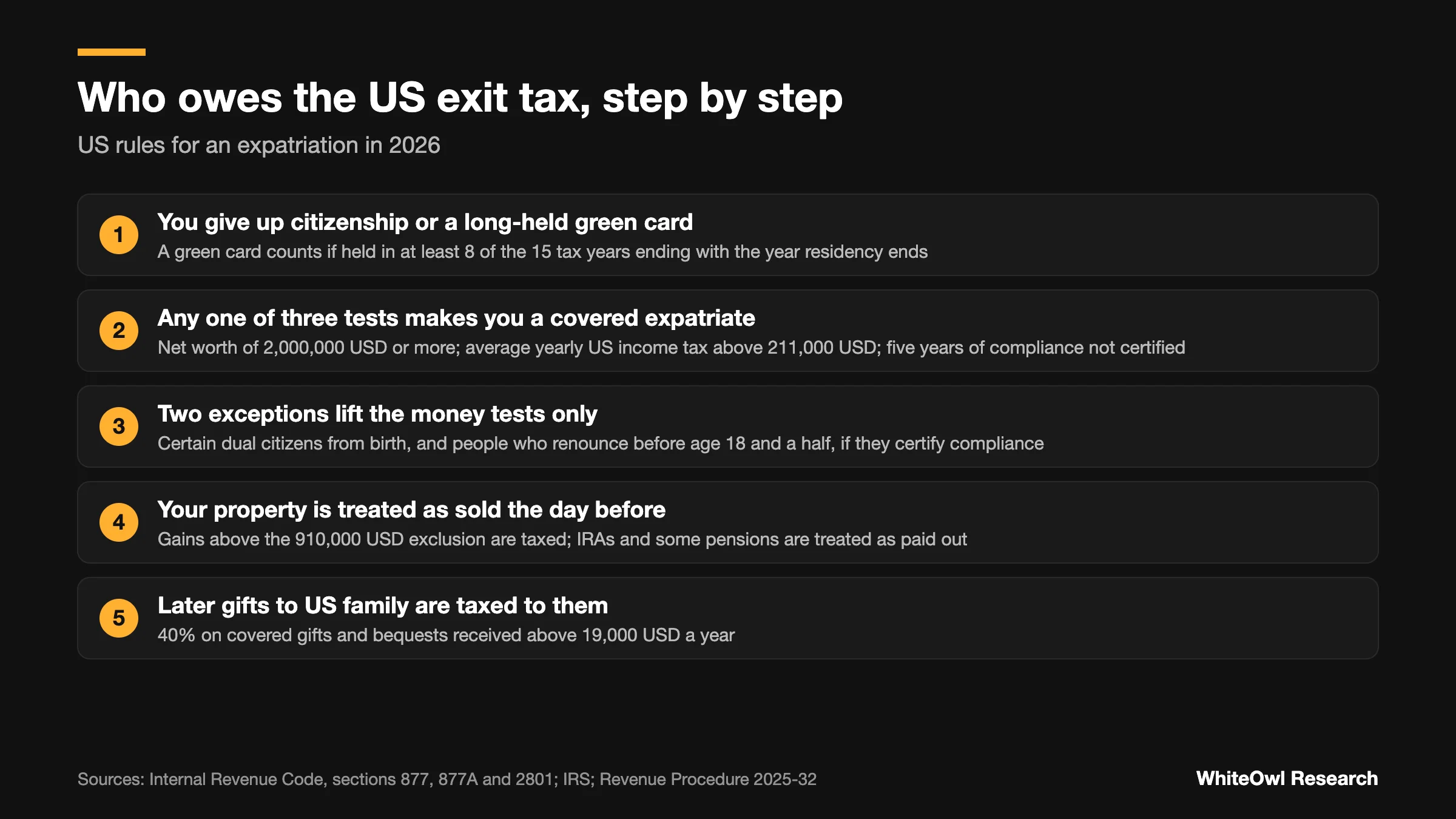
Who owes the exit tax, in five steps.
How the exit tax is figured
For a covered expatriate, as of 2026:
- A deemed sale. All your property, wherever it is, is treated as sold at fair market value on the day before the expatriation date, a personal residence included. A capital gain stays a capital gain, and losses count as far as the tax code otherwise allows.
- An exclusion. The net gain is reduced by 890,000 USD for 2025 and 910,000 USD for 2026, shared among the assets in proportion to their gains. Each person has one exclusion for life.
- A starting value for what you brought. Property you held when you first became a US resident counts, for the exit tax only, as costing at least its market value on that date, unless you elect otherwise.
Three kinds of assets are taxed their own way instead:
- Deferred compensation, including a 401(k) and any foreign pension plan. If the payer is a US person, or a foreign payer that elects to be treated as one, and you notify it and waive treaty reductions, 30% is withheld from each later payment. Otherwise the present value is treated as received the day before expatriation.
- Specified tax-deferred accounts, such as an IRA (other than a SEP or SIMPLE IRA) or a 529 plan, are treated as paid out in full on the day before expatriation, without the early distribution tax.
- Interests in nongrantor trusts: the trustee withholds 30% of the taxable part of each later distribution to you.
You can elect, asset by asset and irrevocably, to defer the tax on the deemed sale until you actually sell, or at the latest your death, with interest and security such as a bond.
The exclusion and the tax test by year
By year of expatriation, the exclusion rose from 600,000 USD in 2008 to 910,000 USD for 2026 and the tax test from 139,000 USD to 211,000 USD, while the net worth test stayed at 2,000,000 USD. Sources: IRS and Internal Revenue Code, listed below.
| Year of expatriation | Exclusion amount (USD) | Average yearly income tax above which you are covered (USD) |
|---|---|---|
| 2008 | 600,000 | 139,000 |
| 2009 | 626,000 | 145,000 |
| 2010 | 627,000 | 145,000 |
| 2011 | 636,000 | 147,000 |
| 2012 | 651,000 | 151,000 |
| 2013 | 668,000 | 155,000 |
| 2014 | 680,000 | 157,000 |
| 2015 | 690,000 | 160,000 |
| 2016 | 693,000 | 161,000 |
| 2017 | 699,000 | 162,000 |
| 2018 | 711,000 | 165,000 |
| 2019 | 725,000 | 168,000 |
| 2020 | 737,000 | 171,000 |
| 2021 | 744,000 | 172,000 |
| 2022 | 767,000 | 178,000 |
| 2023 | 821,000 | 190,000 |
| 2024 | 866,000 | 201,000 |
| 2025 | 890,000 | 206,000 |
| 2026 | 910,000 | 211,000 |
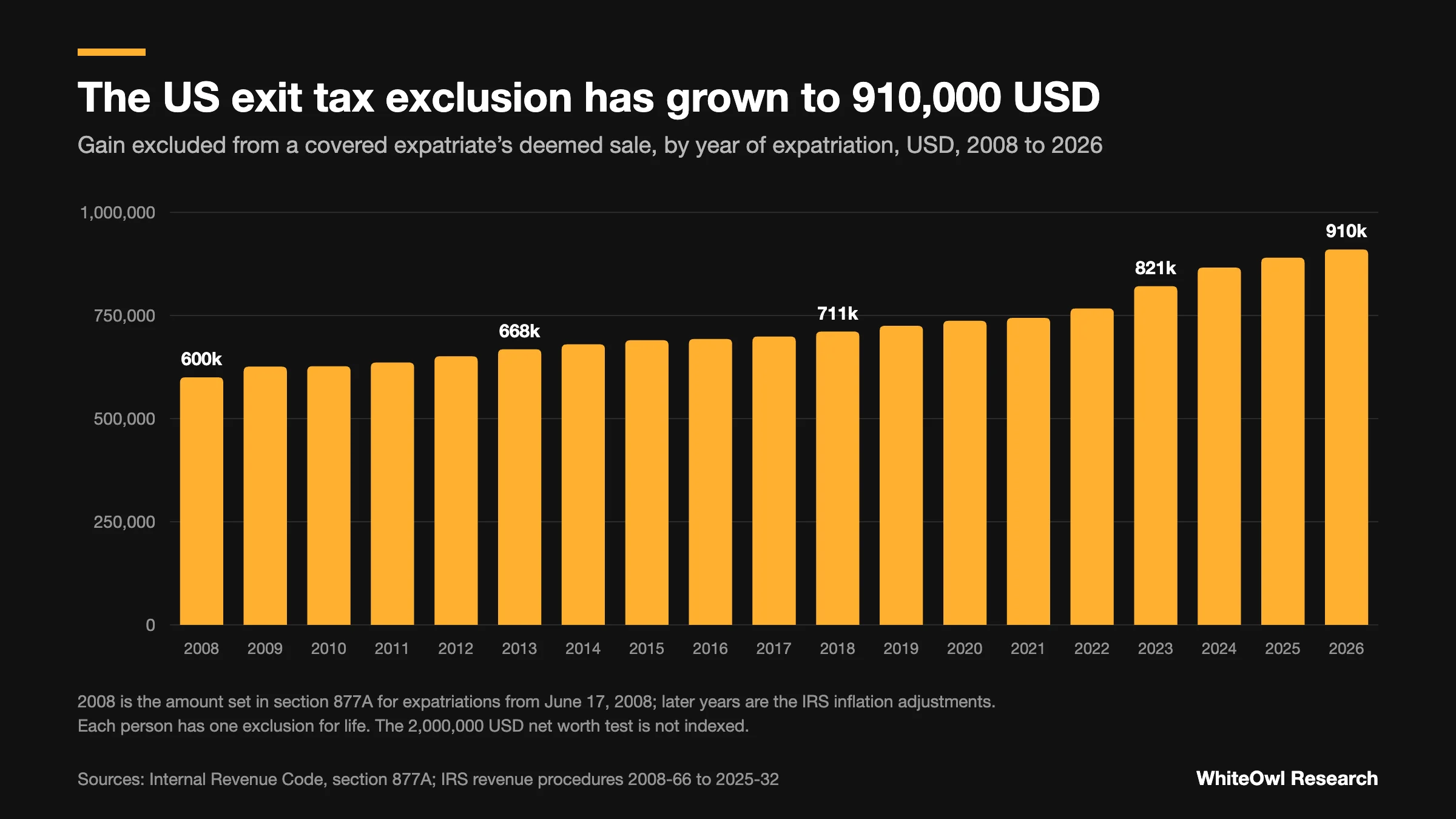
The exclusion by year, 2008 to 2026.
Gifts and bequests to US family after you leave
Section 2801 of the Internal Revenue Code taxes US citizens and residents who receive gifts or bequests from a covered expatriate. The recipient pays 40%, the highest US gift and estate tax rate, on what they receive in a calendar year above 19,000 USD (the amount for 2025 and 2026). Gifts reported on a timely US gift tax return, property shown on a timely US estate tax return, and transfers to a spouse or charity that would qualify for a deduction are excluded. A living donor who does not let the IRS share their return information with the recipient is presumed covered.
Final regulations, published January 14, 2025, apply to gifts and bequests received from January 1, 2025, and the IRS has released Form 708 (the return for gifts and bequests from covered expatriates). The return for 2025 receipts is due June 15, 2027.
Canada as the worked example
The Canada Revenue Agency bases your Canadian tax obligations on residency status, and Canada's own deemed sale of property applies when you stop being resident in Canada. Renouncing US citizenship while you keep living in Canada changes neither, so it is not a Canadian tax event. Two cases follow, with US rules as of 2026 and values in US dollars; for the yearly filing before that, see do you have to pay US taxes if you live abroad.
Claire, a dual citizen from birth. Born in Seattle, a citizen of both countries from birth, Claire has lived and been taxed in Canada since early childhood. Her net worth, mostly her Vancouver home and investments, is 2,400,000 USD. Because she is still Canadian, is taxed as a resident of Canada and has not been a US resident in the last 15 years, the dual citizen exception lifts the net worth test, but only if she certifies five years of US compliance. If she never filed, she must catch up first; the IRS relief procedures for former citizens are closed to her, because their net worth limit of 2,000,000 USD applies even to people who fit the exceptions.
Mark, who moved to Canada as an adult. Mark grew up in the United States, moved to Toronto at 30 and later became a Canadian citizen, so no exception applies. He renounces in 2026 with a net worth of 3,000,000 USD and is a covered expatriate:
- Deemed sale. His shares carry 1,500,000 USD of unrealized gain. After the 910,000 USD exclusion, 590,000 USD of gain goes on his US return for 2026.
- Pension and RRSP. His employer pension is a foreign pension plan, so unless its payer elects to be treated as a US person, its present value is treated as received the day before he expatriates. The IRS notice and form instructions on these rules do not name RRSPs, so how his RRSP is treated is a question for his advisor.
- Canada. Nothing is taxed in Canada on the day he renounces; Canada taxes the gains on his shares when he actually sells them.
- Family. If his daughter stays a US citizen, his later gifts to her above 19,000 USD a year are taxed to her at 40%, unless an exception applies.
The Canada-United States tax treaty addresses deemed sales: when one country taxes an individual on a deemed sale, the individual may elect to be treated by the other as having sold and bought back the property at its market value at that time (Article XIII, paragraph 7). For a US citizen resident in Canada, Canada credits US tax on income arising in the United States, up to what a non-citizen would pay (Article XXIV, paragraph 4). How the election and the credits work out depends on the assets, a question for an advisor who knows both countries.
The figures that matter
The thresholds, rates and fees that decide the exit tax, as of the year shown. Sources: Internal Revenue Code, IRS, Federal Register and US Department of State, listed below.
| Rule | Figure | As of |
|---|---|---|
| Net worth test (USD) | 2,000,000 | 2026 |
| Average yearly income tax test (USD) | 206,000 | 2025 |
| Average yearly income tax test (USD) | 211,000 | 2026 |
| Exclusion from the deemed-sale gain (USD) | 890,000 | 2025 |
| Exclusion from the deemed-sale gain (USD) | 910,000 | 2026 |
| Section 2801 tax on covered gifts and bequests (%) | 40 | 2026 |
| Covered gifts and bequests exempt each calendar year (USD) | 19,000 | 2025 and 2026 |
| State Department fee to renounce citizenship (USD) | 450 | From April 13, 2026 |
How WhiteOwl helps
Whether you are a covered expatriate often turns on five years of US returns and a balance sheet on one date. WhiteOwl keeps your actual documents from one year to the next, so those years are in one file when you and your advisor choose the date. WhiteOwl gathers your documents, organizes your file, finds the issues and runs the numbers. A licensed advisor reviews, decides and files. See how it works.
FAQ
How much is the US exit tax?
There is no flat amount. As of 2026, a covered expatriate pays US income tax at the usual rates on the net gain from the deemed sale above 910,000 USD, plus tax on IRAs and some pensions treated as paid out. Someone who is not covered owes no exit tax but still files Form 8854.
Does the exit tax apply to green card holders?
Only to long-term residents, who held a green card in at least 8 of the 15 tax years ending with the year residency ends. As of 2026 they face the same three tests, and for the exit tax, assets held on arrival count at no less than their market value then.
Can you give up US citizenship without paying the exit tax?
Yes, if none of the three tests applies, or an exception covers the money tests and you certify five years of compliance. As of 2026, IRS relief procedures also treat as not covered certain non-willful non-filers who relinquished after March 18, 2010, with a net worth under 2,000,000 USD and 25,000 USD or less of tax for the year of expatriation and the five before.
Does Canada tax you when you renounce US citizenship?
As of 2026, Canada bases your tax obligations on residency, and its deemed sale of property applies when you stop being resident in Canada. Renouncing US citizenship while you keep living in Canada changes neither, so it is not a Canadian tax event.
Sources
- IRS, expatriation tax · Instructions for Form 8854 (2025) · IRS Notice 2009-85
- 26 U.S.C. 877A, tax responsibilities of expatriation · 26 U.S.C. 877 · 26 U.S.C. 7701(b)(6) · 26 U.S.C. 2801
- IRS inflation adjustments: Rev. Proc. 2025-32 (2026) · 2024-40 (2025) · 2023-34 (2024) · 2022-38 (2023) · 2021-45 (2022) · 2020-45 (2021) · 2019-44 (2020) · 2018-57 (2019) · 2018-18 (2018 exclusion) · 2017-58 (2018 tax test) · 2016-55 (2017) · 2015-53 (2016) · 2014-61 (2015) · 2013-35 (2014) · 2012-41 (2013) · 2011-52 (2012) · 2010-40 (2011) · 2009-50 (2010) · 2008-66 (2009)
- Federal Register, final regulations under section 2801 (January 14, 2025) · IRS, estate and gift tax updates · Instructions for Form 708 (December 2025)
- IRS, relief procedures for certain former citizens
- US Department of State, fee for a certificate of loss of nationality (final rule, Federal Register, March 13, 2026) · correction (April 17, 2026)
- Canada Revenue Agency, determining your residency status · dispositions of property for emigrants of Canada · taxable capital gains · Income Tax Act, section 128.1
- Department of Finance Canada, Canada-United States tax convention (consolidated text)
This article is general information, not personalized tax advice. Consult a qualified cross-border tax professional about your situation.
Related reading
Why governments tax what cannot move: six economic theories of mobile and captive taxpayers
Six economic theories of why governments tax what cannot move, from the Ramsey rule to Leviathan, tax competition and electoral incentives, each with its critique.
By WhiteOwl Research · Oct 29, 2026
Inheritance tax in Canada: what is taxed when someone dies, and across the US border
Canada has no inheritance tax: the final return taxes the gains at death. What changes when an heir lives in the US or a parent owns a Florida condo or US shares, as of 2026.
By WhiteOwl Research · Oct 29, 2026
Countries with an exit tax: what you may owe when you move abroad in 2026
Nine of ten countries compared tax unrealized gains when you leave or give up your status. Who is caught, what is taxed, how to defer it and what a return undoes, as of 2026.
By WhiteOwl Research · Oct 29, 2026