
By WhiteOwl · November 11, 2026 · 10 min read
In short: The Canada-United States tax treaty decides which country may tax each kind of income when your life spans both. As of 2026, it breaks ties over residence, caps tax at source at 15% on dividends to individuals and on periodic pensions, and has your country of residence give the credit. The United States still taxes its citizens.
Why it matters
If you retire to Arizona on Canadian pensions, work a season in Seattle, or live in Vancouver as a US citizen, the treaty decides how much is withheld before the money reaches you, which country gives the credit, and whether a retirement account keeps growing untaxed. Many of its benefits apply only when you claim them, through a declaration to a payer, an election or a disclosure.
How the treaty decides who taxes what
Canada and the United States signed the treaty in 1980 and have amended it five times, most recently by a protocol signed on September 21, 2007 that generally took effect on January 1, 2009. It covers federal income tax and, at death, the US estate tax (Articles II and XXIX B).
For an individual it works in four steps: each country applies its own residence rules, the tie-breaker picks one if both claim you, the article for each kind of income says who may tax it and how much, and the country where you live gives the credit. Above all four, the United States keeps taxing its own citizens.
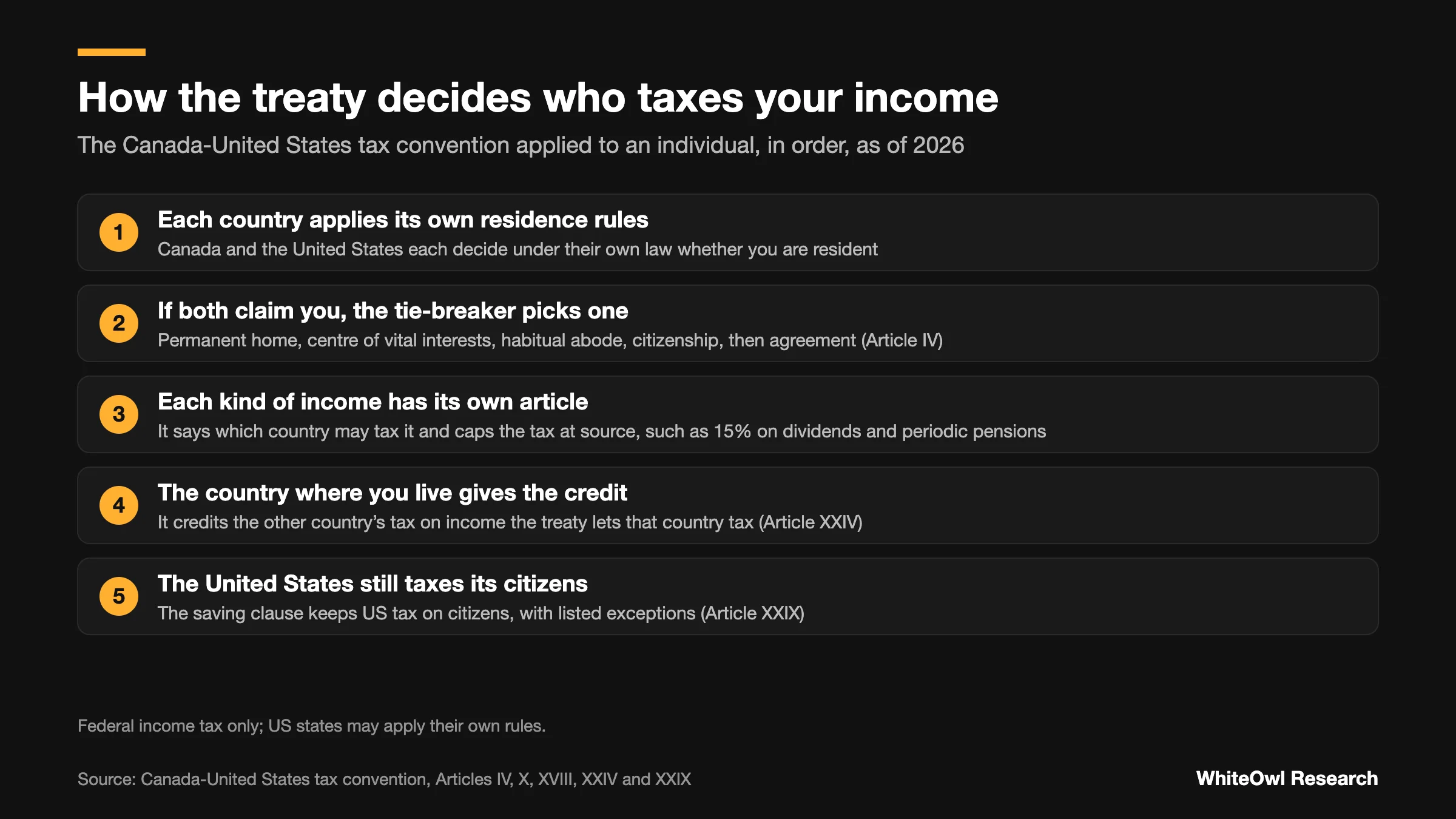
How the treaty decides who taxes your income.
Residence: the tie-breaker, and the saving clause for US citizens
When both countries treat you as resident under their own law, Article IV(2) applies these tests in order and stops at the first that decides: a permanent home available in only one country; your centre of vital interests, the country your personal and economic relations are closer to; your habitual abode; your citizenship; and failing all of these, an agreement between the two tax authorities.
The answer counts in both countries. Canadian law treats someone the treaty makes a resident of the United States as not resident in Canada, which brings the departure tax. A green card holder resident in Canada under the tie-breaker can be taxed by the United States as a non-resident, the IRS says, by disclosing that treaty position on the return. For a long-term resident, one who held a green card in at least 8 of the last 15 years, taking that position can count as giving up US residence and bring the US exit tax.
The tie-breaker does not help a US citizen. Under the saving clause in Article XXIX(2), the United States taxes its citizens as if there were no treaty, and for ten years after a citizen or long-term resident gives up that status, it can still tax their US-source income. Paragraph 3 keeps some protections for citizens, among them the pension and social security rules and the credits. See dual citizenship taxes.
Withholding on dividends, interest, royalties and pensions
When income comes from one country and you live in the other, the country it comes from usually withholds a flat tax on the gross payment: without a treaty, generally 25% in Canada and 30% in the United States. The treaty lowers it when you are the beneficial owner and live in the other country, once the payer holds enough information to show that you qualify.
The treaty's maximum tax at source on payments to a resident of the other country, as of 2026, compared with general rates of 25% in Canada and 30% in the United States without it. Sources: Canada-United States tax convention, Income Tax Act and IRS, listed below.
| Payment | Treaty article | Maximum rate at source (%) |
|---|---|---|
| Dividends to an individual | X(2)(b) | 15 |
| Dividends to a company holding 10% or more of the voting stock | X(2)(a) | 5 |
| Interest, most kinds | XI(1) | 0 |
| Interest tied to the payer's profits or similar measures | XI(6) | 15 |
| Royalties, general, including film and television | XII(2) | 10 |
| Royalties for literary, musical and artistic works, software and patents | XII(3) | 0 |
| Periodic pension payments | XVIII(2)(a) | 15 |
| Annuities, on the taxable part | XVIII(2)(b) | 15 |
| Social security benefits | XVIII(5) | 0 |
Each country's own law already exempts much interest, such as most arm's length interest in Canada and portfolio interest in the United States. Rent from real property can be taxed where the property is, with no treaty maximum (Article VI); see renting out your home in Canada after you leave.
Pensions, RRSPs and social security
For a retiree, Article XVIII does most of the work.
- Pensions and RRIF payments. The paying country may tax a periodic pension payment at no more than 15%, and the IRS counts IRAs, RRSPs and RRIFs as pensions. Canada reads "periodic" narrowly: an RRSP withdrawal before the plan matures is not periodic, so a US resident's lump sum is withheld at the full 25%, and RRIF payments qualify only up to the greater of twice the year's minimum and 10% of the fund's value at the start of the year.
- Growth inside the plan. Article XVIII(7) lets a US citizen or resident defer US tax on the growth inside an RRSP or RRIF until it is paid out, and since Revenue Procedure 2014-55 the IRS treats an eligible individual as having made that election, with no form. See your RRSP after leaving Canada. For someone moving to Canada, Roth IRA payouts are exempt in Canada to the extent the United States would exempt them, and tax on the growth can be deferred by election, except growth on contributions made after becoming resident in Canada.
- Canada Pension Plan and Old Age Security. Paid to a US resident, they are taxable only in the United States, as if they were US Social Security benefits, so up to 85% can be taxable depending on income. Canada withholds 0% on them, against 25% without a treaty.
- US Social Security. Paid to a resident of Canada, it is taxable only in Canada, with 15% exempt, or 50% deductible for someone resident in Canada and receiving it continuously since before January 1, 1996. The IRS exempts it from US tax, including for US citizens living in Canada; without the treaty, the United States taxes 85% of a non-resident's benefit at 30%.
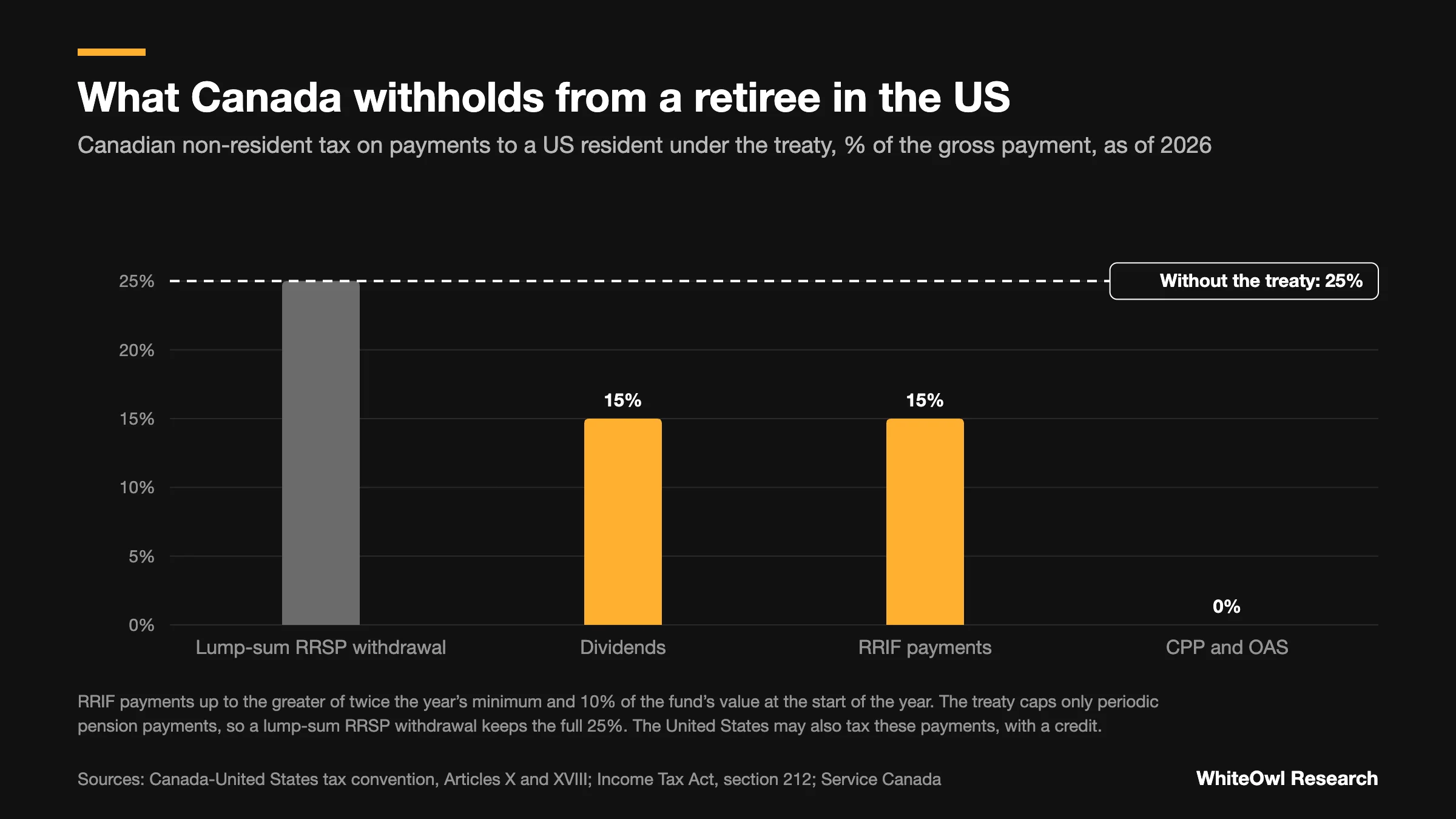
What Canada withholds from a retiree in the United States.
Gains: real estate is taxed where it sits
Under Article XIII, the country where real property is located may tax the gain when a resident of the other country sells it. That includes any US real property interest and, in Canada, shares of a Canadian company, or interests in a partnership or trust, whose value comes mainly from Canadian real estate. Other gains, such as on most shares or funds, are taxable only where the seller lives, subject to the saving clause. A Canadian resident who sells a Florida condo can owe US tax on the gain, and Canada deducts that tax from its own tax on the same gain. See selling US property as a Canadian.
Moving adds one more rule. When Canada taxes the deemed sale on departure, Article XIII(7) lets you elect to be treated, for US purposes, as having sold and bought back the property at its value that day, so the United States taxes only later growth; see Canada's departure tax. The same election works the other way when the United States taxes a deemed sale, as its exit tax does.
Employment income: taxed where the work is done, with two exceptions
Wages are taxable where you live, and may also be taxed where the work is done (Article XV). The country where you work cannot tax them if your pay for that work is no more than 10,000 in its currency (10,000 CAD in Canada, 10,000 USD in the United States), or if you are there no more than 183 days in any twelve-month period starting or ending in the year and your pay is neither paid by or for an employer resident there nor borne by a permanent establishment it has there. So a Toronto engineer sent by a Canadian employer to Seattle for four months, with no US office bearing the pay, is taxed on those wages by Canada only.
Estate taxes: a share of the US credit for Canadians
At death, Canada generally taxes the gains on what a person owns, and the United States taxes the estate. A resident of Canada who is not a US citizen and dies owning US property, such as a Florida condo or US shares, gets a US estate tax credit of 13,000 USD without the treaty. Article XXIX B gives the larger of that and a share of a US citizen's credit, 5,945,800 USD for deaths in 2026, in proportion to the US property's share of the worldwide estate, which must be disclosed. When the worldwide estate is worth 1,200,000 USD or less, the United States can tax only property such as US real estate, so most US shares fall outside. Canada, in turn, lets the US estate tax reduce its own tax on the gains at death from US property. See inheritance tax in Canada.
Relief from double taxation: which country gives the credit
Article XXIV gives the credit to the country where you live. A resident of Canada deducts from Canadian tax the US tax on income the treaty lets the United States tax, such as a US real estate gain or the 15% on US dividends, and a US citizen or resident gets a US credit for Canadian income tax.
A US citizen living in Canada is taxed by both, so the treaty sets an order. On US-source income, Canada's credit need not exceed the US tax that a resident of Canada who is not a US citizen would pay, such as 15% on US dividends. The United States then credits the Canadian tax that remains, treating the income as Canadian-source where needed.
What the treaty does not do
- It does not end US filing for citizens. A US citizen living in Canada still files a US return reporting worldwide income, the IRS says. See US taxes when you live abroad.
- It does not mention the TFSA. The treaty's text does not name the tax-free savings account, and as of October 2026 the IRS has published no guidance that names it. See the TFSA as a non-resident.
- It may not bind US states. The treaty covers federal income tax. California, for example, does not apply the RRSP deferral: under its 2025 guidance, its residents include RRSP earnings in taxable income in the year they are earned.
- It does not make a country collect from its own citizens. Each country helps collect the other's tax debts, but neither collects from someone for a period in which that person was its own citizen (Article XXVI A). See accidental Americans.
The figures that matter
The thresholds and rates that decide how the treaty applies to an individual, as of the 2026 tax year. Sources: Canada-United States tax convention, IRS, Canada Revenue Agency and Service Canada, listed below.
| Rule | Figure |
|---|---|
| General non-resident withholding in Canada without a treaty (%) | 25 |
| General non-resident withholding in the United States without a treaty (%) | 30 |
| Treaty maximum on dividends to an individual (%) | 15 |
| Treaty maximum on periodic pension payments (%) | 15 |
| Pay at or below which the country of work cannot tax wages, in its currency | 10,000 |
| Days present in any twelve-month period for the second wage exception | 183 |
| Share of US Social Security exempt in Canada (%) | 15 |
| Share of US Social Security deductible in Canada for recipients since before 1996 (%) | 50 |
| Share of a non-resident's US Social Security taxed without the treaty (%) | 85 |
| Canadian withholding on CPP and OAS paid to US residents (%) | 0 |
| US estate tax credit for a non-resident without the treaty (USD) | 13,000 |
| US citizen's estate tax credit, deaths in 2026 (USD) | 5,945,800 |
| Worldwide estate at or below which most US shares escape US estate tax (USD) | 1,200,000 |
| Years the United States can tax a former citizen's or long-term resident's US-source income | 10 |
How WhiteOwl helps
The treaty reaches pensions, estates and credits in two countries at once, and an advisor who knows US estate tax may know little about Canadian pensions. WhiteOwl matches you with an advisor whose specialties and countries fit your case, from a Canadian pension paid in Arizona to a US citizen's return filed from Toronto. WhiteOwl gathers your documents, organizes your file, finds the issues and runs the numbers. A licensed advisor reviews, decides and files. See how it works.
FAQ
What does the Canada-United States tax treaty do?
It decides which country may tax each kind of income for people connected to both, and limits the tax the country where the income arises can take. As of 2026, that tax is capped at 15% on dividends to individuals and on periodic pensions and removed on most interest, and the country of residence credits the rest.
Do US citizens living in Canada still pay US tax?
They still file a US return reporting worldwide income, because of the saving clause. Credits share the tax between the two countries, and some income, such as US Social Security, is taxable only in Canada.
How are CPP and OAS taxed if I live in the United States?
As of 2026, Canada withholds nothing on Canada Pension Plan or Old Age Security benefits paid to a US resident. The United States taxes them as if they were US Social Security benefits, so up to 85% can be taxable depending on your income.
Does the treaty cover a TFSA?
The treaty does not mention the tax-free savings account, and as of October 2026 the IRS has published no guidance that names it. Its deferral for retirement plans covers arrangements operated exclusively to provide pension or employee benefits, such as RRSPs and RRIFs.
Sources
- Department of Finance Canada, Canada-United States tax convention (consolidated text)
- IRS, Publication 597, information on the United States-Canada income tax treaty · Canada tax treaty documents · US Department of the Treasury, technical explanation of the 2007 protocol
- IRS, Publication 915, social security benefits · Publication 519, US tax guide for aliens · Publication 515, withholding on nonresident aliens · Revenue Procedure 2014-55
- IRS, Instructions for Form 706 · Instructions for Form 706-NA
- Service Canada, taxes on Canadian pensions and benefits outside Canada · Canada Revenue Agency, tax rates on RRSP withdrawals · Information Circular IC76-12R8 · deduction for US Social Security benefits
- Justice Laws, Income Tax Act section 212 · section 250 · Income Tax Conventions Interpretation Act
- California Franchise Tax Board, Publication 1001 (2025), supplemental guidelines to California adjustments
This article is general information, not personalized tax advice. Consult a qualified cross-border tax professional about your situation.
Related reading
The jock tax in 2026: how athletes and performers are taxed where they play
How the jock tax works in 2026: duty days in a state like New Jersey, the home-state credit, the Canada-United States treaty for league players, and withholding on touring performers.
By WhiteOwl · Nov 11, 2026
Canadian snowbirds and the US 183-day rule: the days test and the two ways out in 2026
How winters in Florida or Arizona can make a Canadian a US tax resident under the 183-day test, and the two ways out: a closer connection statement or the treaty tie-breaker.
By WhiteOwl · Nov 11, 2026
Renting out your home in Canada after you leave: the 25% tax, section 216 and NR6 in 2026
Renting out your Canadian home after you move abroad? Canada takes 25% of the gross rent unless you file a section 216 return. NR6, depreciation, a sale and the US side, as of 2026.
By WhiteOwl · Nov 11, 2026