
By WhiteOwl · November 11, 2026 · 10 min read
In short: A Canadian visitor is a US tax resident for 2026 with at least 31 days in the United States in 2026 and 183 over 2024 to 2026, counting 2025's days at one third and 2024's at one sixth. Under 183 days in 2026, a closer connection statement is the way out; at 183 or more, the treaty tie-breaker.
Why it matters
A Canadian who meets the test and claims neither way out is a resident alien under US law, taxed by the IRS on income from everywhere, as a US citizen is, while Canada keeps taxing the same income. Both ways out are claimed on forms sent to the IRS, by June 15 of the following year for someone with no US wages, and a closer connection statement filed late generally does not count.
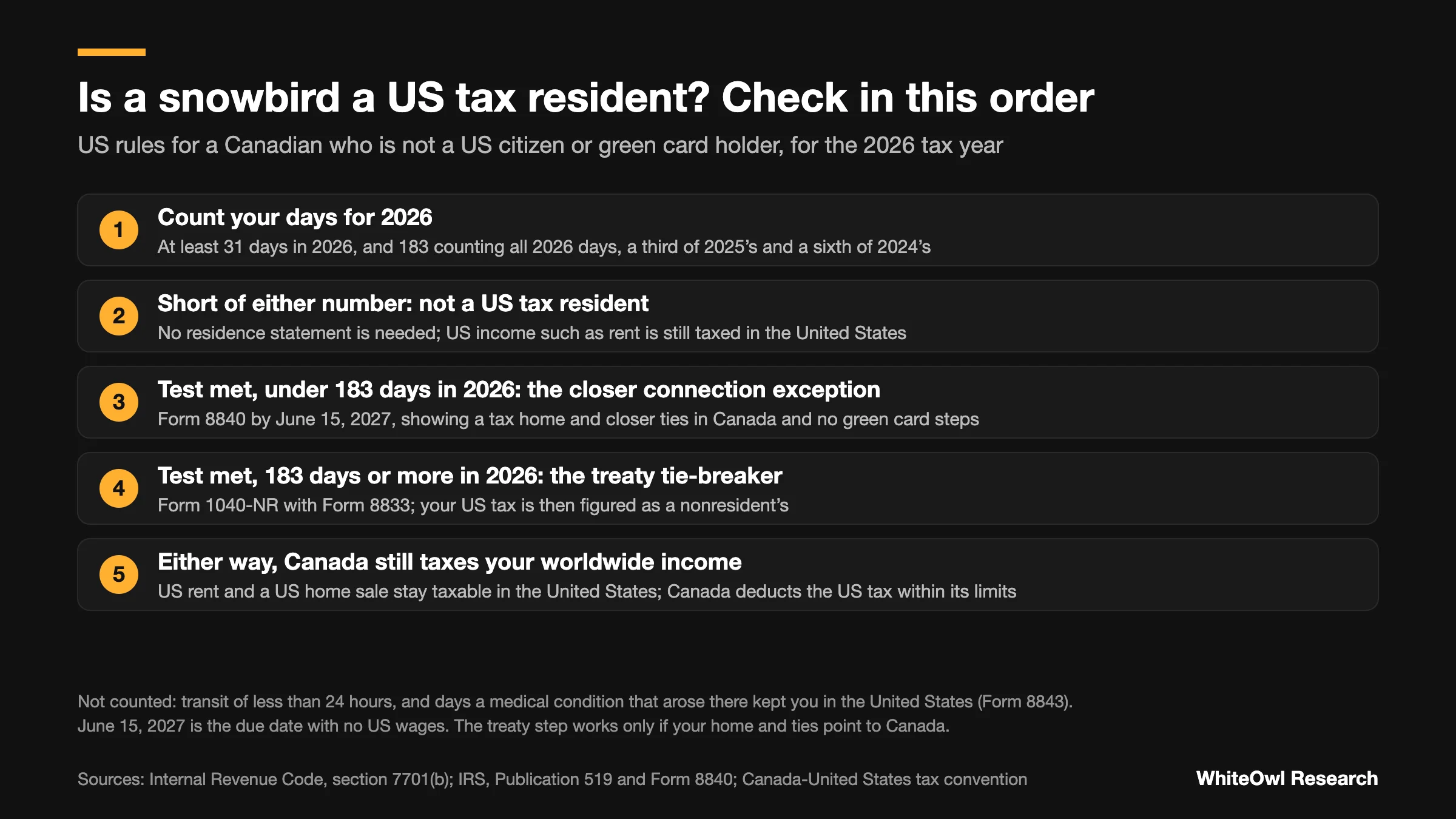
How a snowbird checks US tax residence for 2026, and the way out at each step.
The days test: 31 days this year, 183 over three years
In the United States, as of 2026, a person who is neither a US citizen nor a green card holder is a US resident for tax purposes in any calendar year in which they meet the substantial presence test. A resident of Canada who winters in Florida or Arizona meets it by passing both of its parts: at least 31 days in the United States during the year, and at least 183 days over that year and the two before it, counting all the days of the current year, one third of the days of the year before and one sixth of the days of the year before that.
A winter of the same length every year adds up. The IRS's example is 120 days in each of three years: 120, plus 40, plus 20, makes 180, so the test is not met. At 122 days a year the count reaches 183 exactly, which meets it, since the law asks for 183 days or more; at 121 days a year it is 181.5.
The Government of Canada's travel advice, updated October 15, 2026, says Canadian visitors can usually stay in the United States for 6 months without a visa: that is a separate immigration limit, and a stay within it can still meet the tax test.
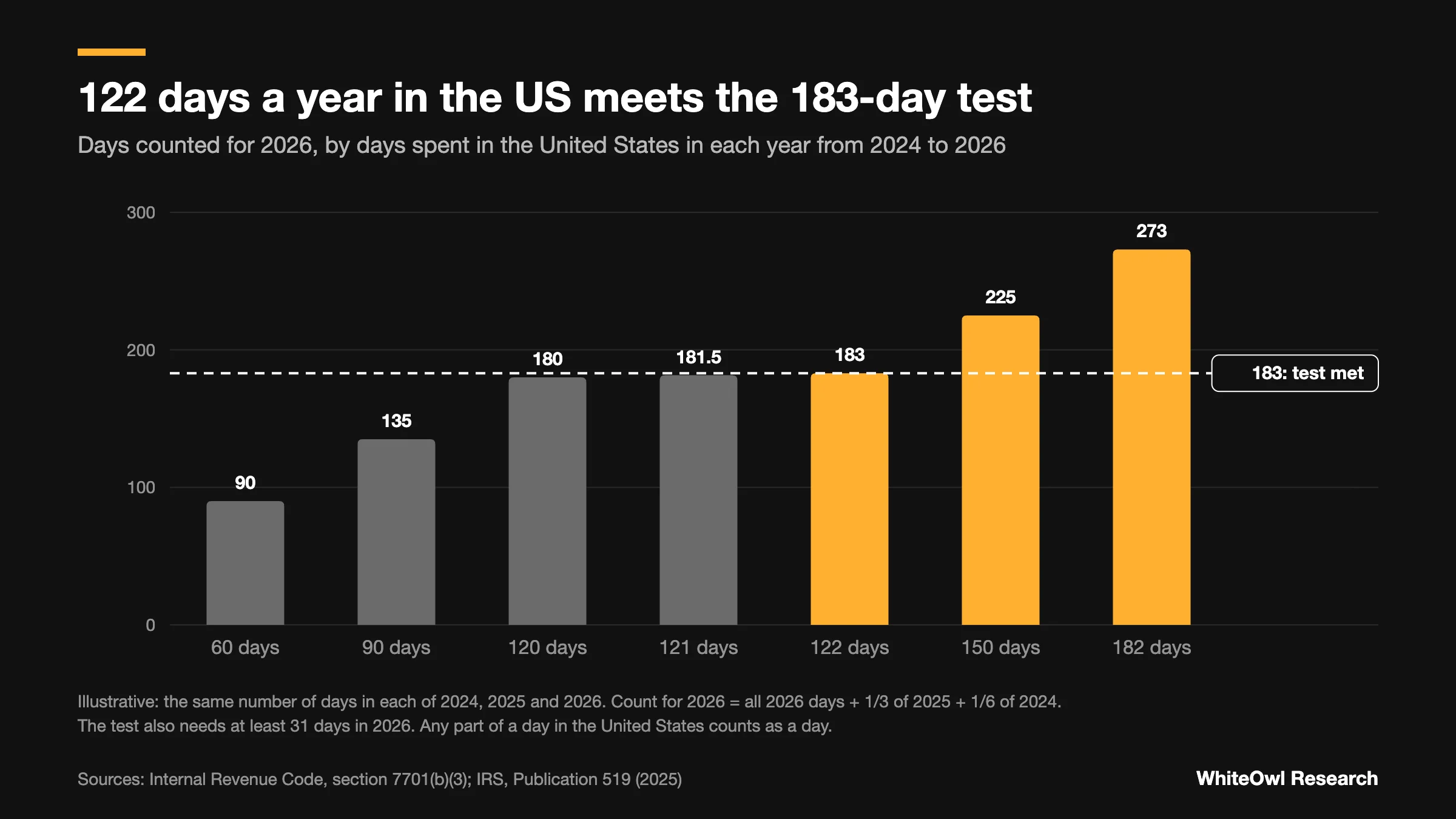
A winter of 122 days, three years running, meets the US 183-day test.
What counts as a day in the United States
Any part of a day in the United States counts as a full day, so the day you drive south and the day you fly home both count. The 50 states and the District of Columbia are in the count; US territories are not.
For a snowbird, two kinds of days are left out: less than 24 hours in transit between two places outside the United States, and days you intended to leave but could not, because of a medical condition that arose while you were there. Medical days are left out only with Form 8843 (a statement for individuals with a medical condition) filed by the due date of the US nonresident return, and not for a condition you already had and knew of on arrival, or for a trip back to treat a condition from an earlier stay.
A worked example: three winters in Florida
A retiree from Ottawa spends 150 days in Florida in 2024, 138 days in 2025 and, wanting less time away, 125 days in 2026. Each figure includes the travel days at both ends.
For this retiree, the count for 2026 is 196 days, above 183, so the substantial presence test is met for 2026. Sources: IRS, listed below.
| Year | Days in the United States | Share counted | Days counted for 2026 |
|---|---|---|---|
| 2026 | 125 | All | 125 |
| 2025 | 138 | One third | 46 |
| 2024 | 150 | One sixth | 25 |
| Count for 2026 | — | — | 196 |
The shorter 2026 winter did not bring the count under 183, because the two earlier winters carry into it: with 71 days already counted from 2025 and 2024, the retiree needed 111 days or fewer in 2026 to stay under. At 125 days, fewer than 183, the closer connection exception is open for 2026. For 2027, the count starts at 64.67 days carried from 2026 and 2025, so 118 days or fewer in 2027 keeps it under 183.
Way out 1: the closer connection exception, under 183 days
A Canadian who meets the test is still treated as a nonresident for the year if they were in the United States on fewer than 183 days that year, had their tax home in Canada all year, had a closer connection to Canada than to the United States, and had not applied for, or taken steps toward, a green card, or had an application pending; a petition a US relative filed for them counts as such a step. For someone retired and not in business, the tax home is their regular place of abode in a real and substantial sense, which for most snowbirds is the home in Canada.
Closer connection is judged on facts, including these that the IRS lists: where your permanent home, family, cars, furniture and other belongings are; your social, cultural and religious ties; where you bank, hold a driver's licence and vote; the country you give as your residence on forms; and whether you have signed Form W-8BEN (a certificate of foreign status given to US payers) or Form W-9 (the one a US person gives). A permanent home may be owned or rented; what matters is that it is available at all times, not only for short stays.
Claiming the exception means filing Form 8840 (the closer connection exception statement) for each year in which you meet the test. It lists your days in the United States for the three years and answers questions on those contacts, down to where your cars are registered. It goes with your US return if you file one, for example a nonresident return for US rent; otherwise you mail it alone by the nonresident return's due date, June 15 of the following year for someone with no US wages. Each person files their own, so a couple files two.
A late statement does not count: you may be treated as a US resident, unless you show, by clear and convincing evidence, that you took reasonable steps to learn of the requirement and significant steps to meet it.
Way out 2: the treaty tie-breaker, at 183 days or more
From 183 days in the year itself, the closer connection exception is closed and, under US law, the person is a US resident. As of 2026, the Canada-United States tax convention then decides where someone resident in both countries is resident for the treaty. Its tests run in order: the country where you have a permanent home available; if you have one in both or in neither, the country with which your personal and economic relations are closer, called the centre of vital interests; then where you have a habitual abode; then citizenship; and last, agreement between the two tax authorities.
A snowbird with a home available all year in each country has a permanent home in both, so the centre of vital interests usually decides. The Canada Revenue Agency looks at the same personal and economic ties it uses for Canadian residence, and quotes the OECD commentary that courts have relied on: keeping the first home, where you have always lived and worked and kept your family and possessions, can, with other facts, show that your centre of vital interests stayed there.
Claiming it means filing a US nonresident return, Form 1040-NR, by its due date, with Form 8833 (a disclosure of a position taken under a treaty) attached, and figuring your US tax as a nonresident.
What claiming the treaty changes
For the part of the year you were resident in both countries, your US tax is figured as a nonresident's: only income from US sources and income connected with a US business is taxed, so income from Canadian sources, such as a Canadian pension, stays off the US tax bill. The choice covers the whole return; the regulations do not allow some items figured as a nonresident and others as a resident. For other purposes, the IRS generally still treats you as a US resident, for example in deciding whether a company outside the United States is controlled by US shareholders.
The claim holds only if the tie-breaker points to Canada. If it points to the United States, Canada deems you a non-resident from that time for all purposes of the Income Tax Act, and its rules for people who leave, including the deemed sale of certain property, apply; see Canada's departure tax.
Each year stands alone: a later year under 183 days reopens the closer connection exception, though the long winter still weighs in the next two counts.
What does not change: Canada's tax and US tax on US property
Neither way out changes Canada's side. In Canada, as of 2026, the Canada Revenue Agency's position is that someone who leaves Canada without severing significant residential ties, chiefly a home, a spouse or common-law partner, and dependants in Canada, generally remains a factual resident, taxed on worldwide income from all sources. Canada taxes individuals by calendar year, so the 2026 Canadian return still reports Canadian pensions, investment income and any US income.
Nor do they change US tax on US property, which follows the property rather than your days. The treaty lets the United States tax income from real property there, rent included, and gains on its sale. If you are a nonresident and rent out a Florida condo, the US tax is 30% of the gross rent, unless you choose to treat the rent as income from a US business and be taxed on the net rent after expenses. On a sale, the gain is taxed in the United States and the buyer generally withholds 15% of the price, or less for some homes bought to live in; the steps and the Canadian side are in Canadian snowbirds selling a Florida home.
Canada taxes the same rent and gain as a resident's income and, under Article XXIV of the treaty, deducts the US income tax on that US income from its own tax on it, within the limits of Canadian law. US estate tax on a Canadian's US property is a separate question, covered in inheritance tax in Canada and across the US border.
The figures that matter
The thresholds that decide a Canadian visitor's US tax residence, and the US tax on US property, as of the 2026 tax year. Sources: IRS, Treasury regulations, Canada-United States tax convention and Government of Canada, listed below.
| Rule | Figure |
|---|---|
| Days in the United States needed in the current year (days) | 31 |
| Weighted days over three years that meet the test (days) | 183 |
| Share of the days of the year before that is counted | One third |
| Share of the days of the second year before that is counted | One sixth |
| Days a year that meet the test when repeated three years running (days) | 122 |
| Days in the current year from which the closer connection exception is closed (days) | 183 |
| Due date of the closer connection statement or nonresident return, with no US wages | June 15 of the following year |
| US tax on a nonresident's gross US rent, unless taxed on the net (%) | 30 |
| Usual withholding on the price of US real estate sold by a nonresident (%) | 15 |
| Usual stay for Canadian visitors without a visa (months) | 6 |
How WhiteOwl helps
For a snowbird, the date that matters each year is June 15, when the statement for any year the test is met is due, and one filed late may not count. WhiteOwl keeps a constant watch on the law and your deadlines, without being asked. WhiteOwl gathers your documents, organizes your file, finds the issues and runs the numbers. A licensed advisor reviews, decides and files. See how it works.
FAQ
How many days can a Canadian spend in the US without becoming a tax resident?
As of 2026, fewer than 31 days in a year never meets the test. Beyond that, the weighted count over three years must stay under 183: with the same number of days every year, 121 days or fewer keeps it under, and 122 meets it.
Do Canadian snowbirds have to file Form 8840?
Only for a year in which they meet the substantial presence test and claim the closer connection exception, which needs fewer than 183 days in that year. For someone with no US wages it is due by June 15 of the following year, and each spouse files their own.
What happens if I miss the Form 8840 deadline?
The IRS does not allow the closer connection exception on a late statement, unless you show by clear and convincing evidence that you took reasonable steps to learn of the requirement and significant steps to meet it.
Do partial days count toward the 183-day rule?
Yes. Any part of a day in the United States counts as a day, so arrival and departure days both count. Transit of less than 24 hours between two places outside the United States, and days you could not leave because of a medical condition that arose there, are left out.
Does the treaty tie-breaker keep me a resident of Canada?
When your home and ties point to Canada, it makes you a resident of Canada for the treaty, and you can figure your US tax as a nonresident's on Form 1040-NR with Form 8833. Canada keeps taxing you on worldwide income. If it pointed to the United States instead, Canada would treat you as having left, with its departure rules.
Sources
- IRS, substantial presence test · closer connection exception to the substantial presence test · Publication 519 (2025), US tax guide for aliens
- IRS, Form 8840, closer connection exception statement for aliens, and its instructions · Form 8843 · Form 8833
- Internal Revenue Code, section 7701(b) · Treasury regulations, section 301.7701(b)-2 · section 301.7701(b)-7 · section 301.7701(b)-8
- Department of Finance Canada, Canada-United States tax convention (consolidated text), Articles IV, VI, XIII and XXIV
- Canada Revenue Agency, Income Tax Folio S5-F1-C1, determining an individual's residence status · Justice Laws, Income Tax Act section 249
- Government of Canada, United States travel advice (updated October 15, 2026)
This article is general information, not personalized tax advice. Consult a qualified cross-border tax professional about your situation.
Related reading
The Canada-United States tax treaty: who taxes what when you live, work or retire across the border
How the Canada-United States tax treaty splits the tax on residence, pensions, social security, gains, wages and estates, and what it leaves to US citizens and states, as of 2026.
By WhiteOwl · Nov 11, 2026
Canadian snowbirds selling a Florida home: the tax in both countries
Selling a Florida home as a Canadian resident: the FIRPTA withholding at closing, the US return that settles the tax, and the gain Canada taxes in Canadian dollars.
By WhiteOwl Research · Oct 23, 2026
Digital nomad taxes: where you are a tax resident when you keep moving
Moving often does not make you resident nowhere. How Canada's ties test, day-count rules and US citizenship-based tax decide where a digital nomad is taxed, with worked examples.
By WhiteOwl Research · Jun 25, 2026