
By WhiteOwl · November 11, 2026 · 9 min read
In short: As of 2026, a mutual fund or ETF organized outside the United States is generally a passive foreign investment company (PFIC) for a US citizen or green card holder. By default, a gain on selling it is spread over the years held, and each earlier year's share is taxed at that year's top rate, 37% since 2018, plus interest.
Why it matters
If you are a US citizen living in Canada, or a green card holder investing from abroad, the funds sold by your local bank or broker are usually foreign funds for US tax. The United States taxes your worldwide income wherever you live (see US taxes when you live abroad), so the PFIC rules can turn a long-term gain into back tax at the top rate, with a yearly return for each fund. The account that holds the fund, and what you choose in the first year, decide most of the outcome.
What makes a foreign fund a PFIC
As of 2026, section 1297 of the Internal Revenue Code makes a foreign corporation a PFIC for any year in which it meets either of two tests:
- Income test: 75% or more of its gross income is passive income.
- Asset test: on average, at least 50% of its assets produce passive income or are held to produce it.
Passive income includes dividends, interest, rents, royalties and gains on selling investments. A fund's income is almost entirely of that kind, so a fund organized outside the United States and treated as a corporation for US tax generally meets both tests.
Many Canadian funds are trusts under Canadian law, but the US classification regulations do not treat an investment trust whose manager can change its investments as a trust, and a foreign entity whose investors all have limited liability is a corporation by default. A typical Canadian fund therefore generally counts as a foreign corporation for US tax.
A fund that was a PFIC while you held it, with no qualified electing fund election, stays one for you after it stops meeting the tests unless you elect a deemed sale. Pledging PFIC shares as security for a loan counts as selling them.
The default: the excess distribution rules
Unless you make an election, the fund is taxed under section 1291 (a section 1291 fund). Holding it is not taxed. Tax comes at two moments:
- A large distribution. The part of a year's distributions above 125% of the average you received in the three previous years (or your holding period, if shorter) is an excess distribution. Nothing received in your first year counts.
- A sale. The whole gain is treated as an excess distribution.
The excess distribution is spread evenly over every day you held the shares, and the part that falls in the current year is ordinary income. The part that falls in each earlier year is taxed at the highest rate in effect for that year, whatever your own bracket, and interest runs on that tax at the IRS underpayment rate from the due date of that year's return to the due date of the current one. For individuals, the highest rate was 37% for each year from 2018 to 2025 and remains 37% for 2026. A loss on selling such a fund does not reduce the gain taxed under these rules.
A worked example: a Canadian ETF in a Toronto account
Take a US citizen in Toronto with a Canadian equity ETF in a non-registered account and no election. She holds it for 1,826 days, from the start of 2021 to the end of 2025, and sells at a gain of 36,520 USD, measured in US dollars. Her distributions stayed level, so none was excess. The figures are illustrative.
Under the default rules, about four fifths of a 36,520 USD gain on a fund sold in 2025 after five years is taxed at the 37% top rate of earlier years, plus interest. Sources: Internal Revenue Code section 1291 and the Instructions for Form 8621, listed below.
| Year of the holding period | Days held | Share of the gain (USD) | Tax at 37% (USD) |
|---|---|---|---|
| 2021 | 365 | 7,300 | 2,701 |
| 2022 | 365 | 7,300 | 2,701 |
| 2023 | 365 | 7,300 | 2,701 |
| 2024 | 366 | 7,320 | 2,708.40 |
| 2021 to 2024 together | 1,461 | 29,220 | 10,811.40 |
| 2025, the year of the sale | 365 | 7,300 | — |
The 10,811.40 USD is added to her 2025 tax, with interest on each year's part, and the 2025 share of 7,300 USD is ordinary income at her own rate. Under the general rules, the whole 36,520 USD would have been a long-term capital gain taxed in 2025 at no more than 20%, or at most 7,304 USD, before any net investment income tax. Canada taxes the sale under its own capital gains rules; the credit for that tax is not shown.
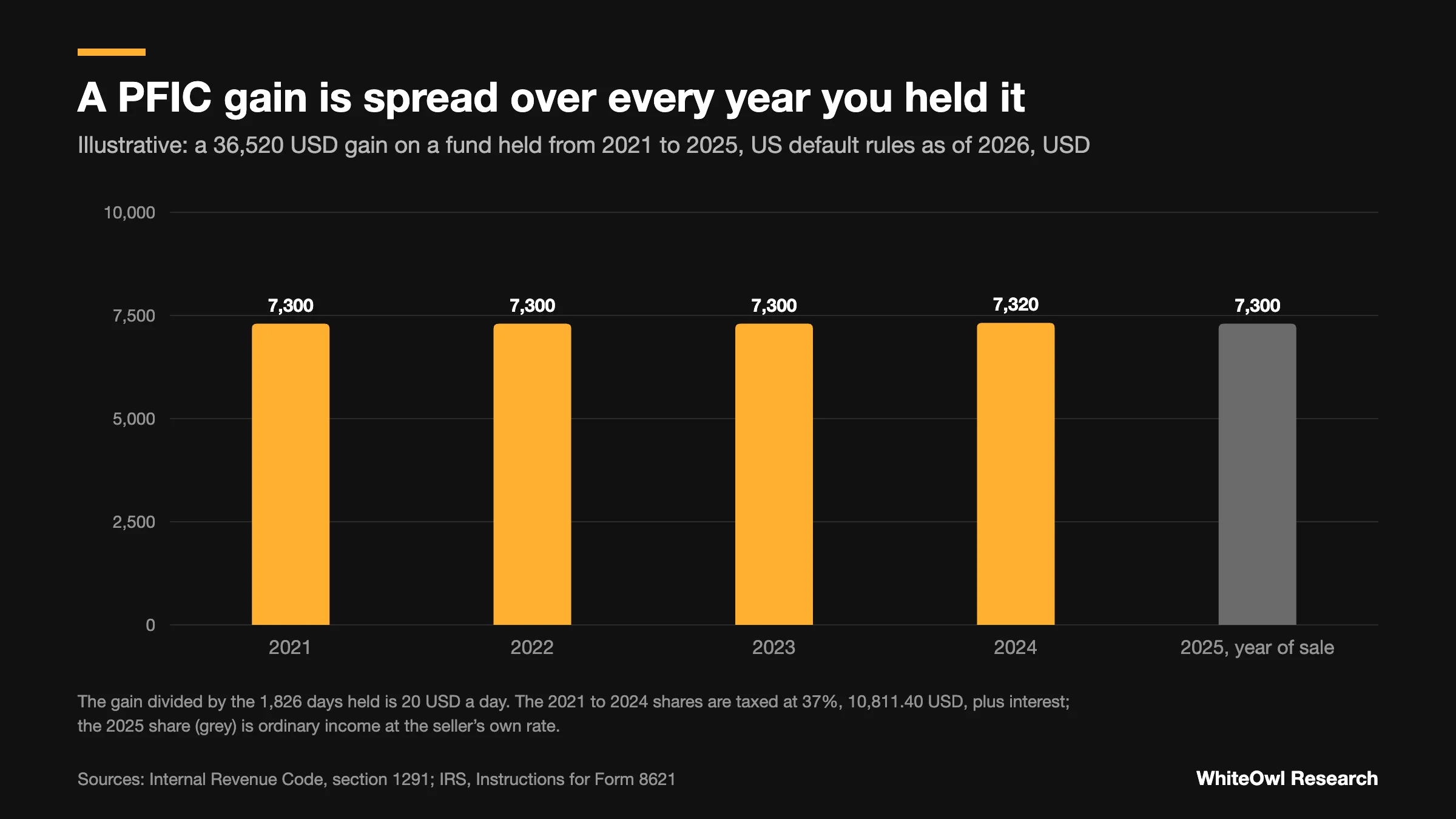
How the default rules spread a gain over every year held.
The two elections: qualified electing fund and mark to market
Two elections replace the default with tax each year. Each is made fund by fund on the US return and continues in later years.
- Qualified electing fund (QEF). Each year you include your share of the fund's ordinary earnings as ordinary income and your share of its net capital gain as long-term capital gain, whether or not the fund pays them out. The fund must give you a PFIC Annual Information Statement each year with your share, or enough to calculate it; without one, there is no QEF. Made for the first year you hold the fund, the election keeps the default rules away; made later, it can be paired with a deemed sale election, which taxes the gain to that date as an excess distribution.
- Mark to market. Only for marketable stock: shares regularly traded on an exchange registered with the US Securities and Exchange Commission or on a foreign exchange that meets the regulations' conditions, and certain funds redeemable at net asset value. Each year, any rise in value at year end above your adjusted cost is ordinary income; a fall is deductible only up to gains included in earlier years. Made after the first year you hold the fund, the election's first year is taxed under the default rules as if you sold at year end.
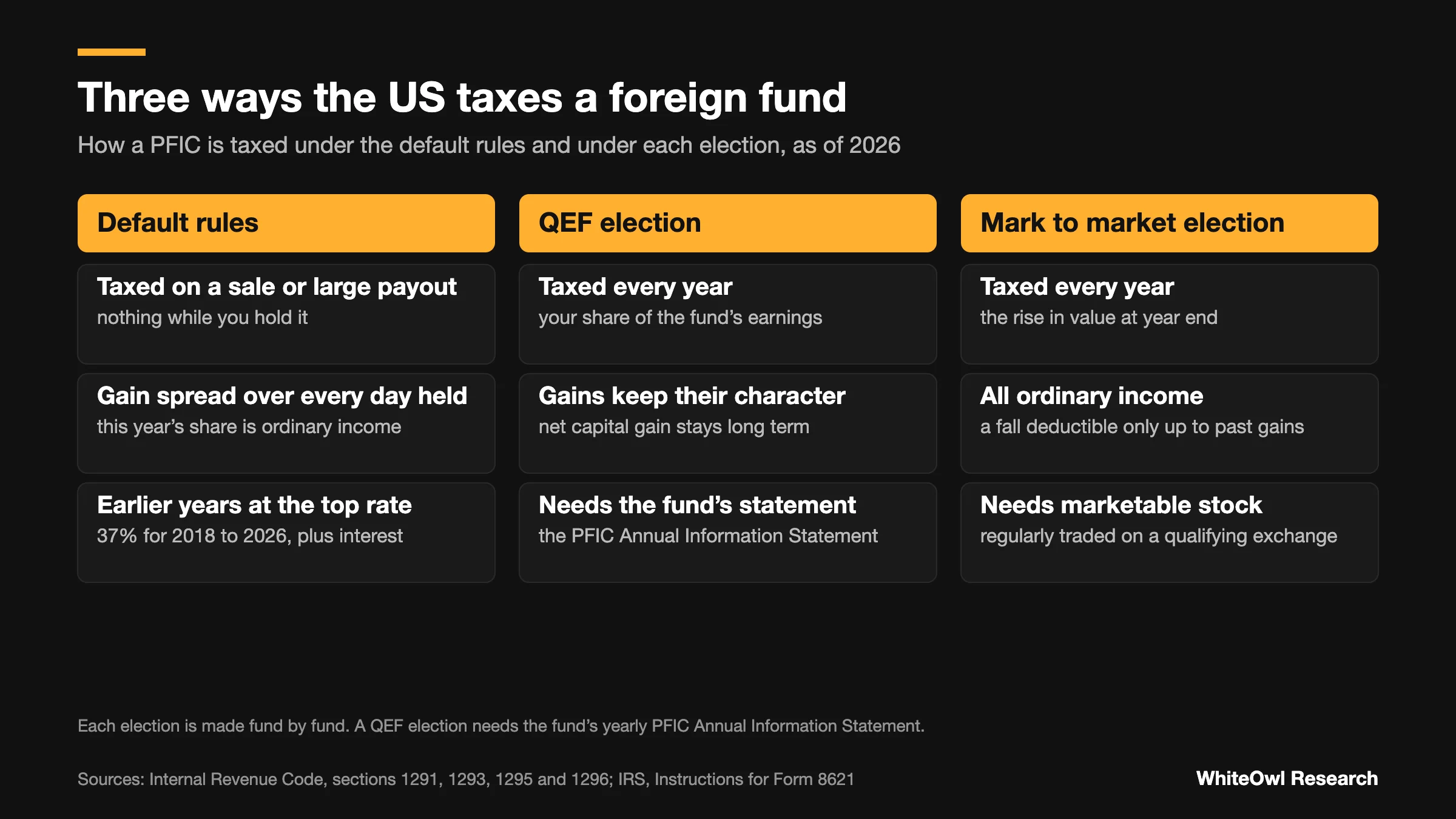
The three ways a foreign fund can be taxed.
Reporting: Form 8621 and the 25,000 USD exception
Form 8621 is the information return a US shareholder of a PFIC attaches to the yearly US return, one per fund: the shares and their value, any excess distribution or gain and its tax, and any election.
As of 2026, you generally need no Form 8621 for a section 1291 fund in a year when, on the last day of your tax year, all your PFIC shares together are worth 25,000 USD or less (50,000 USD on a joint return) and you had no excess distribution or gain from that fund. A fund held only through another PFIC has its own 5,000 USD limit. The exception does not cover a fund under a QEF or mark to market election.
When a required Form 8621 is not filed, the time the IRS has to assess tax on the return stays open until three years after the information is provided; with reasonable cause, only the related items stay open. For years of missed returns, see accidental Americans and streamlined filing.
Accounts where the rules apply differently
- US tax-exempt accounts. A US person who holds a foreign fund through an IRA, a 401(k) or other qualified plan, a 403(b) or 457(b) plan, a 529 plan, a Coverdell education savings account or an ABLE account is not treated as the fund's shareholder under the PFIC rules, and files no Form 8621 for it.
- RRSPs and RRIFs. Article XVIII(7) of the Canada-United States tax convention lets a US citizen or resident defer US tax on income accruing in a Canadian retirement plan until it is paid out, and Revenue Procedure 2014-55 made the deferral automatic for an eligible individual (broadly, one who has filed every required US return and not reported the plan's undistributed income). The PFIC regulations add that a member of a plan a treaty treats as a pension fund, taxed only on what it pays out, files no Form 8621 for funds in it, so Canadian funds in an RRSP or RRIF are generally neither taxed nor reported under the PFIC rules while the deferral applies. See your RRSP after leaving Canada.
- TFSAs. The IRS has not said how the PFIC rules apply to funds held in a TFSA, and neither the list of US tax-exempt accounts nor the treaty rule for pension funds names it. See the TFSA as a non-resident.
The choices an American abroad has
Three kinds of holdings stay outside the default rules, each with its own trade-offs (described here, not recommended):
- US-domiciled funds. A fund organized in the United States is not a foreign corporation, so it is not a PFIC. For a resident of Canada, a US fund held outside an RRSP or TFSA is specified foreign property, reported to the Canada Revenue Agency on Form T1135 (the foreign income verification statement) when the total cost of such property is more than 100,000 CAD at any time in the year.
- Shares of individual companies. A foreign company that runs an operating business is generally not a PFIC, while a holding company whose assets are mostly cash or investments can be. Shares of US companies are never PFICs, since the rules reach only foreign corporations.
- Funds that provide a PFIC Annual Information Statement. For such a fund, a QEF election can apply from the first year you hold it, and you are taxed each year on your share of its earnings and gains, paid out or not.
The figures that matter
The tests, rates and thresholds that decide how a PFIC is taxed and reported, as of the 2026 tax year. Sources: Internal Revenue Code, Treasury regulations, IRS and Canada Revenue Agency, listed below.
| Rule | Figure |
|---|---|
| Income test: share of gross income that is passive (%) | 75 |
| Asset test: average share of assets that are passive (%) | 50 |
| Distributions above this share of the 3-year average are excess (%) | 125 |
| Rate on each earlier year's share, 2018 to 2026 (%) | 37 |
| Highest rate on most long-term capital gains, 2025 (%) | 20 |
| Form 8621 exception, all PFIC shares, single return (USD) | 25,000 |
| Same, joint return (USD) | 50,000 |
| Fund held only through another PFIC (USD) | 5,000 |
| Assessment stays open after missing information is provided (years) | 3 |
| Canada, foreign property report: total cost above (CAD) | 100,000 |
How WhiteOwl helps
The default rules need each fund's dates, costs and distributions for every year you held it, and an election needs each year's fund statement. WhiteOwl keeps your actual documents from one year to the next, so that history is on file when a fund is sold. WhiteOwl gathers your documents, organizes your file, finds the issues and runs the numbers. A licensed advisor reviews, decides and files. See how it works.
FAQ
What is a PFIC?
A passive foreign investment company is a foreign corporation with 75% or more of its gross income passive, or at least 50% of its assets producing passive income. As of 2026, mutual funds and ETFs organized outside the United States generally meet these tests for a US investor.
Is a Canadian ETF a PFIC?
Generally yes, for a US citizen or green card holder: it earns investment income and is generally treated as a corporation for US tax even when it is a trust under Canadian law. Inside an RRSP or RRIF, the treaty deferral and the reporting rules generally keep it out of yearly PFIC tax and filing.
Do I have to file Form 8621 for every PFIC?
One form per fund, in each year one is required. As of 2026, a fund under the default rules needs none in a year when all your PFIC shares are worth 25,000 USD or less at year end (50,000 USD on a joint return) and you had no excess distribution or gain from it.
Are foreign funds in an IRA or 401(k) subject to the PFIC rules?
No. As of 2026, a US person who holds a foreign fund through an IRA, a qualified plan such as a 401(k), a 403(b) or 457(b) plan, a 529 plan or an ABLE account is not its shareholder under the PFIC rules and files no Form 8621 for it.
Sources
- IRS, Instructions for Form 8621 (Rev. December 2025) · About Form 8621 · Publication 54, tax guide for US citizens and resident aliens abroad · Topic 409, capital gains and losses · tax year 2026 inflation adjustments
- Internal Revenue Code section 1291 · section 1293 · section 1295 · section 1296 · section 1297 · section 1298 · section 954 · section 6501
- Treasury regulations section 1.1291-1 · section 1.1295-1 · section 1.1296-2 · section 1.1298-1 · section 301.7701-3 · section 301.7701-4
- IRS, Revenue Procedure 2014-55, Canadian retirement plans · IRS, Canada tax treaty documents
- Canada Revenue Agency, questions and answers about Form T1135
This article is general information, not personalized tax advice. Consult a qualified cross-border tax professional about your situation.
Related reading
QSBS in 2026: the qualified small business stock exclusion for founders who live abroad or move
As of 2026, QSBS lets a US taxpayer exclude up to all of the gain on qualifying startup shares from federal income. What it does for founders abroad, movers and Canadians.
By WhiteOwl · Nov 11, 2026
United States exit tax: who owes it when you give up citizenship or a green card in 2026
As of 2026, the US exit tax falls on covered expatriates. Who they are, how the deemed sale and the 910,000 USD exclusion work, and what Canada does when you renounce.
By WhiteOwl Research · Oct 29, 2026
TFSA for non-residents: what happens to your account when you leave Canada
You can keep a TFSA after leaving Canada and it stays tax-free there. As of 2026, contributing as a non-resident costs 1% a month, and the United States taxes the account.
By WhiteOwl Research · Oct 23, 2026