
By WhiteOwl · November 11, 2026 · 9 min read
In short: As of 2026, qualified small business stock (QSBS) lets a US taxpayer exclude part or all of the gain on original-issue shares of a US C corporation from federal income, up to a per-company cap. Shares acquired after July 4, 2025 qualify after three years for 50%, rising to 100% at five. Another country can still tax the gain.
Why it matters
For a founder, QSBS can decide whether selling the company carries federal tax at all: on shares acquired after July 4, 2025, it can cover 15,000,000 USD of gain per company, or more. But it is a US rule claimed on a US return. A founder who lives abroad, moves before selling, or is Canadian with a Delaware company can find that it saves nothing, or that another country taxes the gain anyway.
What makes a share QSBS
QSBS is the exclusion in section 1202 of the Internal Revenue Code. In the United States, as of 2026, a share qualifies when all of these hold:
- A US C corporation. The company is a domestic corporation taxed as a C corporation, that is, taxed separately from its owners. A company formed outside the United States does not qualify.
- Original issue. You received the shares from the company itself, directly or through an underwriter, for money, property other than stock, or services. Shares bought from another shareholder do not count, though shares received as a gift or on a death keep the giver's status and holding period.
- Small when issued. The company's gross assets (cash plus the tax cost of other property) were no more than 75,000,000 USD before and immediately after the issue, for shares issued after July 4, 2025, and 50,000,000 USD for shares issued earlier.
- An active business. During substantially all of your holding period, at least 80% of the company's assets by value are used in a qualified business.
Qualified businesses exclude services in fields such as health, law, engineering, accounting, consulting and financial services, any business whose main asset is its employees' skill or reputation, and banking, investing, farming, mining, hotels and restaurants. Software and product companies are not on these lists. The holder must be a taxpayer other than a corporation, such as an individual or a trust.
How much is excluded after the July 2025 change
Public Law 119-21, enacted on July 4, 2025, changed the exclusion for shares acquired after that date; as of 2026 it is law, not a proposal. For those shares, the exclusion is 50% of the gain at three years, 75% at four and 100% at five years or more, and nothing before three years. No share acquired under the new rules reaches its first tier before July 2028.
Shares acquired on or before July 4, 2025 keep the earlier rule: nothing is excluded until they have been held more than five years, and then 100% for shares acquired after September 27, 2010 (75% or 50% for shares acquired earlier).
The gain excluded on one company's shares in a year is capped at the larger of 15,000,000 USD for shares acquired after July 4, 2025 (10,000,000 USD for earlier shares), less gain excluded in earlier years, or 10 times the cost of the shares sold that year. Gain excluded on older shares of the same company uses up the new cap. The 15,000,000 USD cap and the 75,000,000 USD asset limit rise with inflation for taxable years beginning after 2026.
The part of the gain that is not excluded, such as the other half at three years, is taxed at a federal rate of no more than 28%, before any net investment income tax.
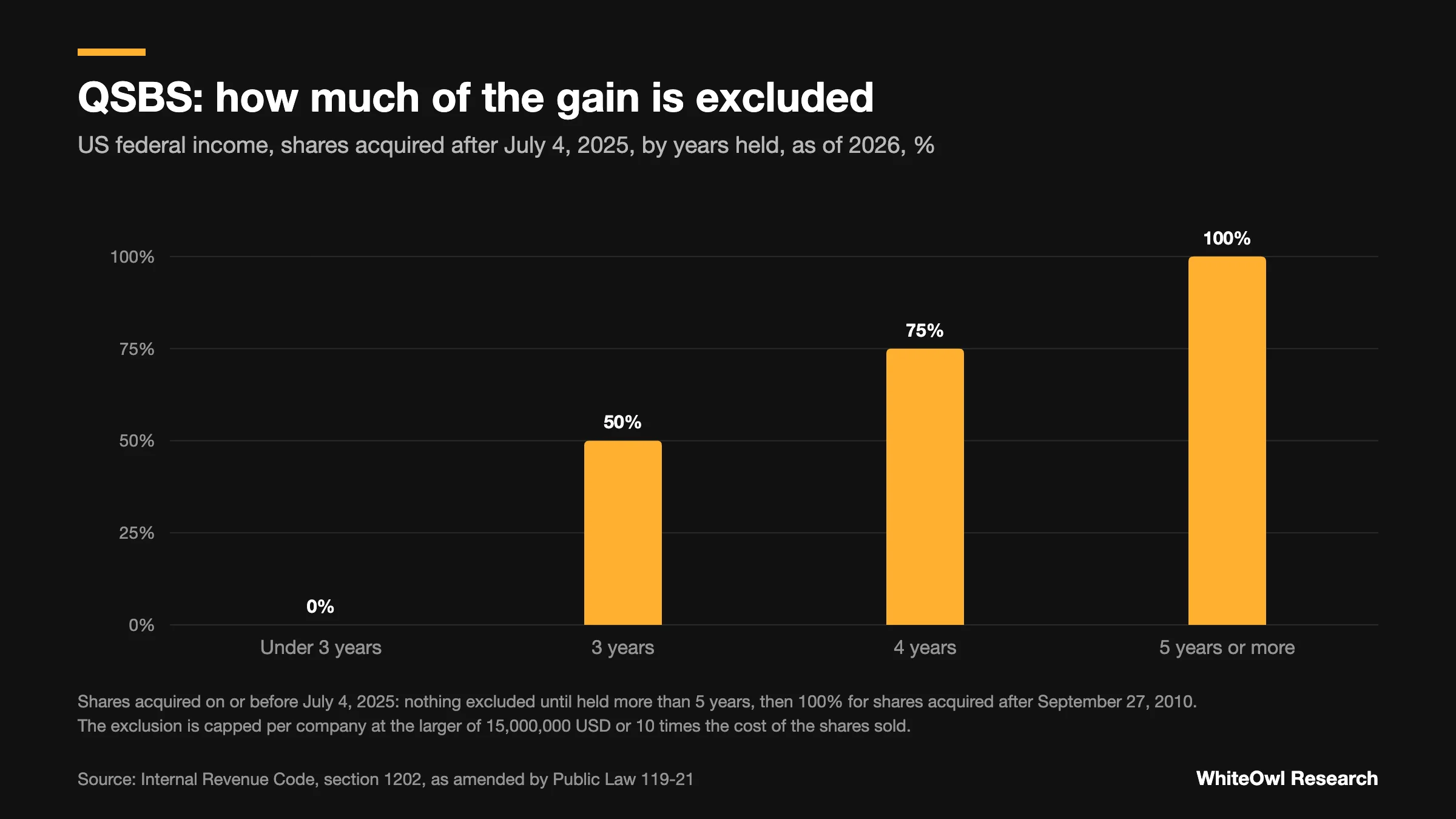
How much of the gain is excluded, by years held.
Who can claim it: people the United States taxes
The exclusion removes gain from US federal income, so it matters only to someone the United States would otherwise tax on that gain. As of 2026, US citizens and resident aliens are taxed on worldwide income wherever they live.
A non-resident alien, someone who is neither a US citizen nor a US resident, is generally not taxed on US capital gains unconnected with a US business, unless present in the United States 183 days or more in the year. The other exception is gain on shares of a US real property holding corporation (one whose US real estate is at least half the value of its real estate and business assets), which is taxed. So a founder who is neither a US citizen nor a US resident usually owes no US tax on selling Delaware shares, with or without QSBS.
Canadian founders with a Delaware company
For a founder who lives in Canada, is not a US citizen and holds shares of a Delaware company, a sale works this way as of 2026:
- The United States does not tax the gain. Under the Canada-United States tax convention, a gain on shares of a US company that is not a US real property holding corporation is taxable only where the seller lives.
- Canada taxes it. Residents are taxed on worldwide income, and half of a capital gain is included in income, measured in Canadian dollars at the exchange rates of the days you bought and sold.
- QSBS does not help. There is no US tax for it to reduce, and Canada has no rule that follows it.
- The Canadian exemption does not apply either. The lifetime capital gains exemption covers qualified small business corporation shares, which must be shares of a Canadian-controlled private corporation, and that must be a Canadian corporation, broadly one resident in Canada and incorporated there. A Delaware company is not.
So a founder in Toronto who sells Delaware shares in 2026 at a gain of 2,000,000 USD owes no US tax, and half of the gain, in Canadian dollars, is added to their 2026 Canadian income, taxed at federal and Ontario rates.
Founders of Canadian companies have the counterpart: for 2025 dispositions, the lifetime capital gains exemption on qualified small business corporation shares covered up to 1,250,000 CAD of gains.
US citizens living abroad
A US citizen is taxed on worldwide income and files a US return from abroad (see US taxes when you live abroad). Section 1202 has no condition about where the holder lives, so a citizen abroad whose shares meet the tests can claim the exclusion on the US return.
In Canada, as of 2026, a US citizen resident there is taxed on the gain like any other resident. Canada credits only foreign tax actually paid, and for a US citizen the treaty limits that credit to the US tax a non-citizen would pay, which on shares of a US company that is not a real property holding corporation is none; the United States credits the Canadian tax instead. The exclusion therefore lowers the US side of the bill and leaves the Canadian tax as it is. See also dual citizenship taxes and, for founders who learn late that they are US citizens, accidental Americans.
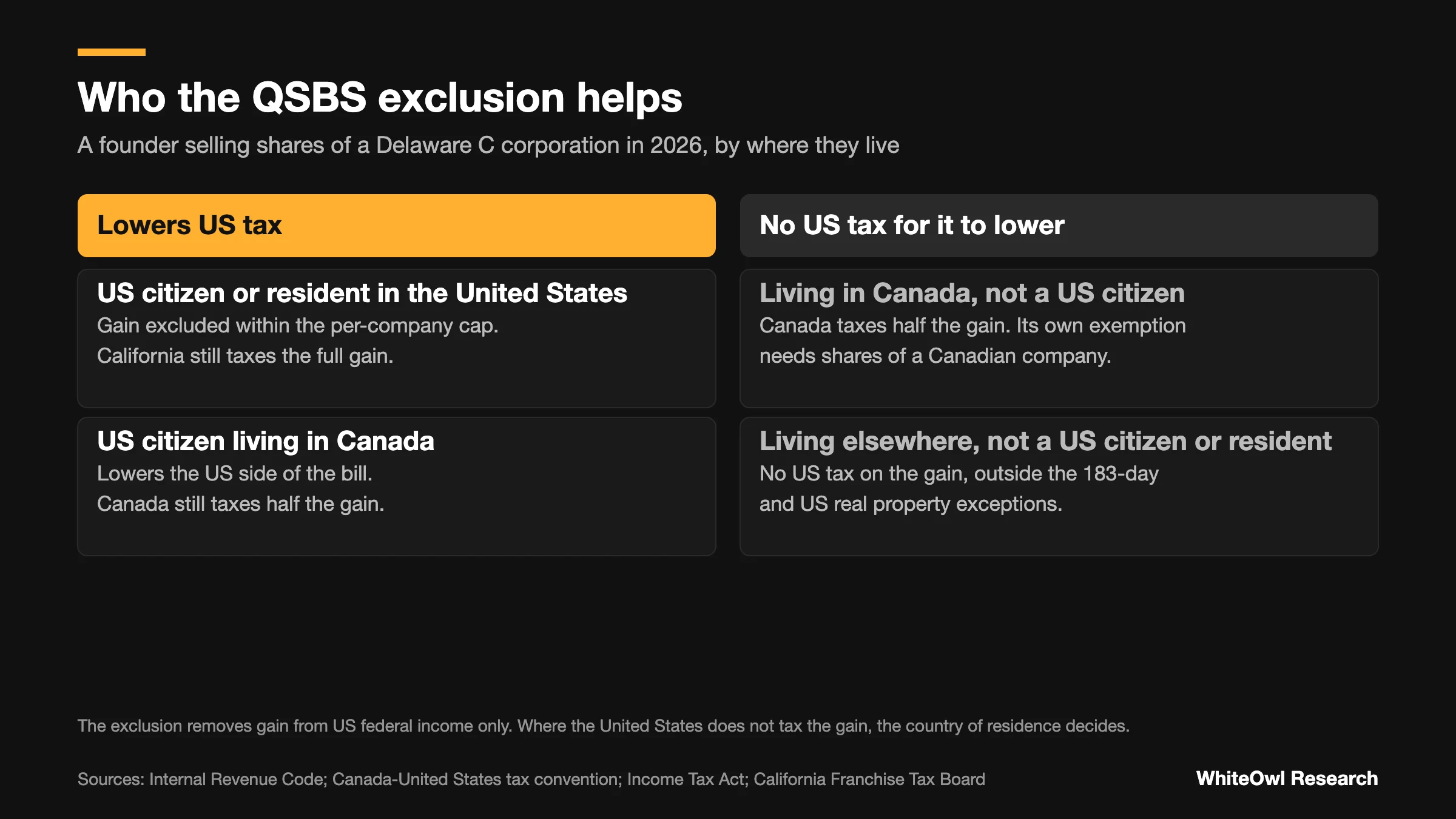
Who the exclusion helps, by where the founder lives.
Moving to the United States with your shares
Section 1202 does not tie the holding period or the original issue test to where you lived. Read that way, the holding period runs from the day you acquired the shares, and the exclusion is claimed by whoever is a US taxpayer in the year of sale: a founder who received Delaware shares in Canada and later moved counts the Canadian years.
When you leave Canada, you are treated as having sold most of your property, Delaware shares included, at market value on the day you leave, and half of the gain to that date is taxed. Canadian law can reduce that tax by tax a treaty country later charges on the gain that built up in Canada, but where the US exclusion leaves no US tax, there is nothing to deduct. The Canadian tax on growth before the move stays.
The treaty election covered in Canada's departure tax treats you, for US purposes, as having sold and bought back the shares at their departure value, which raises your US cost. Neither the treaty nor the US Treasury's explanation of it says how that deemed purchase fits the original issue and holding period rules, and we found no IRS guidance on it: a choice to settle with an advisor before the first US return.
Leaving the United States before you sell
A founder who is not a US citizen and stops being a US resident is generally outside US tax on a later sale, subject to the exceptions above, so the exclusion has nothing to remove and the new country decides. Canada, for example, treats a new resident as having acquired most property at market value on arrival, so it taxes only growth after the move. Giving up citizenship or a long-held green card can bring the US exit tax (other countries: exit taxes around the world).
State tax: California does not follow the exclusion
For the 2025 tax year, California follows the Internal Revenue Code as of January 1, 2025 in general, but not the QSBS exclusion: its instructions tell residents to report the entire gain. A founder living in California pays California tax on the full gain even when the federal exclusion is 100%. Other states set their own rules.
The figures that matter
The percentages, caps and limits that decide QSBS for a founder, with the Canadian figures beside them, as of the 2026 tax year. Sources: Internal Revenue Code as amended by Public Law 119-21, IRS, Income Tax Act and Canada Revenue Agency, listed below.
| Rule | Figure |
|---|---|
| Exclusion, shares acquired after July 4, 2025, held 3 years (%) | 50 |
| Same, held 4 years (%) | 75 |
| Same, held 5 years or more (%) | 100 |
| Exclusion, shares acquired September 28, 2010 to July 4, 2025, held more than 5 years (%) | 100 |
| Per-company cap, shares acquired after July 4, 2025 (USD) | 15,000,000 |
| Per-company cap, shares acquired on or before July 4, 2025 (USD) | 10,000,000 |
| Alternative cap, as a multiple of the cost of the shares sold | 10 |
| Gross assets limit, shares issued after July 4, 2025 (USD) | 75,000,000 |
| Gross assets limit, shares issued on or before July 4, 2025 (USD) | 50,000,000 |
| Assets used in a qualified business, minimum (%) | 80 |
| Top federal rate on the part of an eligible gain not excluded (%) | 28 |
| Days in the United States from which a non-resident's capital gains are taxed | 183 |
| Canada: share of a capital gain included in income (%) | 50 |
| Canada: lifetime capital gains exemption, 2025 dispositions (CAD) | 1,250,000 |
How WhiteOwl helps
Shares that cross a border need an advisor who knows both the US exclusion and the other country's rules, a narrow combination. WhiteOwl matches each founder with an advisor whose specialties and countries fit the case. WhiteOwl gathers your documents, organizes your file, finds the issues and runs the numbers. A licensed advisor reviews, decides and files. See how it works.
FAQ
What is QSBS?
QSBS, or qualified small business stock, is a share of a US C corporation acquired at original issue while the company was small and ran a qualified active business. As of 2026, a US taxpayer other than a corporation can exclude part or all of the gain on it from federal income, up to a per-company cap.
How long do I need to hold QSBS?
For shares acquired after July 4, 2025: three years for a 50% exclusion, four for 75% and five for 100%. Earlier shares must be held more than five years, and then 100% is excluded for shares acquired after September 27, 2010.
Can a non-US citizen claim QSBS?
Yes, if they are a US resident in the year of sale, because the exclusion is for US taxpayers. A non-citizen who does not live in the United States is generally not taxed there on the gain at all, unless present 183 days or more that year or the company is a US real property holding corporation. Their own country may tax the gain.
Does QSBS apply to Canadian companies?
No. The company must be a domestic US corporation. Founders of Canadian-controlled private corporations look instead to Canada's lifetime capital gains exemption, which covered up to 1,250,000 CAD of gains on 2025 dispositions; that exemption, in turn, does not apply to shares of a Delaware company.
Does California allow the QSBS exclusion?
No. For the 2025 tax year, California's instructions say it does not conform to the federal exclusion, so a resident reports the entire gain. Other states set their own rules.
Sources
- Office of the Law Revision Counsel, 26 U.S.C. 1202, partial exclusion for gain from certain small business stock · 26 U.S.C. 1, rates on capital gains · 26 U.S.C. 57, items of tax preference · 26 U.S.C. 871 · 26 U.S.C. 897 · 26 U.S.C. 877A
- GovInfo, Public Law 119-21 of July 4, 2025, section 70431
- IRS, Publication 519 (2025), US tax guide for aliens · US citizens and resident aliens abroad · 2025 instructions for reporting capital gains and losses
- California Franchise Tax Board, 2025 instructions for California capital gain or loss adjustment
- Department of Finance Canada, Canada-United States tax convention (consolidated text) · US Department of the Treasury, technical explanation of the 2007 protocol
- Canada Revenue Agency, Guide T4037, capital gains 2025 · tax rates and income brackets (2026) · Income Tax Folio S5-F2-C1, foreign tax credit
- Justice Laws, Income Tax Act section 38 · section 110.6 · section 125 · section 89 · section 248 · section 128.1 · section 126 · section 261
This article is general information, not personalized tax advice. Consult a qualified cross-border tax professional about your situation.
Related reading
PFIC rules for Americans abroad: how the US taxes foreign funds and ETFs in 2026
A foreign mutual fund or ETF held by an American abroad is usually a PFIC. How the default rules, the two elections and the yearly report work, as of 2026.
By WhiteOwl · Nov 11, 2026
Inheritance tax in Canada: what is taxed when someone dies, and across the US border
Canada has no inheritance tax: the final return taxes the gains at death. What changes when an heir lives in the US or a parent owns a Florida condo or US shares, as of 2026.
By WhiteOwl Research · Oct 29, 2026
United States exit tax: who owes it when you give up citizenship or a green card in 2026
As of 2026, the US exit tax falls on covered expatriates. Who they are, how the deemed sale and the 910,000 USD exclusion work, and what Canada does when you renounce.
By WhiteOwl Research · Oct 29, 2026