In short: As of 2026, when you sell a UK home after moving to the United States, the United Kingdom taxes the gain at 18% or 24%, counted from 5 April 2015 if you owned it then, after relief for a main home. The United States taxes the whole gain in dollars, after its home sale exclusion, and credits UK tax.
Why it matters
The two countries do not measure the same gain. The United Kingdom counts pounds, and stops treating the place as your home nine months after you move out unless an absence relief applies. The United States counts dollars from the day you bought, and keeps its exclusion for three years after you move out. The sale date, the exchange rates on two dates and a mortgage in pounds can each change what you owe.
The UK side: a non-resident is taxed on the gain since 5 April 2015
Once you are not resident in the United Kingdom, it still taxes your gains on UK land and property. For a home you owned on 5 April 2015, the standard method treats it as bought at its market value on that date, a step called rebasing, so only the later gain counts. You can elect instead to split the whole gain by time, or to use the whole gain, which HMRC says may only be worth considering for a loss. A home bought later has no rebasing. The valuation can be made at the time of the sale.
The same rules cover a sale in the overseas part of the tax year in which you leave. If you return to live in the UK within five years, the temporary non-residence rules can bring the gain that these rules left out into UK tax for the year you return.
How much UK relief the home still gets
Private Residence Relief (the UK relief for a main home) removes the share of the gain that matches the time the home was your only or main residence. With rebasing, that time is counted from 6 April 2015 only. For a tax year in which neither you nor your spouse or civil partner is UK resident, the home counts as occupied only if you spend at least 90 days in it (a spouse's or civil partner's days count too) and you nominate it when you report the sale. The last nine months of ownership always qualify if the home was your main residence at some point.
Some absences are treated as occupation: up to three years for any reason, up to four years when your place of work keeps you away, and any length while you, or the spouse or civil partner you live with, work in an employment performed wholly outside the UK. The three-year absence counts only if you live in the home again afterwards; the work-related ones can also count when your place of work prevents your return. HMRC's manual adds that if you have another home during the absence, you may need to nominate the UK home as your main residence.
UK rates and the 60-day report
For the 2026-27 tax year (6 April 2026 to 5 April 2027), the rates are 18% on gains that fit within the basic rate band of 37,700 GBP once your UK taxable income is counted, and 24% on the rest. Each owner has an annual exempt amount of 3,000 GBP and reports their own share of a jointly owned home.
A non-resident reports the sale to HMRC within 60 days of completion, through a Capital Gains Tax on UK property account (HMRC's online return for property sales), and pays any tax within the same 60 days. The report is required even when relief covers the whole gain or the sale made a loss.
The US side: the whole gain, in dollars
The United States taxes its citizens and resident aliens (people who hold a green card or meet its days test) on worldwide income, so the sale goes on the US return wherever the home is. For someone who is not a US citizen, a sale completed before their US residency starting date falls outside US tax. US citizens are taxed throughout: see dual citizenship taxes and Americans moving to the UK.
The US rules for a home have no equivalent of rebasing: the IRS starts from what you paid. Each amount is converted at the exchange rate on its own date, so the gain is the sale price in dollars on the sale date minus the cost in dollars on the purchase date. Take a home bought for 300,000 GBP and sold for 600,000 GBP. If the pound fell from 1.50 USD to 1.30 USD between the two dates, the US gain is 330,000 USD; if it stayed at 1.50 USD, 450,000 USD; if it rose from 1.30 USD to 1.50 USD, 510,000 USD.
The home sale exclusion removes up to 250,000 USD of gain, or 500,000 USD on a joint return, if you owned the home and used it as your main home for at least two of the five years ending on the sale date. Neither the law nor IRS Publication 523 sets a condition on where the home is. That leaves three years after you move out. If you rented the home out, gain equal to the depreciation allowed after May 6, 1997 cannot be excluded.
Gain above the exclusion is long term if you owned the home for more than one year. For 2026, a single filer pays 0% up to 49,450 USD of taxable income, 15% up to 545,500 USD and 20% above; on a joint return the thresholds are 98,900 USD and 613,700 USD. A 3.8% net investment income tax can be added when income passes 200,000 USD, or 250,000 USD on a joint return.
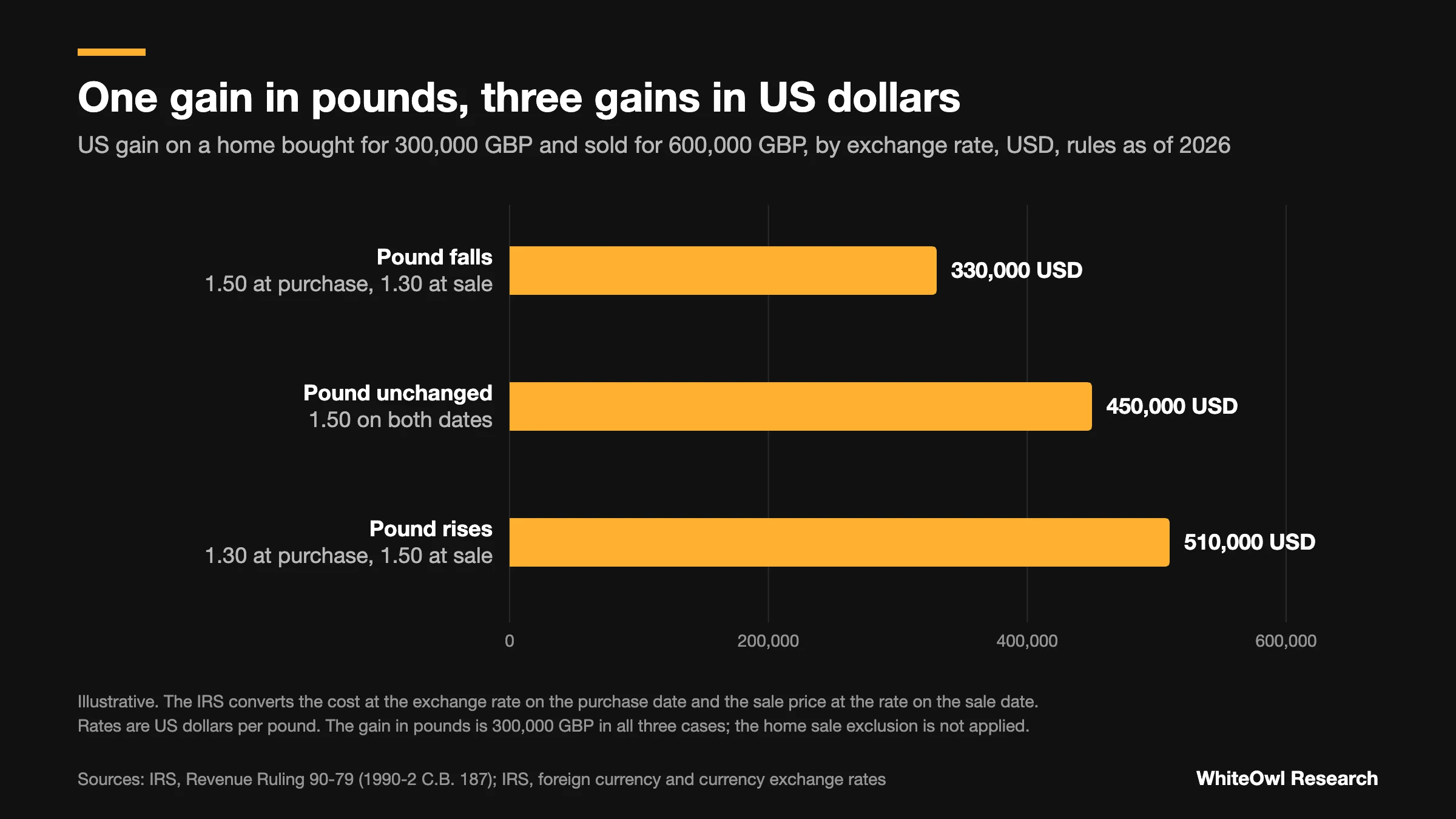
The same gain in pounds gives three different US gains.
A mortgage in pounds is a separate US transaction
In Revenue Ruling 90-79 (1990), the IRS treats borrowing and repaying a foreign currency mortgage as a transaction separate from buying and selling the home, and the repayment as a closed, taxable transaction. A loan of 200,000 GBP taken when the pound was 1.50 USD brought in 300,000 USD; repaying it at 1.30 USD takes 260,000 USD, a gain of 40,000 USD. Under the ruling, a gain on one and a loss on the other cannot be set against each other, and the exclusion applies to gain from the sale of the home itself. In the ruling's own facts the foreign currency had risen, and the loss on repayment was personal and could not be deducted.
The borrower in the ruling was a US citizen when the loan was taken. The ruling does not address a loan taken out before the borrower became a US resident, and it does not say whether a gain on repayment is ordinary income or capital gain.
Who gives the credit: the US-UK treaty
The income tax treaty between the two countries lets the UK tax gains on real property in the UK (Article 13), and lets the United States tax its citizens and residents as if the treaty did not exist (Article 1). Relief comes from Article 24: the United States gives a US citizen or resident a credit for UK tax, UK capital gains tax counts as an income tax for that credit, and a gain the UK may tax is treated as coming from UK sources.
The credit follows US law: it cannot exceed the US tax on foreign income of the same category for the year. When the exclusion removes the whole gain from the US return, there is no US tax on it to credit against. Unused UK tax can be carried back one year and forward ten, and only against US tax on other foreign income of that category. UK tax is converted at the exchange rate on the day you pay it.
A worked example: a London flat sold from the United States
An owner bought a flat in London on 6 October 2010 for 300,000 GBP and lived in it until 5 August 2023, when they retired to the United States. They did not live in it again, and no absence relief applies. On 5 April 2015 the flat was worth 466,000 GBP. The sale completes on 5 June 2026 for 600,000 GBP after selling costs. Assumed: 1.50 USD to the pound on the purchase date, 1.30 USD on the sale date and when the UK tax is paid, no UK income in 2026-27, and a single US filer with 70,000 USD of other taxable income.
For this owner, in the 2026-27 UK tax year and the 2026 US tax year, the UK taxes 22,000 GBP of the gain and the United States taxes 80,000 USD of it. Sources: HMRC, legislation.gov.uk and IRS, listed below.
| Step | United Kingdom (GBP) | United States (USD) |
|---|---|---|
| Cost each country starts from | 466,000 | 450,000 |
| Sale price | 600,000 | 780,000 |
| Gain before relief | 134,000 | 330,000 |
| Relief for the home | 109,000 | 250,000 |
| Annual exempt amount | 3,000 | — |
| Gain taxed | 22,000 | 80,000 |
| Tax, at 18% in the UK and 15% in the United States | 3,960 | 12,000 |
| Credit for the UK tax | — | 5,148 |
| US federal income tax after the credit | — | 6,852 |
The UK counts 134 months from 6 April 2015 to the sale. The owner lived in the flat for 100 of them and the last nine always qualify, so 25 months, or 25,000 GBP, remain. After the annual exempt amount, 22,000 GBP falls within the basic rate band.
In pounds the gain since purchase is 300,000 GBP, or 390,000 USD at the sale date rate. The US gain is 330,000 USD, because the cost was converted when the pound was higher. The owner lived in the flat for 26 of the 60 months before the sale, so the exclusion applies. With that other income, the 80,000 USD is taxed at 15% and the 3.8% tax does not apply. The UK tax of 3,960 GBP is 5,148 USD, less than the US tax on the same gain, so the credit covers it in full. State income tax is left out.
A married couple filing jointly who both met the two-year test could exclude the whole 330,000 USD, leaving no US tax on the gain for the UK tax to offset.
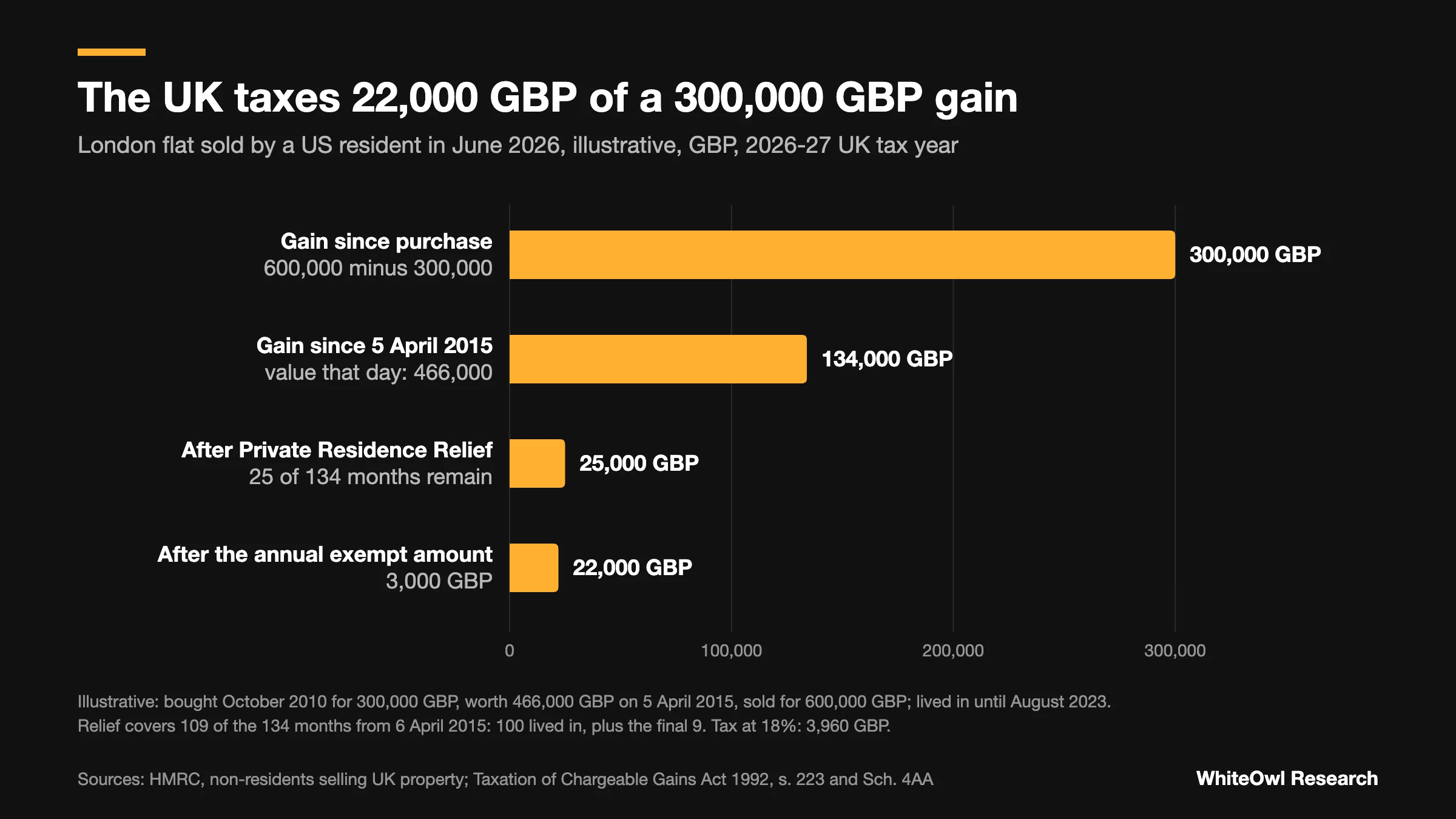
The UK taxes 22,000 GBP of a 300,000 GBP gain in this example.
Three dates that change the result
Before US residency starts. For someone who is not a US citizen, the United States does not tax a sale completed before that date. A sale made while you are still UK resident and living in the home has the ordinary UK relief for a home lived in throughout.
Within nine months of moving out. The UK's final period covers the gap, so a home that was your main residence for the whole period counted is still fully relieved. A non-resident still files the 60-day report.
Within three years of moving out. The full US exclusion is still available, while the UK taxes a share that grows with each month beyond the final nine. After three years, the two-year test fails and the dollar gain since purchase is taxable in the United States.
For a UK pension left behind, see a UK pension when you live in the United States.
The figures that matter
The rates, thresholds and periods that decide the tax on the sale, for the 2026-27 UK tax year and the 2026 US tax year. Sources: HMRC, legislation.gov.uk, IRS and the US-UK income tax treaty, listed below.
| Rule | Figure |
|---|---|
| UK rate on gains within the basic rate band, 2026-27 (%) | 18 |
| UK rate on gains above the basic rate band, 2026-27 (%) | 24 |
| UK basic rate band, 2026-27 (GBP) | 37,700 |
| UK annual exempt amount for each owner, 2026-27 (GBP) | 3,000 |
| Date the UK gain is counted from, for a home owned on that date | 5 April 2015 |
| Time in the home that makes a non-resident tax year count for UK relief (days) | 90 |
| Final period of ownership that always qualifies for UK relief (months) | 9 |
| Time to report the sale to HMRC and pay, from completion (days) | 60 |
| US home sale exclusion, single filer (USD) | 250,000 |
| US home sale exclusion, joint return (USD) | 500,000 |
| Use as a main home needed in the five years before the sale (years) | 2 |
| Taxable income where the US 15% rate on long-term gains starts, single filer, 2026 (USD) | 49,450 |
| Taxable income where the US 20% rate on long-term gains starts, single filer, 2026 (USD) | 545,500 |
| US net investment income tax (%) | 3.8 |
| US foreign tax credit carryback (years) | 1 |
| US foreign tax credit carryforward (years) | 10 |
How WhiteOwl helps
A sale years after a move depends on papers from long before it: the purchase contract, the value on 5 April 2015, the dates you lived in the home, the mortgage statements and the exchange rates on each date. WhiteOwl keeps your actual documents from one year to the next, so they are on file when the sale comes and both countries ask for them. WhiteOwl gathers your documents, organizes your file, finds the issues and runs the numbers. A licensed advisor reviews, decides and files. See how it works.
FAQ
Do I pay UK Capital Gains Tax if I sell my UK home while living in the United States?
You can. For the 2026-27 tax year, a non-resident is taxed at 18% or 24% on the gain, counted from 5 April 2015 if they owned the home then. Private Residence Relief removes the share for the time it was their main home, plus the last nine months of ownership.
Do I pay US tax when I sell a home in the UK?
Yes, if you are a US citizen or resident alien on the sale date, because both are taxed on worldwide income. The gain is measured in dollars from the original purchase. Up to 250,000 USD, or 500,000 USD on a joint return, can be excluded if you used the home as your main home for two of the five years before the sale.
How long do I have to tell HMRC about the sale?
A non-resident reports the sale within 60 days of completion and pays any Capital Gains Tax in the same period. The report is required even if no tax is due or the sale made a loss.
Can I claim the UK tax against my US tax?
Yes. Under Article 24 of the US-UK income tax treaty, the United States gives a credit for UK Capital Gains Tax. The credit is limited to the US tax on that foreign income, and unused UK tax can be carried back one year and forward ten.
Is the gain worked out in pounds or in dollars?
Both. The UK works in pounds. The United States converts the purchase price at the exchange rate on the purchase date and the sale price at the rate on the sale date, so the US gain can be larger or smaller than the gain in pounds.
Sources
- GOV.UK, tax if you live abroad and sell your UK home · HMRC, tell HMRC about Capital Gains Tax on UK property or land if you are not a UK resident · HMRC, work out your tax if you are a non-resident selling UK property or land
- GOV.UK, Capital Gains Tax rates · allowances · report and pay Capital Gains Tax on UK property · tax when you sell your home · living away from your home
- HMRC, helpsheet HS283, Private Residence Relief (2026) · helpsheet HS278, temporary non-residents (2026) · Capital Gains Manual CG64577 · CG64585 · CG64985 · CG65040 · CG65046 · CG65047 · CG65050
- legislation.gov.uk, Taxation of Chargeable Gains Act 1992, section 1A · section 222B · section 222C · section 223 · Schedule 4AA
- IRS, Publication 523, selling your home · Topic 701, sale of your home · Topic 409, capital gains and losses · Publication 519, US tax guide for aliens · Publication 551, basis of assets · Publication 514, foreign tax credit for individuals · Publication 525, taxable and nontaxable income
- IRS, foreign currency and currency exchange rates · questions and answers on the net investment income tax · Revenue Procedure 2025-32 · Revenue Ruling 90-79, Internal Revenue Cumulative Bulletin 1990-2, page 187
- United States Code, title 26, section 121 · section 862 · section 904 · section 988 · section 1012 · section 1411
- US Department of the Treasury, United States-United Kingdom income tax convention (2001) · 2002 protocol
This article is general information, not personalized tax advice. Consult a qualified cross-border tax professional about your situation.