In short: As of November 2026, an ISA is free of UK tax but not of US tax. A US citizen or green card holder living in the United Kingdom reports its interest, dividends and gains on the US return every year. Funds held in a stocks and shares ISA usually fall under the US rules for passive foreign investment companies.
Why it matters
For an American working in London, an ISA is the ordinary place to save, and the United Kingdom lets a resident pay in 20,000 GBP a year. What that saves depends on what is held inside. Cash and individual shares are taxed in the United States in the ordinary way, while a gain on a typical fund can be taxed at up to 37%, plus interest.
What the United Kingdom exempts in an ISA in 2026-27
In the United Kingdom, an ISA (Individual Savings Account) is open to anyone aged 18 or over who is resident there; nationality is not a condition. Interest, income and capital gains inside it are free of UK tax and are left off the UK tax return.
For the 2026-27 tax year (6 April 2026 to 5 April 2027), the limit is 20,000 GBP across four kinds: the cash ISA, the stocks and shares ISA, the innovative finance ISA and the Lifetime ISA, itself limited to 4,000 GBP. A Junior ISA, for a child under 18, has a separate limit of 9,000 GBP.
The Budget of 28 October 2026 kept the cash ISA limit at 20,000 GBP: regulations made earlier in 2026 to cut it to 12,000 GBP for savers under 65 from 6 April 2027 are to be revoked, and had not yet been on 11 November 2026. It also announced a First Time Buyer ISA from April 2029, in place of the Lifetime ISA for new savers, with legislation still to come. The move itself is covered in Americans moving to the UK.
Why the United States taxes it anyway
The United States taxes its citizens and resident aliens on their worldwide income wherever they live. No US rule exempts an ISA, and as of 11 November 2026 the IRS has published nothing that names the account.
The 2001 income tax convention between the two countries does not change this: its saving clause (Article 1, paragraph 4) lets the United States tax its citizens as if the convention had not come into effect. The exceptions to the clause include pension schemes (Article 18), and the notes exchanged with the convention list the occupational and personal pension schemes of the United Kingdom; the ISA, which dates from 6 April 1999, is not among them. Pensions are in a UK pension when you live in the United States.
Because the United Kingdom charges nothing on ISA income, there is no UK tax to credit. Outside an ISA, the United Kingdom would tax the same income first and the United States would credit that tax under Article 24.
A green card holder is taxed like a citizen, with one difference: one whom the convention's residence test makes a resident of the United Kingdom alone can claim to be taxed in the United States as a nonresident. US law then stops treating them as a lawful permanent resident for tax purposes, which for a green card held in at least 8 of the last 15 tax years brings in the US exit tax.
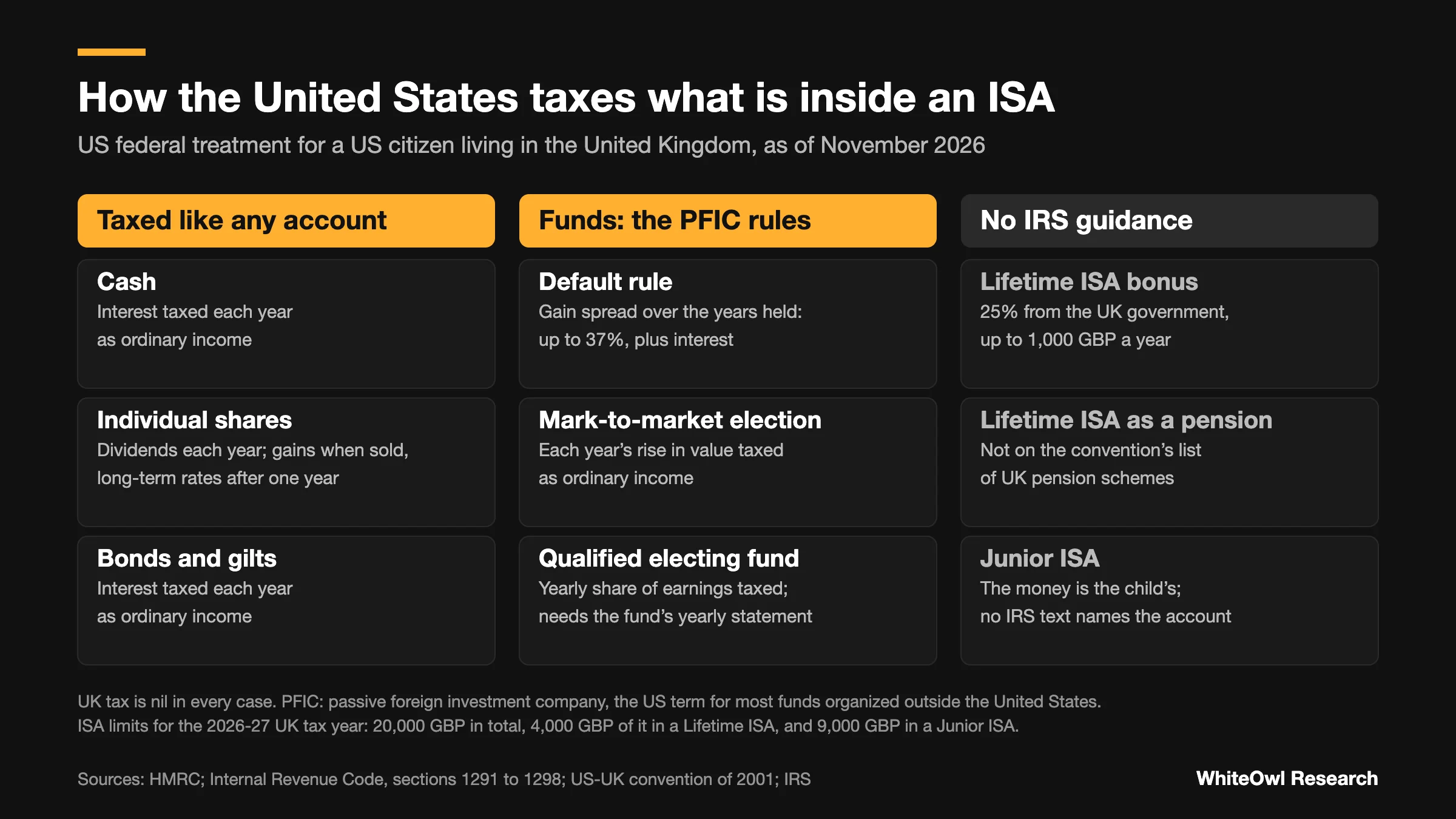
Cash and shares in an ISA are taxed in the United States like any account; funds are not.
A cash ISA: interest on the US return
Interest credited to a cash ISA is ordinary interest income on the US return for the year it is credited, converted into US dollars at the rate on the day it is received. It is investment income, so the foreign earned income exclusion does not cover it, and with no UK tax on it there is nothing for the foreign tax credit to use. Above 200,000 USD of income for a single filer, the 3.8% net investment income tax is added.
Take a UK higher-rate taxpayer with 2,000 GBP of interest in 2026-27, and suppose the US tax on it comes to 24%. In a cash ISA, the United States takes the equivalent of 480 GBP. In an ordinary account, the United Kingdom would take 40% of the 1,500 GBP above the 500 GBP personal savings allowance, or 600 GBP, and the US credit for it would cover the US tax. The ISA saves 120 GBP, not 600 GBP. Where the UK tax would be lower than the US tax, the ISA saves nothing, because the US tax is due either way.
The Budget also announced UK rates on savings interest of 24%, 44% and 49% from 6 April 2027, in Finance Bill 2026-27, which would widen that gap.
A stocks and shares ISA holding funds: the PFIC rules
A stocks and shares ISA can hold shares, funds and bonds, including, HMRC confirms, funds based outside the United Kingdom such as Irish funds. For the United States, a fund organized abroad that US rules treat as a corporation is usually a passive foreign investment company (PFIC): a foreign corporation with 75% or more of its gross income passive, or at least 50% of its assets producing passive income. The IRS guide for citizens abroad says an individual who owns a mutual fund or exchange-traded fund not domiciled in the United States may have to file the yearly PFIC statement, Form 8621. The ISA changes none of this.
Under the default rule, a gain on sale is spread by day across the whole time the fund was held, as is any distribution above 125% of the average of the three preceding years. The part for the year of sale is ordinary income. The parts for earlier years are taxed at the highest rate in force in each of those years, 37% from 2018 to 2025, with interest as though the tax had been due each year. The long-term capital gains rates never apply.
Two elections replace that rule. Mark-to-market, for funds regularly traded on a regulated exchange and certain funds redeemable at net asset value, taxes each year's rise in value as ordinary income. A qualified electing fund election taxes the holder each year on their share of the fund's earnings and gains, and needs a yearly statement from the fund.
For a 10,000 USD gain on a holding kept five years and sold in 2026, the default PFIC rule costs 3,440 USD before interest, against 1,500 USD for an individual share. Sources: Internal Revenue Code and IRS, listed below.
| Step | Amount (USD) |
|---|---|
| Bought on 31 December 2021 | 20,000 |
| Sold on 31 December 2026 | 30,000 |
| Gain | 10,000 |
| Individual share: tax at the 15% long-term rate | 1,500 |
| Fund, mark-to-market election: 24% of each year's rise, in total | 2,400 |
| Fund, default rule: gain allocated to 2022 to 2025 (1,461 of 1,826 days) | 8,001 |
| Fund, default rule: tax on that part at 37% | 2,960 |
| Fund, default rule: gain allocated to 2026 (365 days) | 1,999 |
| Fund, default rule: tax on that part at 24% | 480 |
| Fund, default rule: total tax before interest | 3,440 |
The example assumes a single filer in the 24% bracket every year and leaves out the net investment income tax and any credits.
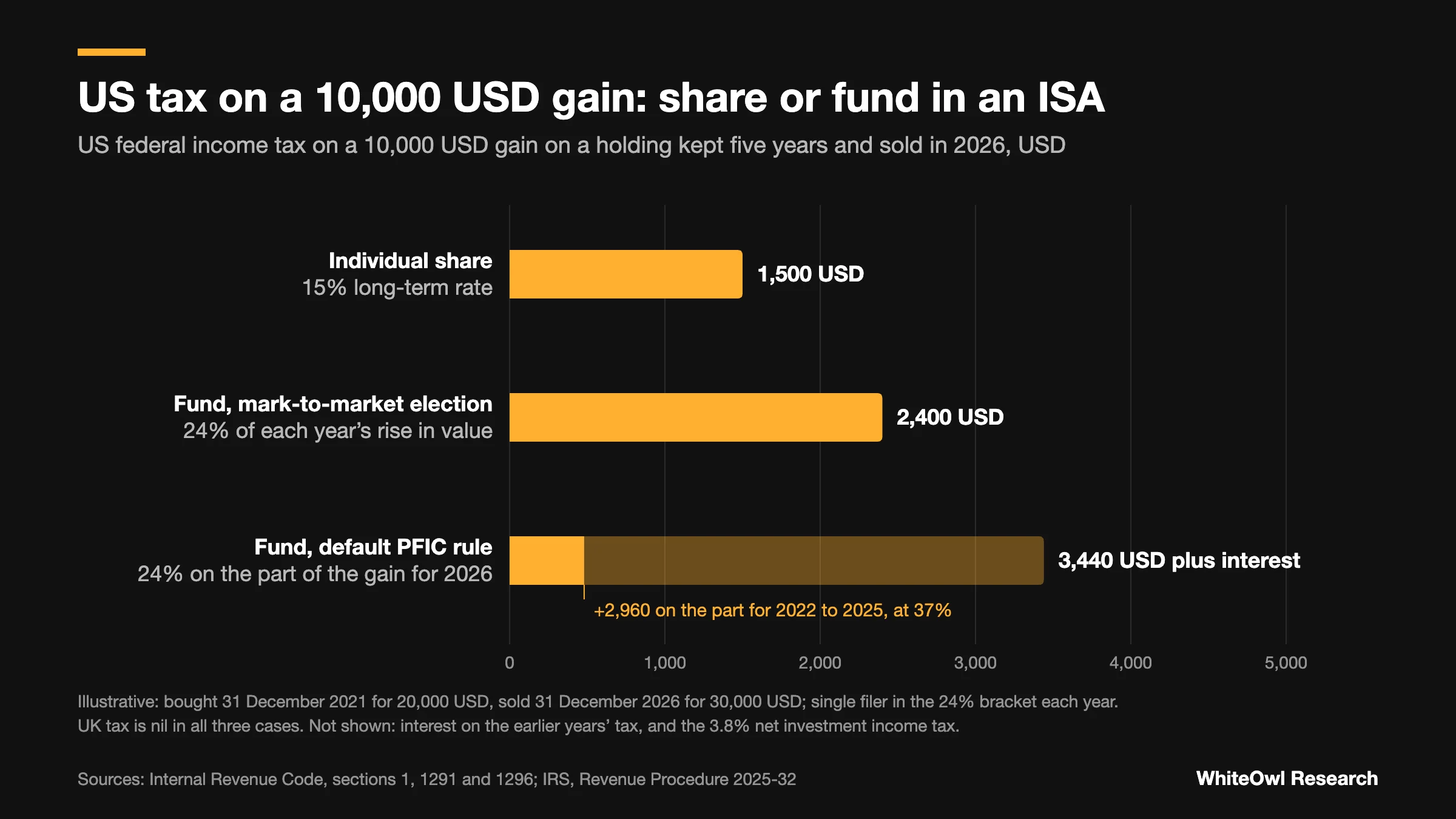
The same 10,000 USD gain costs more than twice as much US tax in a fund as in a share.
Holding individual shares instead
The PFIC test looks at what a company earns and owns, so an ordinary trading company is usually outside it, while a listed investment trust, a company that holds investments, has to be tested like a fund. Shares of trading companies in a stocks and shares ISA are taxed in the United States as in any brokerage account: dividends each year and gains when sold, both measured in US dollars at the rate on the day.
Dividends from a UK company can qualify for the 0%, 15% or 20% rates, the convention being on the IRS list for that purpose, if the share was held for more than 60 days around the dividend date. Gains on shares held for more than one year get the same rates; for 2026, 15% applies to a single filer with taxable income from 49,450 to 545,500 USD.
The Lifetime ISA bonus and the Junior ISA: what the IRS has not said
A Lifetime ISA can be opened from age 18 to 39 and takes up to 4,000 GBP a year until age 50; the UK government adds 25%, up to 1,000 GBP a year. Money comes out free of charge for a first home costing up to 450,000 GBP, from age 60, or in terminal illness; otherwise a 25% charge applies, or 20% since 29 October 2026 where the first home costs more.
The IRS has published nothing on the Lifetime ISA. It has not said whether the bonus is income when it is added, whether the charge reduces income, or whether an account meant partly for later life is a pension scheme under the convention.
A Junior ISA belongs to the child: HMRC says the money is the child's and cannot be taken out before age 18. The IRS has published nothing on it either, which leaves the general rules: a child who is a US citizen is taxed on their own income, and for 2026 investment income above 2,700 USD is taxed at the parent's rate if that is higher. Whether a child born abroad is a US citizen is covered in accidental Americans.
Reporting the accounts
An ISA is a foreign financial account whether or not it produces taxable income. A US person whose foreign accounts together exceed 10,000 USD at any time in the calendar year reports them on the FBAR (Report of Foreign Bank and Financial Accounts), sent to the Financial Crimes Enforcement Network of the US Treasury, not with the tax return. A child has their own report, filed by a parent when the child cannot.
Form 8938 (statement of specified foreign financial assets) goes with the tax return when those assets exceed, for a single filer living abroad, 200,000 USD at the end of the year or 300,000 USD at any time; the figures double on a joint return. Each PFIC needs its own Form 8621 every year, except a default-rule fund in a year when all PFIC holdings are worth 25,000 USD or less (50,000 USD on a joint return) and none was sold or paid an excess distribution.
The IRS has not said whether any kind of ISA is a foreign trust, which would carry reports of its own. Its 2020 relief from those reports covers, outside retirement, only savings for medical, disability or educational benefits.
The choices this leaves
The decision is less whether to hold an ISA than what to hold in it. Cash keeps the US side simple, and saves the amount by which UK tax would have exceeded US tax. Individual shares and bonds are taxed in the United States as in any account, while the ISA removes UK tax on gains and on dividends (10.75%, 35.75% or 39.35% above a 500 GBP allowance in 2026-27). Funds mean an election and a yearly statement for each fund, or the default rule. A UK pension, unlike an ISA, is protected by the convention.
An ISA that held funds for years without US reporting can be brought up to date through the IRS streamlined filing compliance procedures, where the omission was not willful. Which route costs least depends on the saver's rates in both countries and how long the money stays invested.
The figures that matter
The limits, rates and thresholds that decide how an ISA is taxed for an American in the United Kingdom, for the 2026-27 UK tax year and the 2026 US tax year. Sources: HMRC, Internal Revenue Code and IRS, listed below.
| Rule | Figure |
|---|---|
| ISA limit, 2026-27 (GBP) | 20,000 |
| Lifetime ISA limit within it, 2026-27 (GBP) | 4,000 |
| Lifetime ISA government bonus (%) | 25 |
| Junior ISA limit, 2026-27 (GBP) | 9,000 |
| UK higher rate on savings interest outside an ISA, 2026-27 (%) | 40 |
| PFIC test: passive share of gross income, at or above (%) | 75 |
| PFIC test: share of assets producing passive income, at least (%) | 50 |
| Excess distribution: above this share of the three-year average (%) | 125 |
| Rate on a PFIC gain allocated to 2018 to 2025 (%) | 37 |
| US long-term gains rate, single filer, taxable income 49,450 to 545,500 USD, 2026 (%) | 15 |
| Net investment income tax (%) | 3.8 |
| Child's investment income taxed at the parent's rate above, 2026 (USD) | 2,700 |
| FBAR: total of foreign accounts at any time in the year, above (USD) | 10,000 |
| Form 8938, single filer abroad: assets on the last day of the year, above (USD) | 200,000 |
| Form 8938, single filer abroad: assets at any time in the year, above (USD) | 300,000 |
| Form 8621 not required for a default-rule fund: all PFIC holdings, at or below (USD) | 25,000 |
How WhiteOwl helps
An ISA taxed in the United States needs a record the United Kingdom never asks for: every purchase date and price, each year's statements, and each fund's value at the end of each year. WhiteOwl keeps your actual documents from one year to the next, so those figures are on file when a holding is sold. WhiteOwl gathers your documents, organizes your file, finds the issues and runs the numbers. A licensed advisor reviews, decides and files. See how it works.
FAQ
Is an ISA tax-free for US citizens?
Not in the United States. As of 2026, an ISA is free of UK tax, but a US citizen reports its interest, dividends and gains on the US return, because the saving clause of the 2001 convention lets the United States tax its citizens as if the convention did not exist.
Can a US citizen living in the UK open an ISA?
The UK conditions are age and residence, not nationality: in the 2026-27 tax year, a UK resident aged 18 or over can pay in up to 20,000 GBP. Someone who later leaves the United Kingdom can keep the account but cannot pay into it.
Are funds in a stocks and shares ISA PFICs?
Usually. A foreign corporation is a passive foreign investment company when 75% or more of its gross income is passive or at least 50% of its assets produce passive income, which describes most investment funds organized outside the United States. Ordinary trading companies are usually outside the definition.
Do I have to report my ISA on the FBAR?
Yes, when your foreign financial accounts together exceed 10,000 USD at any time in the calendar year. The IRS states that whether an account produced taxable income has no effect. The report goes to the Financial Crimes Enforcement Network, separately from the tax return.
How is the Lifetime ISA bonus taxed in the United States?
As of 11 November 2026, the IRS has not said. It has published nothing on the 25% government bonus, on the withdrawal charge, or on whether a Lifetime ISA is a pension scheme under the convention.
Sources
- GOV.UK, Individual Savings Accounts (ISAs) · how ISAs work · if you move abroad · Lifetime ISA · withdrawing money from a Lifetime ISA · Junior ISAs
- HMRC, Tax-free savings newsletter 24 (October 2026) · Budget 2026, overview of tax legislation and rates · Individual Savings Account (Amendment) (No. 2) Regulations 2026 · (No. 3) Regulations 2026 · Individual Savings Account Regulations 1998
- HMRC, Income Tax rates and allowances · tax on savings interest · tax on dividends · helpsheet HS265, offshore funds
- US Treasury, United States-United Kingdom income tax convention (2001) · exchange of notes · technical explanation · IRS, tax treaties
- Internal Revenue Code, section 1297 · section 1291 · section 1293 · section 1295 · section 1296 · section 1298 · section 1 · section 7701 · section 877 · section 877A
- Treasury Regulations, section 1.1298-1 · section 1.1296-2 · section 1.1295-1 · section 301.7701-3 · section 301.7701(b)-7
- IRS, Publication 54, tax guide for US citizens and resident aliens abroad · Publication 550, investment income and expenses · Publication 514, foreign tax credit for individuals · Instructions for Form 8621 · Instructions for Form 8615 · currency exchange rates · net investment income tax
- IRS, Revenue Procedure 2025-32 (2026 inflation adjustments) · Revenue Procedure 2020-17 (tax-favoured foreign trusts)
- IRS, Report of Foreign Bank and Financial Accounts (FBAR) · do I need to file Form 8938 · comparison of Form 8938 and FBAR requirements · FinCEN, FBAR filing instructions
This article is general information, not personalized tax advice. Consult a qualified cross-border tax professional about your situation.