In short: As of 2026, under the US-UK tax treaty, regular payments from a UK workplace or personal pension and the UK State Pension are taxed only by the United States once you live there. The UK does not tax its 25% tax-free lump sum, but IRS letters say the United States can, and the IRS has issued no ruling on it.
Why it matters
For a retiree who built a pension in London and now lives in Florida, the treaty decides which country taxes each payment, and the answer is different for the lump sum, the State Pension and a government pension. A UK provider keeps taking UK tax until HMRC accepts a treaty claim, and the IRS gives no credit for tax you could have reclaimed. Taking the 25% lump sum can add the whole amount to that year's US income.
Who taxes what, and when citizenship matters
The income tax treaty between the United Kingdom and the United States, signed on 24 July 2001 and in force since 31 March 2003, gives each kind of UK pension payment to one country or to both. It contains a saving clause: each country keeps the right to tax its own residents, and the United States its citizens, as if the treaty did not exist, except under the provisions the treaty lists as exceptions. Several pension rules are on that list.
For most of what follows, it makes no difference whether you are British, American or both. What counts is that you live in the United States and are resident there under the treaty. Citizenship changes the answer for two things: a UK government service pension, and US relief for contributions while you work in the United States. If you hold both citizenships, see also dual citizenship taxes. UK savings accounts are covered in ISAs for US citizens, a home you kept in selling a UK home after moving to the United States, and the move in the other direction in Americans moving to the UK.
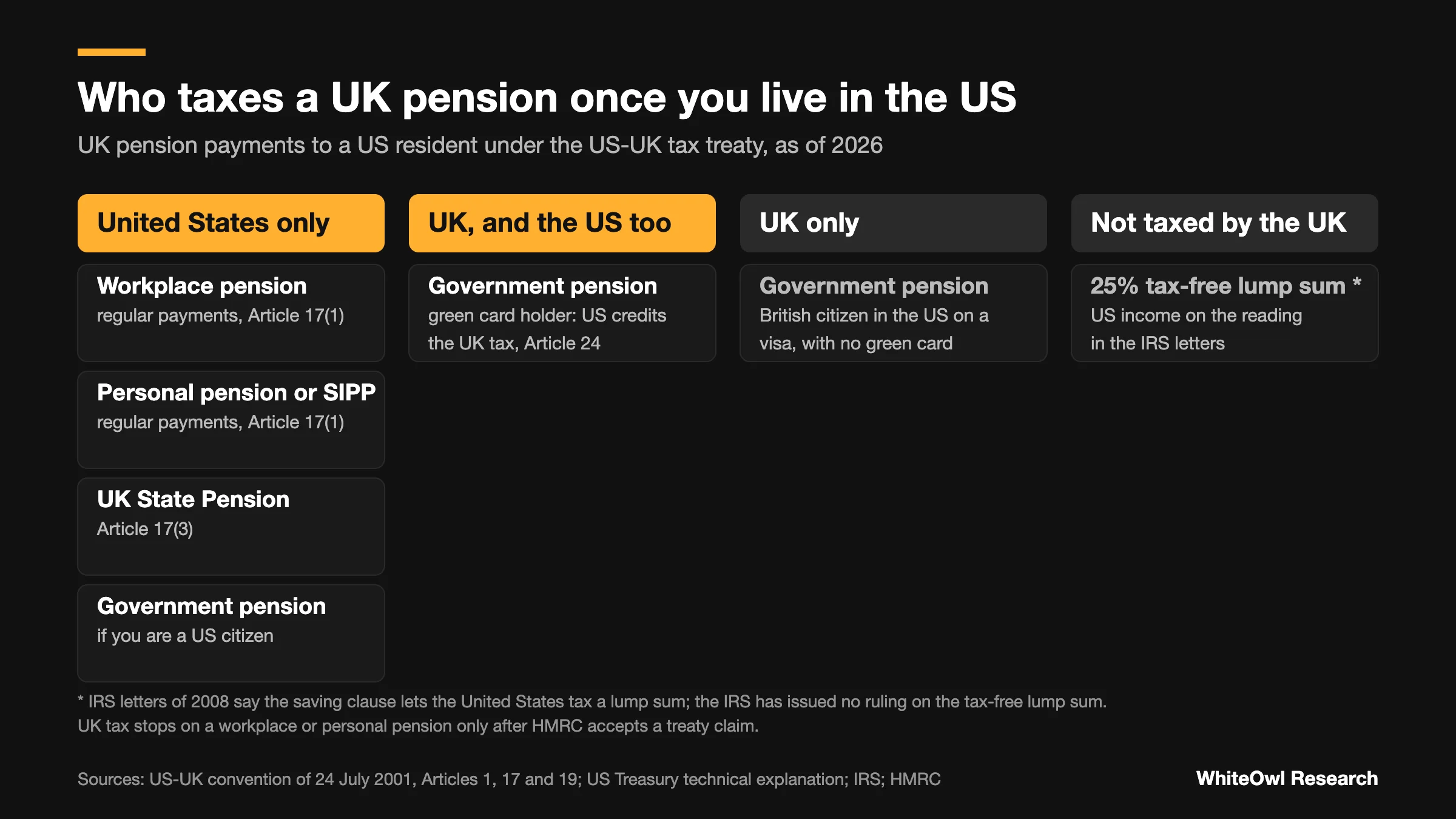
Which country taxes each UK pension payment once you live in the United States.
Workplace and personal pensions: taxed in the United States
Under Article 17(1)(a) of the treaty, a pension paid to a resident of one country is taxable only in that country. For a US resident, that covers regular payments from a UK workplace pension, whether final salary or defined contribution, and from a personal pension or SIPP (a self-invested personal pension). The notes exchanged with the treaty count as a pension any payment from a UK approved occupational or personal pension scheme, or from a substantially similar scheme set up under later UK law.
The UK stops taxing these payments only after HMRC accepts a treaty claim, covered below. In the United States, they are ordinary income on your return, converted to US dollars. A payment is tax-free only up to your cost in the plan, and section 72(w) of the Internal Revenue Code leaves out of that cost any contribution made for work done abroad while you were not a US citizen or resident, if it was taxed neither in the United States nor in any other country, and the untaxed earnings on it from that time. Contributions that received UK tax relief before you moved therefore give no US cost. For an American who built the pension while filing US returns from the UK, the cost depends on how each year's contributions were treated on those returns.
The 25% tax-free lump sum
In the UK you can usually take up to 25% of a pension as a tax-free lump sum, up to 268,275 GBP for most people as of the 2026-27 tax year (6 April 2026 to 5 April 2027). The UK does not tax it, whether or not you live there.
Article 17(2) gives the country where a scheme is set up the sole right to tax a lump sum it pays to a resident of the other country, so only the UK may tax it, and the UK exempts it. Article 17(2) is not among the exceptions to the saving clause, however. In a 2008 information letter about a lump sum from a UK pension paid to a US resident, the IRS said the saving clause lets the United States tax it, and a memorandum from the IRS Chief Counsel the same year said the same. The Treasury's technical explanation, its official guide to the treaty, places lump sums under paragraph 2 rather than the general rule of paragraph 1, and says paragraph 2 is subject to the saving clause. HMRC's manual says the United States can tax lump sums that US citizens receive from UK schemes.
Article 17(1)(b) says the country of residence must exempt any part of a pension that the scheme's country would exempt for its own residents, and it is an exception to the saving clause. The IRS has not said whether it covers the UK tax-free lump sum. The 2008 letter quotes paragraph 1(b) without applying it, and neither 2008 document is a ruling or precedent. On the reading in those documents, the lump sum is US income in the year you take it, with no UK tax to credit against it.
Other lump sums fall under the same paragraph. HMRC's notes for US residents say that UK tax taken from a trivial commutation lump sum (a small pension paid out in one go) can be reclaimed by someone resident in the United States on the day it was paid.
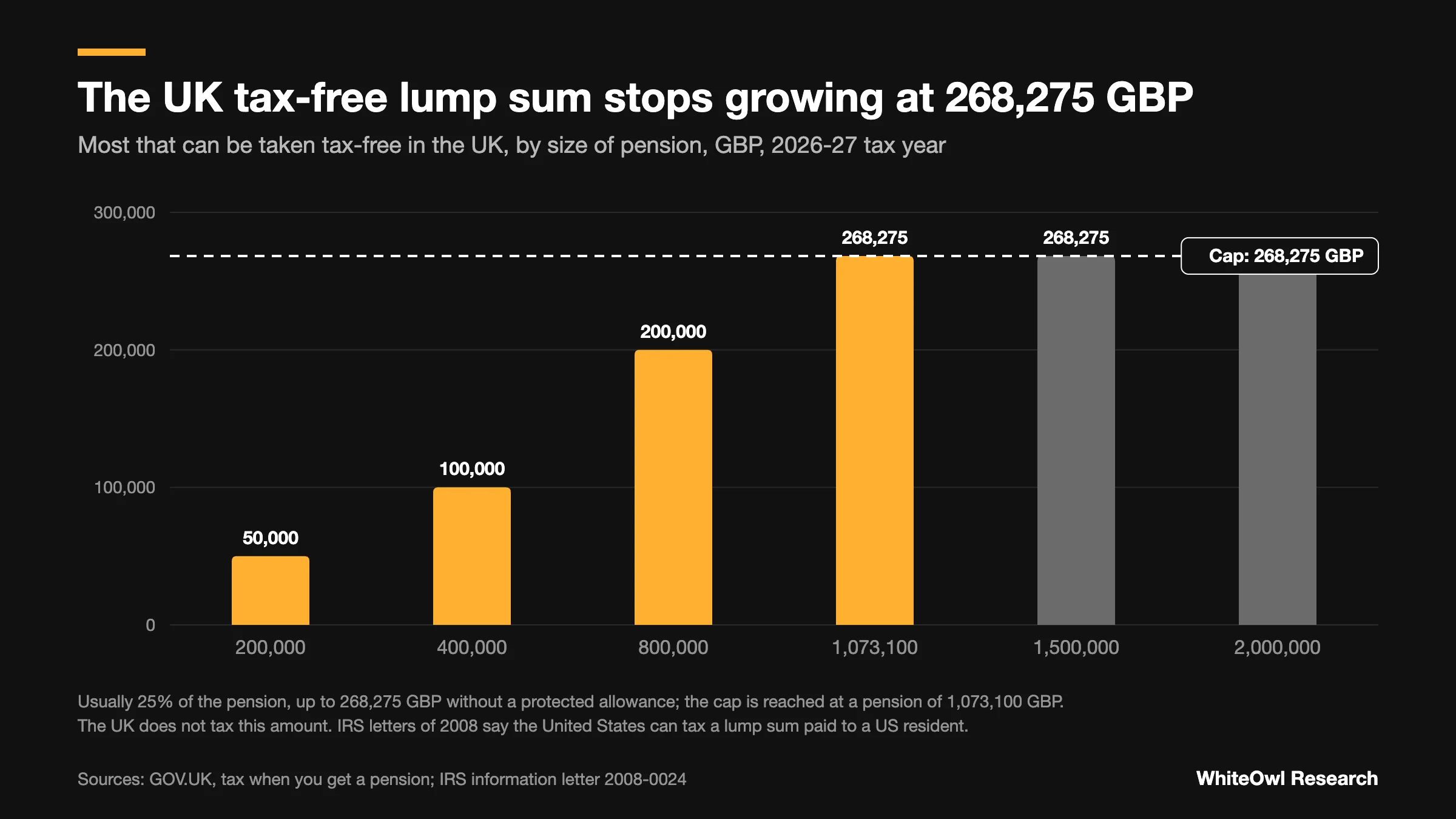
The UK tax-free lump sum is 25% of the pension, capped at 268,275 GBP.
The UK State Pension
Article 17(3) makes social security paid by one country to a resident of the other taxable only in the country of residence, and it is also an exception to the saving clause. The UK State Pension of a US resident is therefore taxed only in the United States. The UK pays it without deducting tax, and HMRC's notes say a US resident can claim exemption from UK income tax on it.
The IRS taxes foreign social security benefits as annuities, unless a treaty exempts them or treats them as US Social Security. The UK treaty does neither for a US resident, so the special rules for US Social Security benefits do not apply to it. As of the 2026-27 tax year, the full new State Pension is 241.30 GBP a week. It rises each year for people living in the United States, one of the countries with a social security agreement with the UK.
UK government service pensions
A pension for service to the UK government or a local authority follows Article 19 instead. It is taxable only in the UK, unless you are both resident in the United States and a US citizen, in which case it is taxable only in the United States. HMRC's list treats civil service, armed forces, police, local authority and most teachers' pensions as government pensions. It treats NHS pensions as non-government unless a local authority pays them, so they follow Article 17.
The saving clause matters here. Article 19 binds the United States only for people who are neither US citizens nor green card holders. A British citizen living in the United States on a visa is taxed on the pension only by the UK. A British citizen with a green card is taxed on it by the UK and by the United States, which allows a foreign tax credit for the UK tax under Article 24.
A worked example: a British retiree with a green card
A British retiree with a green card moved from Leeds to North Carolina in 2022. Their SIPP is worth 400,000 GBP, built entirely from contributions that received UK tax relief while they worked in the UK. During the 2026-27 tax year, they take 100,000 GBP as a tax-free lump sum and 20,000 GBP of drawdown income, and receive a civil service pension of 15,000 GBP and the full new State Pension.
For this retiree in the 2026-27 tax year, the UK taxes only the civil service pension, while the United States taxes all four payments. Sources: the treaty, IRS and HMRC, listed below.
| Payment | Amount (GBP) | Taxed by the UK | Taxed by the United States |
|---|---|---|---|
| Tax-free lump sum from the SIPP | 100,000 | No | Yes, on the reading in the IRS letters |
| Drawdown income from the SIPP | 20,000 | No, once HMRC accepts the treaty claim | Yes |
| Civil service pension | 15,000 | Yes | Yes, with a credit for the UK tax |
| State Pension, 52 weeks at the 2026-27 rate | 12,547.60 | No | Yes |
The four payments, 147,547.60 GBP in all, go on the retiree's US returns in US dollars, in the calendar year each is paid. A British citizen who lives abroad can claim the UK personal allowance of 12,570 GBP, so the UK tax on the civil service pension is 486 GBP: 20% of the 2,430 GBP above the allowance. Because the SIPP contributions received UK relief before the move, the SIPP payments have no US cost to recover.
Stopping or reclaiming UK tax at source
A UK provider takes UK tax from a non-resident's pension through pay-as-you-earn unless HMRC says otherwise. To stop it, you make a claim to HMRC under the treaty, on its form for US residents, which the IRS certifies, for a fee, as proof that you are resident in the United States. If HMRC agrees, it tells the provider to pay without UK tax (the tax code NT, meaning no tax on that income); where it cannot arrange that, it repays the tax taken. The adjustment goes back to the latest of the date you became resident in the United States, the date payments began, and the earliest UK tax year still open for a repayment claim.
Each new source of income needs its own claim, and the relief ends from the date you return to live in the UK. Reclaiming matters for the US return too: the IRS allows no foreign tax credit for foreign tax that would be refunded if you claimed it.
Growth inside the pension, and contributions
Article 18(1) stops the United States from taxing income and gains inside a UK pension scheme until they are paid out, and it is an exception to the saving clause, so it protects US citizens too. Under IRS regulations, a member of such a scheme need not file the yearly return for foreign investment funds (passive foreign investment companies) held inside it. A 2010 IRS information letter said a transfer between two UK schemes, such as from a workplace pension to a SIPP, is not taxed in the United States. The 2008 Chief Counsel memorandum said the treaty does not make a transfer to a US IRA a tax-free rollover, so it may be taxed in the United States as a payout.
Contributions get less help. US tax relief for employer plans requires a trust created or organized in the United States, which a UK scheme is not. Article 18(2) lets someone who already belonged to a UK scheme before starting work in the United States deduct their contributions while working there, within US limits, without being taxed on the employer's contributions, but only if they are neither a US citizen nor a green card holder.
In the UK, a non-resident with no UK earnings gets tax relief on contributions of up to 3,600 GBP a year, gross, for the five tax years after the year they leave, provided they were UK resident when they joined the scheme.
The figures that matter
The amounts, rates and dates that decide how a US resident's UK pension is taxed, as of the 2026-27 UK tax year. Sources: the treaty, HMRC, GOV.UK and the IRS, listed below.
| Rule | Figure |
|---|---|
| Share of a pension that can usually be taken as a tax-free lump sum (%) | 25 |
| Most that can be taken as tax-free lump sums, without a protected allowance (GBP) | 268,275 |
| Full new State Pension, 2026-27 (GBP a week) | 241.30 |
| UK personal allowance, 2026-27 (GBP) | 12,570 |
| UK basic rate of income tax, 2026-27 (%) | 20 |
| Contributions with UK relief for a non-resident with no UK earnings (GBP a year, gross) | 3,600 |
| Tax years after leaving in which that relief continues | 5 |
| US-UK treaty signed | 24 July 2001 |
| US-UK treaty in force | 31 March 2003 |
How WhiteOwl helps
Tax expertise is narrow, especially across borders: an advisor who knows US retirement accounts may know little about UK pensions and the treaty claim to HMRC. WhiteOwl matches you with an advisor whose specialties and countries fit your case, here a UK pension paid to someone living in the United States. WhiteOwl gathers your documents, organizes your file, finds the issues and runs the numbers. A licensed advisor reviews, decides and files. See how it works.
FAQ
Is my UK pension taxable in the US?
Yes, if you live in the United States. As of 2026, regular payments from UK workplace and personal pensions, and the UK State Pension, are taxable only in the United States under Article 17 of the US-UK treaty, and the UK stops taxing a workplace or personal pension once HMRC accepts your claim. A UK government service pension is taxed by the UK unless you are a US citizen.
Is the 25% UK tax-free lump sum taxable in the US?
The UK does not tax it. A 2008 IRS information letter and a 2008 IRS Chief Counsel memorandum say the saving clause lets the United States tax a lump sum from a UK pension paid to a US resident, and the Treasury's technical explanation treats lump sums the same way. The IRS has issued no ruling on the tax-free lump sum itself.
Is the UK State Pension taxable in the US?
For a US resident, yes, and only there, under Article 17(3) of the treaty. The UK pays it without deducting tax. The IRS taxes foreign social security benefits as annuities unless a treaty exempts them or treats them as US Social Security, and the UK treaty does neither.
Can I move my UK pension to a US IRA?
A 2008 IRS Chief Counsel memorandum said the treaty does not make such a transfer a tax-free rollover, so it may be taxed in the United States as a payout. A transfer between two UK schemes is not taxed in the United States, according to a 2010 IRS information letter. UK rules on transfers abroad apply separately.
How do I stop UK tax being taken from my pension?
You claim relief from HMRC under the treaty, on its form for US residents, certified by the IRS. If HMRC agrees, it tells the pension provider to pay without UK tax, and it repays tax already taken back to the date you became resident in the United States, within the time limit for repayment claims. Each new pension needs its own claim.
Sources
- HMRC, 2001 UK-USA double taxation convention as amended by the 2002 protocol, with the exchange of notes · US Treasury, technical explanation of the convention
- IRS, information letter 2008-0024, lump sum from a UK pension paid to a US resident · IRS Chief Counsel memorandum AM2008-009, UK pension rollovers · information letter 2010-0151, SIPPs
- IRS, Publication 915, social security benefits · Publication 514, foreign tax credit for individuals · Internal Revenue Code, section 72 · section 401 · Treasury Regulations, section 1.1298-1
- HMRC, Double Taxation Relief Manual, USA notes · USA, convention in force · form US-Individual 2002 and its notes
- HMRC, PAYE Manual, double taxation claims by non-residents · cancellation of relief · pensioners abroad · code NT · International Manual, government or non-government pensions
- GOV.UK, tax-free pension lump sums · the new State Pension · State Pension if you retire abroad · countries with social security agreements · personal allowance if you live abroad · income tax rates
- Finance Act 2004, section 189 · section 190
This article is general information, not personalized tax advice. Consult a qualified cross-border tax professional about your situation.