In short: As of 2026, an American who becomes UK resident is taxed by the UK on worldwide income, and the United States keeps taxing citizens and green card holders on theirs. For four tax years after ten years away, a yearly UK claim can exempt foreign income and gains, at the cost of that year's allowances.
Why it matters
For a family relocating to London for a job, two countries tax the same salary and investments from the first year, on calendars that do not line up. The choices with the longest reach come early: the arrival date, which foreign income to claim relief on, the credit or the exclusion on the US return, and what to do with US funds.
When you become UK resident
The United Kingdom decides residence for each tax year, such as the 2026-27 tax year (6 April 2026 to 5 April 2027), by the statutory residence test. Spending 183 days or more in the UK makes you resident. If you were not UK resident in any of the three previous tax years, fewer than 46 days makes you non-resident.
Two more automatic tests make you resident, each with further conditions: having a UK home, and no overseas home you use for 30 days or more, for 91 consecutive days; or working full-time in the UK over 365 days. Otherwise your ties decide. A new arrival counts four (family, accommodation, work and a 90-day tie): all four make 46 to 90 days enough, three make 91 to 120 days enough, and two make more than 120 days enough.
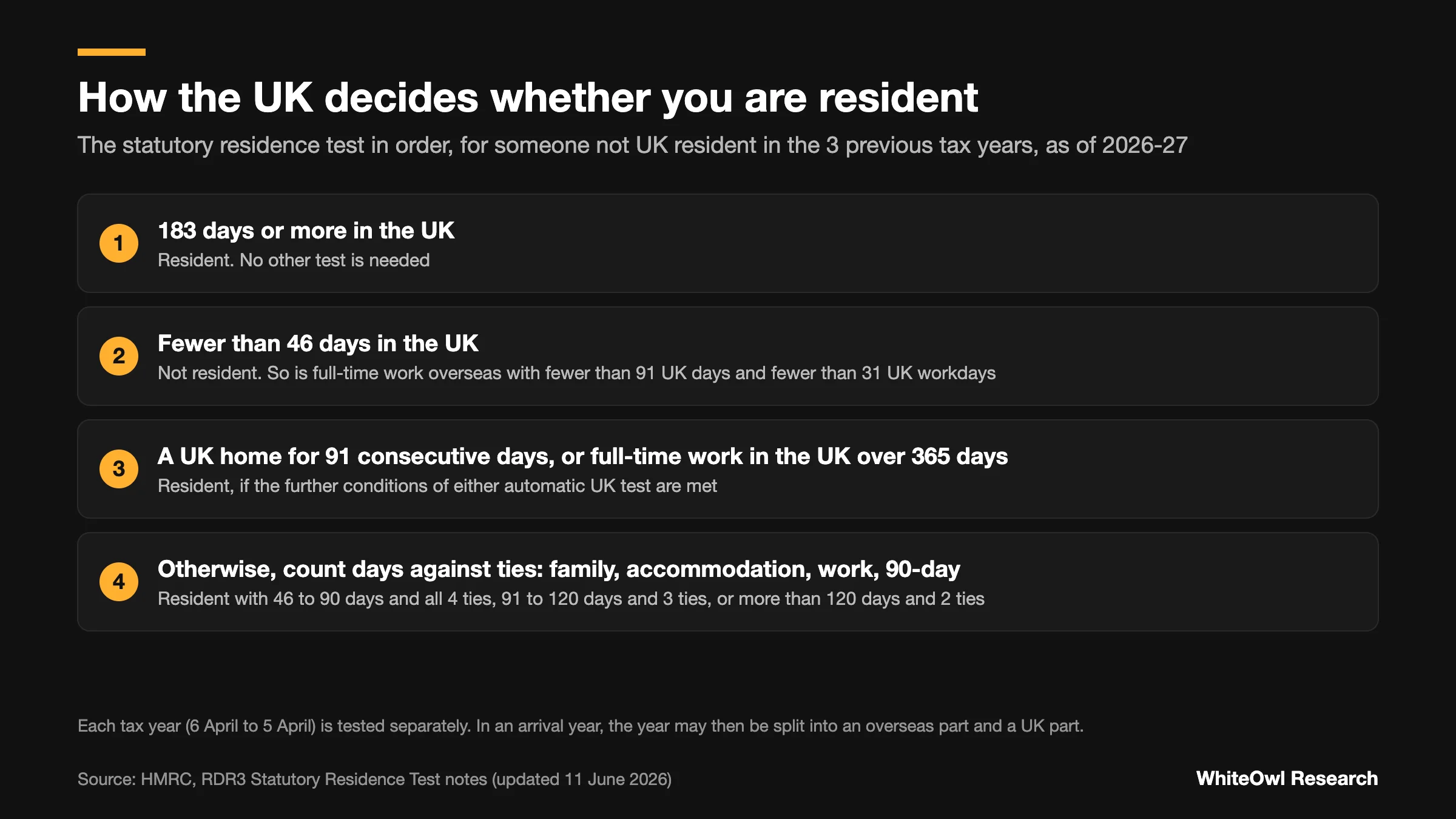
The UK residence test, in the order it is applied.
The arrival year can be split
The arrival year can be split into an overseas part, taxed mostly as a non-resident, and a UK part, taxed as a resident. Five cases cover arrivals, among them starting to have your only home in the UK (case 4), starting full-time work in the UK (case 5) and starting to have a UK home while staying resident the next year (case 8). Each of these requires that you were not UK resident the year before.
Split-year treatment is not a choice: if you meet every condition of a case, it applies. It does not change your residence under a tax treaty. The United States taxes the calendar year, so one UK arrival year falls across two US returns.
The four-year foreign income and gains regime
From 6 April 2025, the UK abolished the remittance basis and taxes every resident on worldwide income and gains as they arise. In its place, a qualifying new resident, someone not UK resident in any of the 10 tax years before arriving, can claim relief on foreign income and gains in each of their first four tax years. Nationality and domicile do not matter.
The four years run back to back, and a split arrival year counts as the first of them in full. Years you do not claim are lost, not carried forward. An American who starts full-time work in London in February 2027 may be UK resident for 2026-27 with the year split; that year is then the first of the four.
A claim removes UK tax on the foreign income and gains it covers, whether or not the money comes to the UK. Qualifying income includes dividends from non-UK companies, interest on foreign accounts, overseas rental profits, foreign pension income with some exceptions, and offshore income gains. You claim on your Self Assessment return (the UK's annual tax return), source by source, within 12 months after the normal filing date: for 2026-27, by 31 January 2029.
What a claim gives up
Any claim, even for income only or gains only, costs that year's personal allowance (12,570 GBP for 2026-27), the capital gains tax annual exempt amount (3,000 GBP) and a few smaller reliefs. Foreign losses of that year can no longer be used, and the UK gives no foreign tax credit relief on the income claimed.
The personal allowance falls by 1 GBP for every 2 GBP of adjusted net income above 100,000 GBP, and the relieved foreign income still counts in that figure; from 125,140 GBP the allowance is zero anyway, so a claim costs mainly the capital gains allowance and any foreign losses. On a UK salary of 75,000 GBP in England, losing the allowance adds 5,028 GBP of UK tax for 2026-27.
Losing the personal allowance adds up to 5,028 GBP of UK income tax for the 2026-27 tax year, for a person whose only UK income is a salary taxed at the rates for England, Wales and Northern Ireland. Sources: HMRC, listed below.
| UK salary (GBP) | Tax with the allowance (GBP) | Tax without it (GBP) | Extra tax (GBP) |
|---|---|---|---|
| 30,000 | 3,486 | 6,000 | 2,514 |
| 50,000 | 7,486 | 12,460 | 4,974 |
| 75,000 | 17,432 | 22,460 | 5,028 |
| 100,000 | 27,432 | 32,460 | 5,028 |
| 110,000 | 33,432 | 36,460 | 3,028 |
| 125,140 | 42,516 | 42,516 | 0 |
For an American, the United States taxes the same income either way. Without a claim, the treaty credits generally leave the higher of the two countries' tax on it; with one, the US tax alone. A claim saves tax overall only when the UK would tax that income more heavily than the United States, by more than the allowances are worth.
Salary for days worked abroad
Employment income is outside the claim. For days worked outside the UK, a new resident can instead elect Overseas Workday Relief in the same four years. It covers salary and income from employment-related securities, such as share awards, up to the lower of 30% of the qualifying employment income and 300,000 GBP a year, and costs the same allowances. Without it, a US citizen working for a UK employer is taxed in the UK on US workdays with no UK credit for the US tax; the United States credits the UK tax instead.
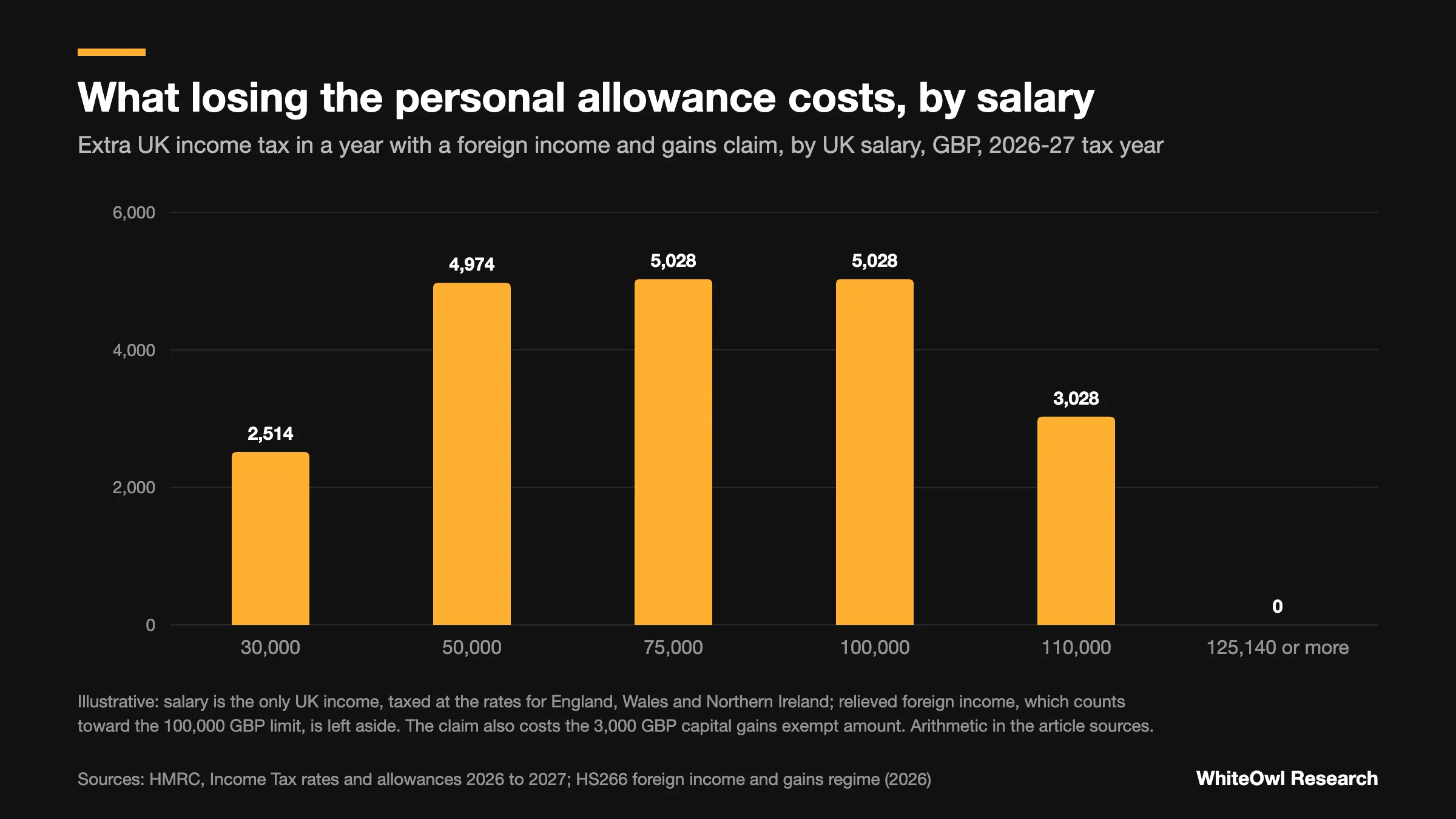
Losing the personal allowance costs up to 5,028 GBP of UK tax.
The US side: worldwide income and the saving clause
The United States taxes citizens and resident aliens, green card holders included, on worldwide income wherever they live (see US taxes when you live abroad). The US-UK income tax convention keeps that right: its saving clause, Article 1(4), lets the United States tax its citizens as if the treaty did not exist, except under the articles listed in Article 1(5), among them Article 24 on double tax relief.
Article 24 sets who credits whom. On UK income, such as a London salary, the United States credits the UK tax. On US-source income, such as dividends on US shares, the UK credits only the US tax the treaty allows on a UK resident who is not a US citizen (15% on portfolio dividends, nothing on most interest), and the United States credits the UK tax that remains while keeping at least that amount.
A green card holder can claim UK residence under the treaty's tie-breaker, but doing so, without waiving the treaty and with notice to the IRS, ends their treatment as a lawful permanent resident for US tax. After holding the card in 8 of the last 15 tax years, that can count as an expatriation (see the US exit tax).
Foreign tax credit or foreign earned income exclusion
On the US return, a UK salary gets one of two reliefs. The foreign earned income exclusion removes up to 132,900 USD of foreign earnings from US income for 2026, plus a housing amount, if your tax home is abroad and you pass the bona fide residence test or the physical presence test (330 full days abroad in 12 consecutive months). The foreign tax credit reduces US tax by the UK tax, up to the US tax on foreign income of the same category; unused credit carries back one year and forward ten.
When the UK tax on a salary is higher than the US tax on it, the credit can cancel the US tax on the whole salary and leave credit for later years. The exclusion stops at 132,900 USD, and the rest of the income is taxed at the rates that would apply without it. Excluded pay earns no credit and does not count as compensation for IRA contributions. Once chosen, the exclusion stays until revoked, and after a revocation it cannot be chosen again for five years without IRS approval.
A 401(k), IRA or Roth IRA after the move
US retirement accounts are pension schemes under the treaty: the US Treasury's technical explanation lists 401(a) plans, 401(k) plans among them, IRAs, Roth IRAs and 403(b) plans. Article 18(1) stops the UK from taxing income and growth inside a US scheme until it is paid out.
Regular payments are taxed by the UK as the country of residence (Article 17(1)(a)), and by the United States on a citizen through the saving clause, with credit under Article 24. The UK exempts any amount the United States would exempt for its own residents (Article 17(1)(b)), so a Roth IRA distribution that is tax-free in the United States is free of UK tax. A lump sum is taxable in the United States under Article 17(2), and HMRC reads the saving clause as letting the UK tax its residents on it too, with relief in the usual way.
If you joined a US workplace plan before starting work in the UK, Article 18(2) can make your contributions deductible in the UK, and keep your employer's out of your UK income, up to the relief the UK gives for its own schemes, unless you are a British citizen or UK permanent resident. UK pensions joined later are covered in a UK pension and US tax.
US funds and ETFs seen from the UK
A US mutual fund or ETF can be an offshore fund under UK rules, which apply to investment funds based outside the UK that meet certain conditions. If the fund has UK reporting fund status, you are taxed each year on its reported income and a sale gives a capital gain, taxed at 18% or 24% for 2026-27. If not, a gain on sale is normally an offshore income gain, taxed as income at up to 45%. HMRC publishes the list of approved reporting funds.
A claim in the first four years can cover offshore income gains, at the cost of that year's allowances. In the other direction, a foreign fund treated as a corporation for US tax is a passive foreign investment company when 75% or more of its income is passive or half its assets produce passive income, which describes most investment funds. UK funds and ISAs are covered in ISAs for Americans living in the UK.
The choices, in order
The decisions an American moving to the UK meets in the first years, as of the 2026-27 UK tax year. Sources: HMRC and IRS, listed below.
| When | Choice | What turns on it |
|---|---|---|
| Before the move | The arrival date | Which tax year is the first of the four, and whether it splits |
| Before the move | US funds held outside retirement accounts | Gains on funds without UK reporting status are taxed as income |
| First US return after the move | Foreign tax credit or foreign earned income exclusion | US tax on the UK salary, and five years without the exclusion after revoking it |
| Each UK return, years 1 to 4 | A foreign income claim, a foreign gain claim, or neither | UK tax removed, against the allowances lost |
| Each UK return, years 1 to 4 | Overseas Workday Relief | UK tax on pay for days worked abroad |
| Any year, green card holders | A treaty claim to UK residence | Whether the expatriation rules apply |
From the fifth year, foreign income and gains are taxed in the UK as they arise, with treaty credits. UK inheritance tax can reach worldwide assets after 10 of the previous 20 tax years of UK residence.
The figures that matter
The thresholds that shape an American's first UK years, for the 2026-27 UK tax year and the 2026 US tax year. Sources: HMRC, IRS and the US-UK convention, listed below.
| Rule | Figure |
|---|---|
| Days in the UK in a tax year that make you resident (days) | 183 |
| Days below which a new arrival is not resident, if non-resident in the 3 previous tax years (days) | 46 |
| Tax years of non-residence needed before the four-year regime (years) | 10 |
| Tax years in which a qualifying new resident can claim (years) | 4 |
| Personal allowance, lost in a year with a claim (GBP) | 12,570 |
| Adjusted net income at which the personal allowance starts to fall (GBP) | 100,000 |
| Adjusted net income at which the personal allowance is zero (GBP) | 125,140 |
| Capital gains tax annual exempt amount, lost in a year with a claim (GBP) | 3,000 |
| UK capital gains tax, lower rate (%) | 18 |
| UK capital gains tax, higher rate (%) | 24 |
| UK income tax, additional rate (%) | 45 |
| Overseas Workday Relief cap (GBP a year) | 300,000 |
| Overseas Workday Relief cap (% of qualifying employment income) | 30 |
| US foreign earned income exclusion, 2026 (USD) | 132,900 |
| Physical presence test (full days abroad in 12 consecutive months) | 330 |
| US foreign tax credit carryback (years) | 1 |
| US foreign tax credit carryforward (years) | 10 |
| Wait to choose the exclusion again after revoking it, without IRS approval (years) | 5 |
| Treaty limit on US tax on portfolio dividends to a UK resident (%) | 15 |
| Green card years in the last 15 tax years that make a long-term resident (years) | 8 |
How WhiteOwl helps
In each of the first four years, whether a claim leaves less tax depends on the UK tax it removes, the US tax on the same income and the allowances it costs; the choice between the credit and the exclusion is the same kind of two-country arithmetic. WhiteOwl's figures are computed by a tax engine from each country's rules, on your own income. WhiteOwl gathers your documents, organizes your file, finds the issues and runs the numbers. A licensed advisor reviews, decides and files. See how it works.
FAQ
Do Americans living in the UK pay tax in both countries?
Yes. As of 2026, the UK taxes its residents on worldwide income, and the United States taxes its citizens and green card holders on theirs wherever they live. The US-UK treaty does not stop either, but its Article 24 sets which country credits the other's tax, so the same income is not taxed twice in full.
Can a US citizen use the UK four-year foreign income and gains regime?
Yes, if they were not UK resident in any of the 10 tax years before arriving; nationality does not matter. The relief must be claimed on each year's UK return and costs that year's personal allowance and capital gains allowance. The United States still taxes the relieved income.
Is the foreign tax credit or the foreign earned income exclusion better in the UK?
It depends on the figures. When UK tax on a salary is higher than the US tax on it, the credit can cancel the US tax on the whole salary and carry the excess forward ten years, while the exclusion stops at 132,900 USD for 2026. Revoking the exclusion later bars it for five years without IRS approval.
Does the UK tax my 401(k) or IRA?
Not while the money stays in the account: Article 18(1) of the treaty stops the UK taxing growth inside a US scheme. Payments are taxed in the UK as pension income, except amounts the United States itself would exempt, such as a tax-free Roth IRA distribution.
How are US ETFs taxed for a UK resident?
It depends on whether the fund has UK reporting fund status. Gains on a reporting fund are capital gains, taxed at 18% or 24% for 2026-27; gains on a non-reporting fund are normally taxed as income, at up to 45%. HMRC publishes the list of approved reporting funds.
Sources
- HMRC, RDR3, statutory residence test · Residence and FIG Regime Manual, RFIG21000, split year cases · RFIG21010, what a split year is · RFIG21020, when a tax year is split · RFIG21150, case 4
- HMRC, HS266, foreign income and gains regime (2026) · RFIG44000, qualifying new resident · RFIG43000, effects of a claim · RFIG45100, qualifying foreign income
- HMRC, Employment Income Manual, EIM43555, Overseas Workday Relief · EIM43560, eligibility · EIM43600, financial limit
- HMRC, Income Tax rates and allowances · Income Tax rates and Personal Allowances · Capital Gains Tax rates and allowances · Inheritance Tax if you are a long-term UK resident
- HMRC, HS265, offshore funds · approved offshore reporting funds
- HMRC, Double Taxation Relief Manual, DT19853, United States notes · International Manual, INTM163160, pension lump sums
- US Treasury, US-UK income tax convention (2001) · Treasury technical explanation of the convention and 2002 protocol
- IRS, Publication 54, tax guide for US citizens and resident aliens abroad · Revenue Procedure 2025-32 · Publication 514, foreign tax credit for individuals · Publication 590-A, IRA contributions
- IRS, Instructions for Form 8854 · Publication 519, US tax guide for aliens · Instructions for Form 8621
This article is general information, not personalized tax advice. Consult a qualified cross-border tax professional about your situation.