In short: As of 2026, Canada and the United States each tax most employee stock options at exercise, and each can tax the part earned by work on its soil. Their tax treaty splits an option benefit by the days your main workplace was in each country between grant and exercise, and the country where you live gives the credit.
Why it matters
An engineer or executive who moves between Toronto and Seattle with unexercised options or unvested restricted share units (RSUs) can owe tax on the same benefit in both countries. For options, the split is not fixed on moving day: it keeps changing until the day of exercise. Canada can leave half of an option benefit untaxed while the United States taxes all of it, and the two countries do not always tax in the same year, which decides whether a credit can be used.
When Canada taxes options and RSUs
In Canada, as of 2026, there is generally no tax when an option is granted. When you exercise it, the share's value that day minus the price you pay is an employment benefit of that year. If the employer is a Canadian-controlled private corporation (CCPC) and you deal with it at arm's length, the benefit is taxed in the year you sell the shares instead.
You may deduct half of the benefit when the conditions are met, chiefly that the exercise price was at least the share's market value on the grant date and that the share is of a prescribed kind. For CCPC shares, holding them for at least two years also gives the deduction. A proposed change to the deduction, which was to take effect June 25, 2024, did not go ahead: on March 21, 2025, the government announced it would not proceed.
For options granted on or after July 1, 2021 by an employer that is not a CCPC and whose group revenue exceeds 500 million CAD, the deduction is capped. It covers options on shares worth up to 200,000 CAD, valued on the grant date, for each year in which options become exercisable. The benefit on options above that limit is taxed in full.
An RSU plan under which the employer agrees to issue shares follows the same timing, the Canada Revenue Agency says: for most employers, the benefit is taxed in the year you acquire the shares. Where the plan pays cash, the payment is employment income in the year you receive it. A share received at no cost does not meet the price condition, so the half deduction does not apply.
When the United States taxes them
In the United States, as of 2026, an option granted outside an incentive stock option plan or an employee stock purchase plan is a nonstatutory option, often called nonqualified. For most of these there is no tax at grant; at exercise, the share's value minus the price you pay is included in your income for that year.
An incentive stock option (ISO) works differently. Nothing is included in income at grant or at exercise for regular tax, and the gain is taxed when you sell the shares, as a capital gain if you sell more than two years after the grant and more than one year after the exercise. The spread at exercise does count for the alternative minimum tax, whose exemption for 2026 is 90,100 USD for an unmarried person and 140,200 USD on a joint return; Public Law 119-21 of July 4, 2025 made the higher exemption amounts permanent. Options count as ISOs only up to 100,000 USD of shares, valued at grant, that first become exercisable in a calendar year.
For RSUs, the IRS explains that nothing is generally taxed at grant and that the value of the shares is typically included in income when the units vest. US citizens and resident aliens are taxed on worldwide income. A nonresident alien is taxed on the part from US sources, which the IRS measures by workdays inside and outside the United States between grant and vesting.
The treaty rule: days between grant and exercise
Under Article XV of the Canada-United States tax convention, the country where you live may tax your pay, and the country where the work is done may tax the pay for that work. For stock options, a note agreed with the 2007 protocol (Annex B to the convention, paragraph 6) fixes how much of the benefit belongs to each country. The benefit is treated as earned in a country in the proportion that the days on which your principal place of employment for the employer was in that country bear to all the days you were employed by the employer, counted from the day of grant to the day of exercise.
The country where you live at exercise may tax the whole benefit. The other country may tax only its share of days, subject to the treaty's exemptions for small amounts and short stays, which are tested for the years the work was done. The US Treasury's technical explanation, to which the Government of Canada subscribes, sets out this reading.
The count runs to the day of exercise, not to vesting, while the United States' own sourcing rule stops at vesting. The two tax authorities may agree on a different split when an option was in the money at grant or had no substantial vesting period. The note speaks only of options and of shares acquired under them: neither it nor the technical explanation mentions RSUs, which leaves them to Article XV's general rule and to each country's own way of matching pay to workdays.
Which country gives the credit
The country where you live gives the credit for the other country's tax on its share. If you have moved to the United States, the United States taxes the whole benefit and credits the Canadian income tax on the Canadian share (Article XXIV, paragraph 1); Canada computes that tax on half the benefit when the deduction applies. The US credit is limited to the US tax on foreign income of the same category, and unused foreign tax can be carried back one year and forward ten.
If you have moved to Canada, Canada taxes the whole benefit and deducts the US tax on the US share from its own tax (Article XXIV, paragraph 2). Canada's credit works one year at a time: foreign tax on employment income that cannot be credited in the year cannot be carried to another year, although it can be deducted from income.
US citizens living in Canada are taxed by both countries on the whole benefit (see dual citizenship taxes). Canada credits US tax on the US share only up to what a non-citizen would owe, and the United States credits the remaining Canadian tax (Article XXIV, paragraph 4). Social security contributions are a separate question.
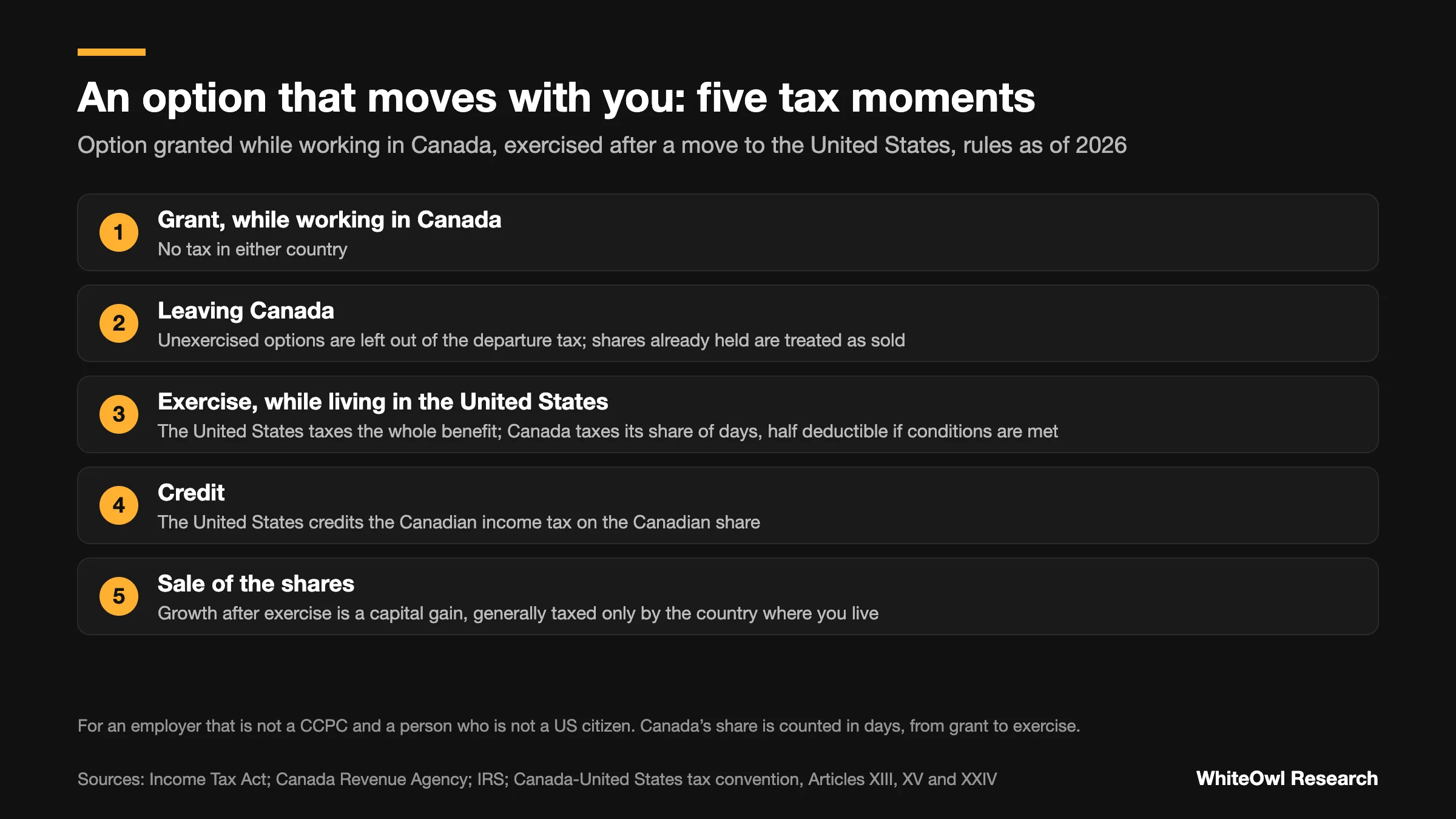
The five moments when tax can arise on an option that moves from Canada to the United States.
Timing traps around a move
Incentive stock options exercised in Canada. Canada's rules make no exception for a US incentive stock option, so a Canadian resident is taxed in the year of exercise, while US regular tax waits for the sale. For a US citizen, or anyone with a US share of days, the two taxes can fall in different years.
CCPC options exercised in the United States. The mismatch runs the other way: the United States taxes a US resident at exercise, and Canada taxes its share when the shares are sold, possibly years later, while the US carryback reaches only one year.
Leaving Canada. Canada's departure tax treats most of what you own as sold at fair market value when you stop being a resident. Unexercised options are left out and are taxed later, at exercise. Shares you already hold from earlier exercises or vested RSUs are treated as sold, and half of any gain is taxable; the benefit already taxed counts as part of their cost. The treaty (Article XIII, paragraph 7) lets you elect to be treated in the United States as having sold and bought back those shares at the same value. For CCPC shares, leaving does not count as a sale for the deferred option benefit.
Arriving in Canada. Shares you own when you become a Canadian resident are generally treated as bought that day at fair market value, so Canada taxes only later growth; options are excluded from that reset. Giving up US citizenship or a long-held green card is covered in the US exit tax.
A worked example: options granted in Toronto, exercised in Seattle
An engineer works in Toronto for the Canadian subsidiary of a US-listed company. On January 1, 2023, the company grants them 2,000 options at 50 USD, the market price that day; the grant meets the conditions for the half deduction, is within Canada's vesting limit and has fully vested by the end of 2025. They leave Canada on December 31, 2025, start at the group's Seattle office on January 1, 2026 as a US resident who is not a US citizen, and exercise all 2,000 options on October 1, 2026, when the share trades at 150 USD.
For this engineer in 2026, the treaty places 80% of a 200,000 USD option benefit in Canada and 20% in the United States. Sources: Canada-United States tax convention, Income Tax Act and IRS, listed below.
| Step | Figure |
|---|---|
| Days employed from grant to exercise | 1,370 |
| Days with the main workplace in Canada | 1,096 |
| Days with the main workplace in the United States | 274 |
| Canada's share of days (%) | 80 |
| Benefit at exercise: 2,000 shares at 150 minus 50 (USD) | 200,000 |
| Canadian share of the benefit (USD) | 160,000 |
| Taxable in Canada after the half deduction (USD) | 80,000 |
| United States share of the benefit (USD) | 40,000 |
| Taxed by the United States as the country of residence (USD) | 200,000 |
When the engineer leaves, the departure tax leaves the unexercised options alone. At exercise, Canada taxes them as a non-resident on its 160,000 USD share, reduced by half. The United States taxes the whole 200,000 USD in 2026 and credits the Canadian income tax. Amounts are shown in USD for both countries, for comparison.
The exercise date moves the split. Exercised on December 31, 2025, their last day in Canada, the whole benefit would have been Canadian. Exercising on December 31, 2027 would place 60.0% in Canada (1,096 of 1,826 days), and on December 31, 2029, 42.9% (1,096 of 2,557 days). From Seattle to Toronto, the same count applies with the roles exchanged: Canada taxes the whole benefit, the United States taxes its share of days, and Canada gives the credit.
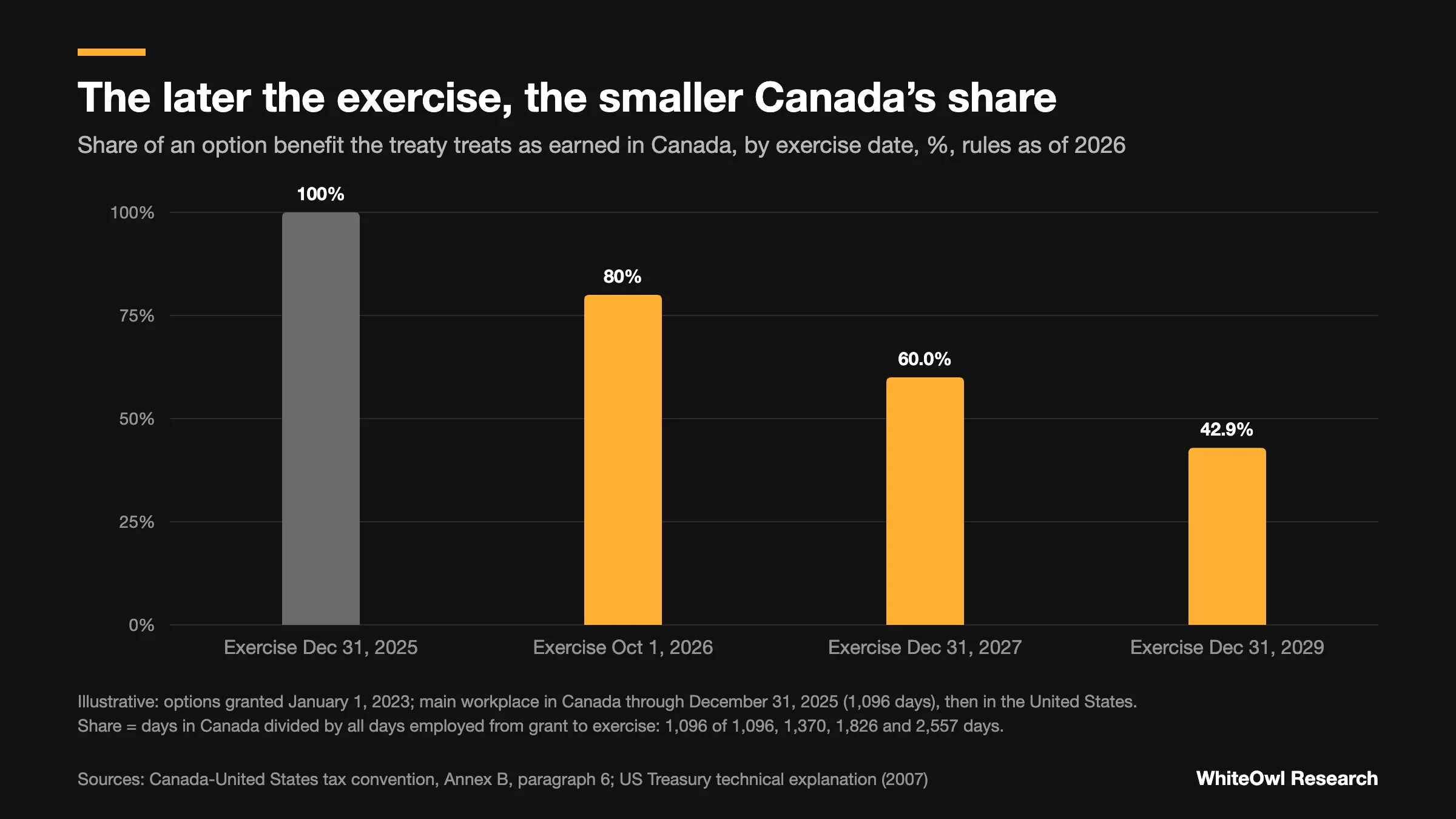
Canada's share of an option benefit falls with each day worked in the United States before exercise.
The figures that matter
The rates, limits and periods that decide the tax on options and RSUs across the Canada-United States border, as of the 2026 tax year. Sources: Income Tax Act, Canada Revenue Agency, IRS and the tax convention, listed below.
| Rule | Figure |
|---|---|
| Canada: share of an option benefit deductible when the conditions are met (%) | 50 |
| Canada: annual vesting limit for the deduction, value of the shares at grant (CAD) | 200,000 |
| Canada: group revenue above which a non-CCPC employer's grants face the vesting limit (CAD) | 500,000,000 |
| Canada: holding period that gives the deduction on CCPC shares (years) | 2 |
| Canada: taxable share of a capital gain (%) | 50 |
| United States: ISO holding period after the grant (years) | 2 |
| United States: ISO holding period after the exercise (years) | 1 |
| United States: ISO limit on shares first exercisable in a calendar year, value at grant (USD) | 100,000 |
| United States: alternative minimum tax exemption, unmarried person, 2026 (USD) | 90,100 |
| United States: alternative minimum tax exemption, joint return, 2026 (USD) | 140,200 |
| United States: foreign tax credit carryback (years) | 1 |
| United States: foreign tax credit carryforward (years) | 10 |
| Treaty: pay at or below which the country of work does not tax a visiting employee (that country's currency) | 10,000 |
| Treaty: days of presence at or below which the short-stay exemption can apply (days in any 12 months) | 183 |
How WhiteOwl helps
An option that crosses the border is measured twice, once under each country's rules, with a count of days between them. With WhiteOwl, the figures are computed by a tax engine from each country's rules, using your own grant, vesting and exercise records, so both countries' numbers can be read side by side. WhiteOwl gathers your documents, organizes your file, finds the issues and runs the numbers. A licensed advisor reviews, decides and files. See how it works.
FAQ
Do I pay Canadian tax on stock options exercised after I move to the United States?
Yes, on the Canadian share. As of 2026, Canada taxes a non-resident on employment income from work done in Canada, and the treaty sets that share by days between grant and exercise. The United States taxes the whole benefit and credits the Canadian tax.
How is a stock option benefit split between Canada and the United States?
By days. Under Annex B to the tax convention, each country's share is the number of days your principal place of employment was there, divided by all the days you were employed by the employer, from grant to exercise.
Are RSUs split the same way as options?
Not by the same rule. The treaty note covers options, and neither it nor the technical explanation mentions RSUs. They fall under the general rule that the country where the work was done may tax the pay for it.
Do unexercised stock options count for Canada's departure tax?
No. As of 2026, rights under an employee stock option agreement are left out of the deemed sale when you leave Canada. Shares you already own from earlier exercises are treated as sold at fair market value.
Sources
- Department of Finance Canada, Canada-United States tax convention (consolidated text) · Annex B to the convention, paragraph 6, stock options
- US Department of the Treasury, Technical Explanation of the 2007 Protocol to the convention
- Canada Revenue Agency, employee security (stock) options · dispositions of property for emigrants of Canada · leaving Canada (emigrants) · Income Tax Folio S5-F2-C1, foreign tax credit
- Justice Laws, Income Tax Act section 7 · section 38 · section 53 · section 110 · section 115 · section 126 · section 128.1
- IRS, Topic no. 427, stock options · Publication 525, taxable and nontaxable income · US taxation of stock-based compensation received by nonresident aliens · Revenue Procedure 2025-32
- IRS, Publication 514, foreign tax credit for individuals · Publication 519, US tax guide for aliens · Internal Revenue Code, section 422 (govinfo)
This article is general information, not personalized tax advice. Consult a qualified cross-border tax professional about your situation.