In short: As of 2026, a qualified charitable distribution (QCD) lets IRA owners aged 70½ or older give up to 111,000 USD a year to United States charities without United States income tax. Canada's Income Tax Act and the United Kingdom-United States treaty exempt what the United States exempts, though neither tax authority has named QCDs. France does not tax IRA payments.
Why it matters
If you are a United States citizen or green card holder retired abroad, two countries look at every IRA withdrawal: the United States and the country where you live. A QCD that only the United States recognized would leave you taxed where you live on money you gave away. Whether that happens depends on the country, and the answers for Canada, the United Kingdom and France rest on three different rules.
The United States rule: what makes a gift a QCD in 2026
In the United States, section 408(d)(8) of the Internal Revenue Code keeps a QCD out of gross income. As of 2026, the conditions are these:
- You are aged 70½ or older on the day of the distribution.
- The money comes from an IRA, not a 401(k), and not a SEP or SIMPLE IRA that still receives employer contributions.
- The IRA trustee pays the charity directly.
- The charity can receive tax-deductible gifts, which means it was created or organized in the United States (section 170(c)(2)). Donor-advised funds, supporting organizations and most private foundations are excluded.
- Your QCDs for the year total no more than 111,000 USD (IRS Notice 2025-67). A one-time election lets up to 55,000 USD go to a charitable remainder trust or charitable gift annuity.
- You claim no deduction for it, and you hold the charity's written acknowledgment.
A QCD counts toward the year's required minimum distribution, which starts at age 73 for owners born from 1951 through 1958. It may exceed the required amount, but the excess does not reduce a later year's requirement.
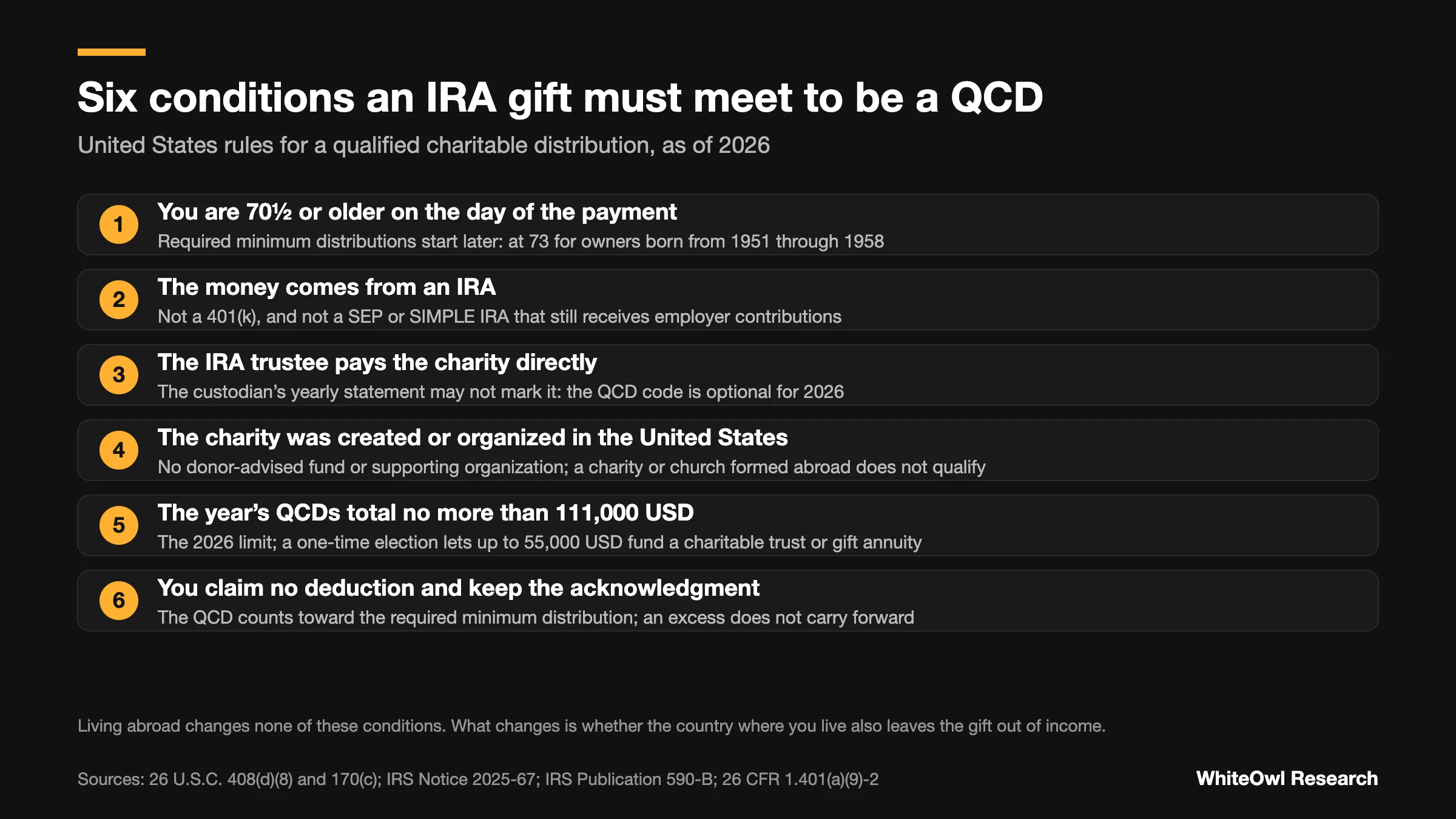
The six United States conditions for a QCD in 2026.
How the IRS sees a QCD
The IRA custodian reports every distribution on Form 1099-R (the yearly statement of payments from a retirement account). Its 2026 instructions include a code, Y, for a distribution the owner intends to treat as a QCD, and make the code optional for tax year 2026. A QCD can therefore still appear as an ordinary withdrawal; the owner identifies it on the return and keeps the charity's acknowledgment.
On any part paid to you, an owner whose home address is outside the United States cannot choose to have no federal tax withheld. Whether you owe United States tax at all is covered in do you have to pay US taxes if you live abroad.
Canada: the exclusion is written into the Income Tax Act
Canada taxes its residents on payments out of a foreign retirement arrangement, a term the Income Tax Regulations (section 6803) limit to IRAs. Clause 56(1)(a)(i)(C.1) of the Income Tax Act includes such a payment in income, except to the extent that the amount would not be subject to income tax in the arrangement's country if the taxpayer were resident there. A QCD within the limit is not income for a United States resident, so by that wording it is not income in Canada either. Article XVIII(1) of the Canada-United States tax convention says the same of any pension, a term it extends to retirement arrangements.
The Canada Revenue Agency restates the rule in Income Tax Folio S2-F1-C3. As of November 2026, it has published nothing that names a QCD, and its guide to the return tells anyone who received amounts from an IRA to contact the agency.
On the rest of the distribution, both countries tax a United States citizen. Canada credits United States tax up to what a resident who is not a citizen would owe, capped by the treaty at 15% of a periodic pension payment, and the United States credits the remaining Canadian tax (Article XXIV(4)).
A gift made outside a QCD has its own relief: Article XXI(7) treats a gift by a resident of Canada to a United States charity as a gift to a registered charity, claimable up to 75% of the net United States source income on the Canadian return. The agency has not said whether a gift paid as a QCD can also be claimed.
United Kingdom: a treaty rule, and no guidance that names a QCD
The United Kingdom taxes a resident on the full amount of a foreign pension (90% before 6 April 2017). Under the 2001 United Kingdom-United States convention, an IRA is a pension scheme, and Article 17(1)(a) lets the country of residence tax what it pays. The United States also taxes its citizens (Article 1(4)), and Article 24(6) has it credit the United Kingdom tax. See Americans moving to the UK; the reverse case is in a UK pension when you live in the United States.
The United Kingdom has no rule of its own for a QCD. What it has is Article 17(1)(b): the amount of a pension from a United States scheme that would be exempt in the United States, if its owner were resident there, is exempt in the United Kingdom, and the saving clause does not override this. HMRC's Double Taxation Relief Manual applies the paragraph to IRAs: a distribution to a United Kingdom resident is exempt to the same extent that it would be exempt in the United States. The manual does not mention a payment an IRA makes directly to a charity, and as of November 2026 HMRC has published nothing that names a QCD.
The paragraph covers pensions, not lump sums: HMRC treats an irregular or abnormal payment as a lump sum, which it says the United Kingdom may also tax. And since 6 April 2024, Gift Aid, the United Kingdom's relief for gifts by individuals, covers United Kingdom charities only, so a gift to a United States charity earns no relief there.
The United Kingdom taxes by tax year: a QCD made in December 2026 falls in the 2026-27 tax year (6 April 2026 to 5 April 2027), while the United States, Canada and France use the calendar year. A new arrival, after at least 10 tax years of non-residence, can claim relief on foreign income, foreign pension income included, for their first four tax years under the regime that began on 6 April 2025. In a year with that claim, the United Kingdom does not tax the IRA distribution.
France: only the United States taxes the IRA
France is the simplest case. Article 18 of the 1994 France-United States convention, rewritten by a 2004 protocol, makes pension distributions paid from a retirement arrangement established in the United States to a resident of France "taxable only" in the United States, citizen or not. The treaty names IRAs as retirement arrangements in its rule on contributions, and its payment rule uses the same term. France then counts that income to set the rate on the household's other income and gives a credit equal to the French tax on it (Article 24).
France therefore collects no income tax on the distribution, with or without a QCD, and what the QCD saves is United States tax. BOFiP, the French administration's official doctrine, has no document that mentions a QCD, so one point stays open: whether the amount paid to the charity still counts when France sets the rate. The notice to the French foreign income form says that, in the general case, this credit requires tax actually paid abroad; Article 24 sets no such condition.
France's relief for gifts, the réduction d'impôt pour dons (income tax reduction for gifts), 66% of the gift in the general case, applies to organizations in France, in another European Union member state, or in Iceland, Norway or Liechtenstein. A United States charity is outside it.
The three countries side by side
Whether a QCD made in 2026 also stays out of income in the country where the retiree lives, and what relief a gift to a United States charity earns there. Sources: Income Tax Act (Canada), the three tax treaties, Canada Revenue Agency, HMRC and service-public.fr, listed below.
| Country of residence | Taxes the IRA distribution | QCD exclusion carries over | Relief for a gift to a United States charity |
|---|---|---|---|
| Canada | Yes | Yes, by the words of the Income Tax Act and the treaty; no agency guidance names a QCD | Donation credit, up to 75% of net United States source income |
| United Kingdom | Yes, in full | Yes for a pension payment, by the words of treaty Article 17(1)(b); HMRC may treat an irregular payment as a lump sum; no HMRC guidance names a QCD | None |
| France | No, taxable only in the United States | Not needed for French tax; its effect on the French rate is not published | None |
An example: a 40,000 USD required distribution and a 10,000 USD gift
A retiree aged 75, a United States citizen, must take 40,000 USD in 2026 from a traditional IRA with no after-tax contributions. They have the trustee send 10,000 USD to a United States charity as a QCD and receive the other 30,000 USD.
For this retiree in 2026, the United States taxes 30,000 USD of the 40,000 USD wherever they live; the table shows what the country of residence taxes, by the words of the rules above, before each country converts to its own currency. Sources: Internal Revenue Code, Income Tax Act (Canada) and the three tax treaties, listed below.
| Country of residence | Taxable there with no QCD (USD) | Taxable there with the QCD (USD) | Rule |
|---|---|---|---|
| Canada | 40,000 | 30,000 | Income Tax Act, clause 56(1)(a)(i)(C.1) |
| United Kingdom | 40,000 | 30,000 | Treaty Article 17(1)(b) |
| France | 0 | 0 | Treaty Article 18 |
In Canada and the United Kingdom, the 10,000 USD leaves both countries' income, provided the agency or HMRC applies its rule as written. In France there was no French tax to remove: the QCD saves United States tax on 10,000 USD. Withdrawn first and then given, the same 10,000 USD would be income in the United States, Canada and the United Kingdom.
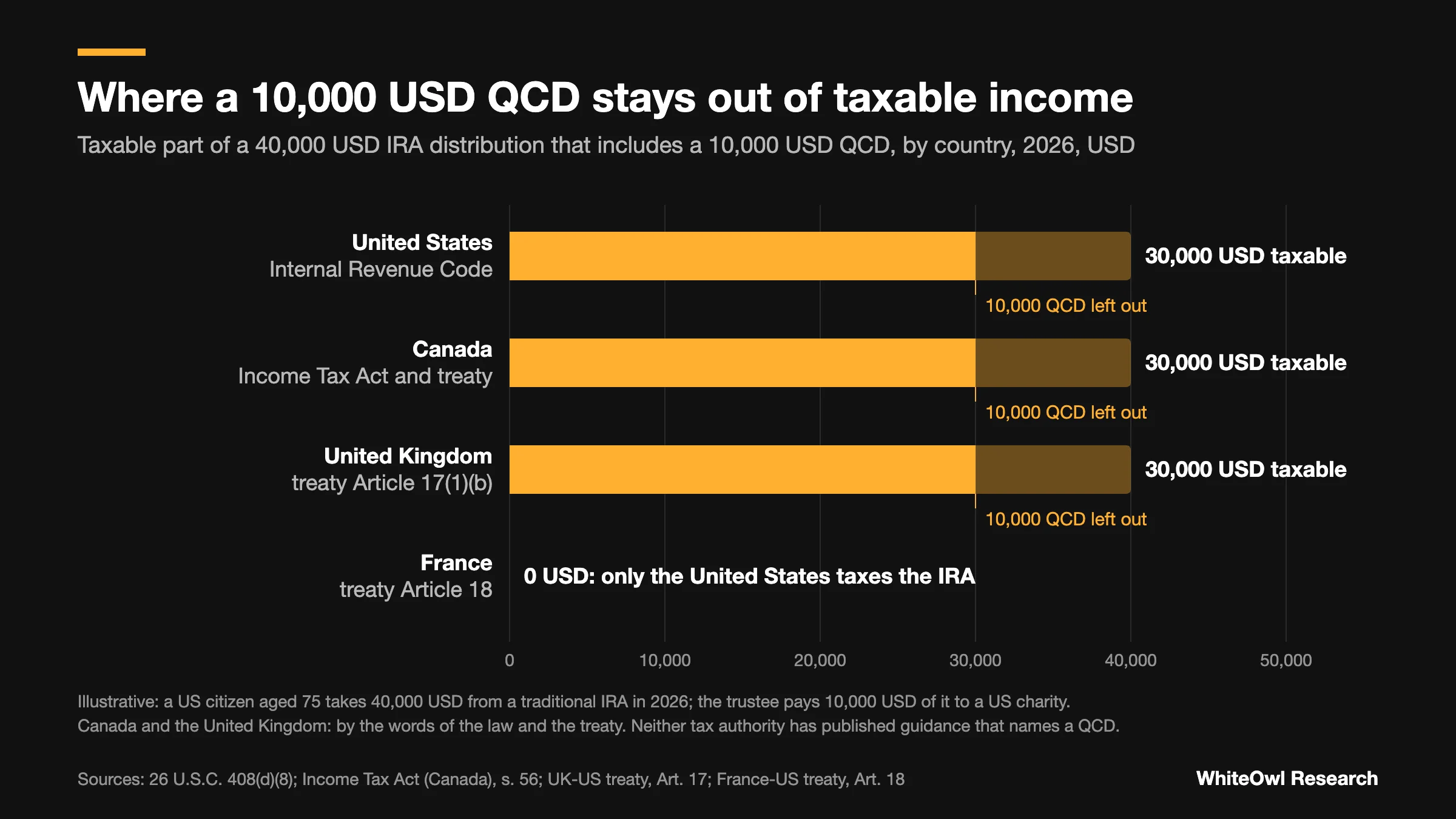
By the words of their rules, Canada and the United Kingdom leave a QCD out of income too.
The figures that matter
The amounts, ages and rates that decide a QCD for a retiree abroad, as of the 2026 tax year (2026-27 in the United Kingdom). Sources: IRS, Canada Revenue Agency, HMRC and service-public.fr, listed below.
| Rule | Figure |
|---|---|
| Minimum age for a QCD (years) | 70½ |
| QCD limit per person, 2026 (USD) | 111,000 |
| QCD limit per person, 2025 (USD) | 108,000 |
| One-time amount to a charitable trust or gift annuity, 2026 (USD) | 55,000 |
| Age when required minimum distributions start, owners born 1951 through 1958 (years) | 73 |
| Age when they start, owners born in 1960 or later (years) | 75 |
| Canada-United States treaty cap on tax at source, periodic pension payments (%) | 15 |
| Canada: gifts to United States charities claimable up to this share of net United States source income (%) | 75 |
| United Kingdom: share of a foreign pension that is taxable, from 6 April 2017 (%) | 100 |
| United Kingdom: tax years a new arrival can claim relief on foreign income (years) | 4 |
| United Kingdom: tax years of non-residence needed before that claim (years) | 10 |
| France: income tax reduction for gifts to eligible organizations, general case (%) | 66 |
| United States: gross income from which a single person aged 65 or older must file, 2026 (USD) | 18,150 |
How WhiteOwl helps
A QCD is a United States rule that Canada, the United Kingdom and France each read through their own law, and tax expertise is narrow: an advisor who knows IRA distributions may know little about Canada's foreign retirement arrangement clause or HMRC's treaty practice. WhiteOwl matches you with an advisor whose specialties and countries fit your case. WhiteOwl gathers your documents, organizes your file, finds the issues and runs the numbers. A licensed advisor reviews, decides and files. See how it works.
FAQ
Can my QCD be larger than my RMD?
Yes. As of 2026, QCDs of up to 111,000 USD a year stay out of United States income whatever the required minimum distribution is, and they count toward it. An amount above the requirement does not reduce a later year's requirement. Canada's and the United Kingdom's rules exempt what the United States exempts, so they follow the same limit.
How does the IRS know you made a QCD?
The custodian reports the distribution on Form 1099-R. Its 2026 instructions include code Y for a QCD but make the code optional for 2026, so the statement may look like an ordinary withdrawal. You identify the QCD on your return and keep the charity's written acknowledgment, which is also your record for the tax authority where you live.
Can I make a QCD to a charity or church outside the United States?
No. A QCD must go to an organization created or organized in the United States, so a charity or church formed abroad does not qualify. A United States charity that funds work abroad can qualify if it controls the use of the money and the gift is not earmarked for a foreign organization. IRS Publication 590-B does not mention the treaty rule that lets United States taxpayers deduct some gifts to Canadian charities.
Can I make a QCD from a 401(k)?
No. A QCD can come only from an IRA, and not from a SEP or SIMPLE IRA that still receives employer contributions. A 401(k) balance can be rolled over into an IRA first, but the year's required minimum distribution from the 401(k) cannot be rolled over. The answer is the same wherever you live: the condition is in United States law.
Do I still file a US return if my only income is an IRA and I give it all to charity?
The duty to file depends on gross income, and a QCD within the limit is not part of gross income. For 2026, a single person aged 65 or older must file from 18,150 USD of gross income; a married person who files separately had to file from 5 USD for 2025. Income from outside the United States counts toward those amounts, so a retiree abroad with a foreign pension or interest may still have to file.
Sources
- Internal Revenue Code, section 408(d)(8) · section 170 · section 6012 · Treasury Regulations, section 1.401(a)(9)-2
- IRS, Notice 2025-67, 2026 amounts for retirement plans and IRAs · Revenue Procedure 2025-32 · Instructions for Forms 1099-R and 5498 (2026)
- IRS, Publication 590-B, distributions from IRAs · Publication 526, charitable contributions · Publication 501, filing information · rollovers of retirement plan and IRA distributions
- Justice Laws, Income Tax Act section 56 · Income Tax Regulations section 6803 · Department of Finance Canada, Canada-United States tax convention (consolidated text)
- Canada Revenue Agency, Income Tax Folio S2-F1-C3, pension benefits · other pensions and superannuation · Guide P113, gifts and income tax
- HMRC, 2001 United Kingdom-United States double taxation convention · Double Taxation Relief Manual, DT19853 · Employment Income Manual, EIM75500 · Income Tax (Earnings and Pensions) Act 2003, sections 573 to 576
- HMRC, helpsheet HS342, charitable giving (2026) · restriction of charitable reliefs to UK charities · helpsheet HS266, foreign income and gains regime (2026)
- US Treasury, 2004 protocol to the France-United States convention · IRS, France-United States convention of 1994 · 2009 protocol · technical explanation of the United Kingdom convention
- impots.gouv.fr, notice to form 2047, foreign income (2026) · BOFiP · service-public.fr, gifts to associations and organisations
This article is general information, not personalized tax advice. Consult a qualified cross-border tax professional about your situation.