In short: As of 2026, restricted stock units (RSUs) and stock options are treated as earned over their vesting period, so each country where you worked during that period can tax its share, at its own moment. The United States, the United Kingdom and France each measure that share by time, and tax treaties say which country gives the credit.
Why it matters
An engineer or executive who changes country partway through a four-year vesting schedule can owe tax in two countries on every award that vests afterward. The two shares do not always add up to the whole: countries count different days and tax at different moments (vesting, exercise or sale), and an employer may report the whole amount to one of them.
The principle: an award is earned where you worked while it vested
Most tax treaties follow the OECD model. Its commentary on employment income (Article 15, paragraphs 12 to 12.15) says the country where the work was done may tax the part of a stock option benefit earned there, even if it levies the tax after the employee has left. As a general rule, an option rewards the period of employment required to earn the right to exercise it, and each country's part is the days worked there over all the days of that service. Each country stays free to tax at grant, at exercise or at sale, so the two taxes can fall in different years; the commentary says the country of residence should still give relief. Two countries may also agree on another measure, such as the days from grant to exercise. The commentary notes that many of the same problems arise for other pay based on shares.
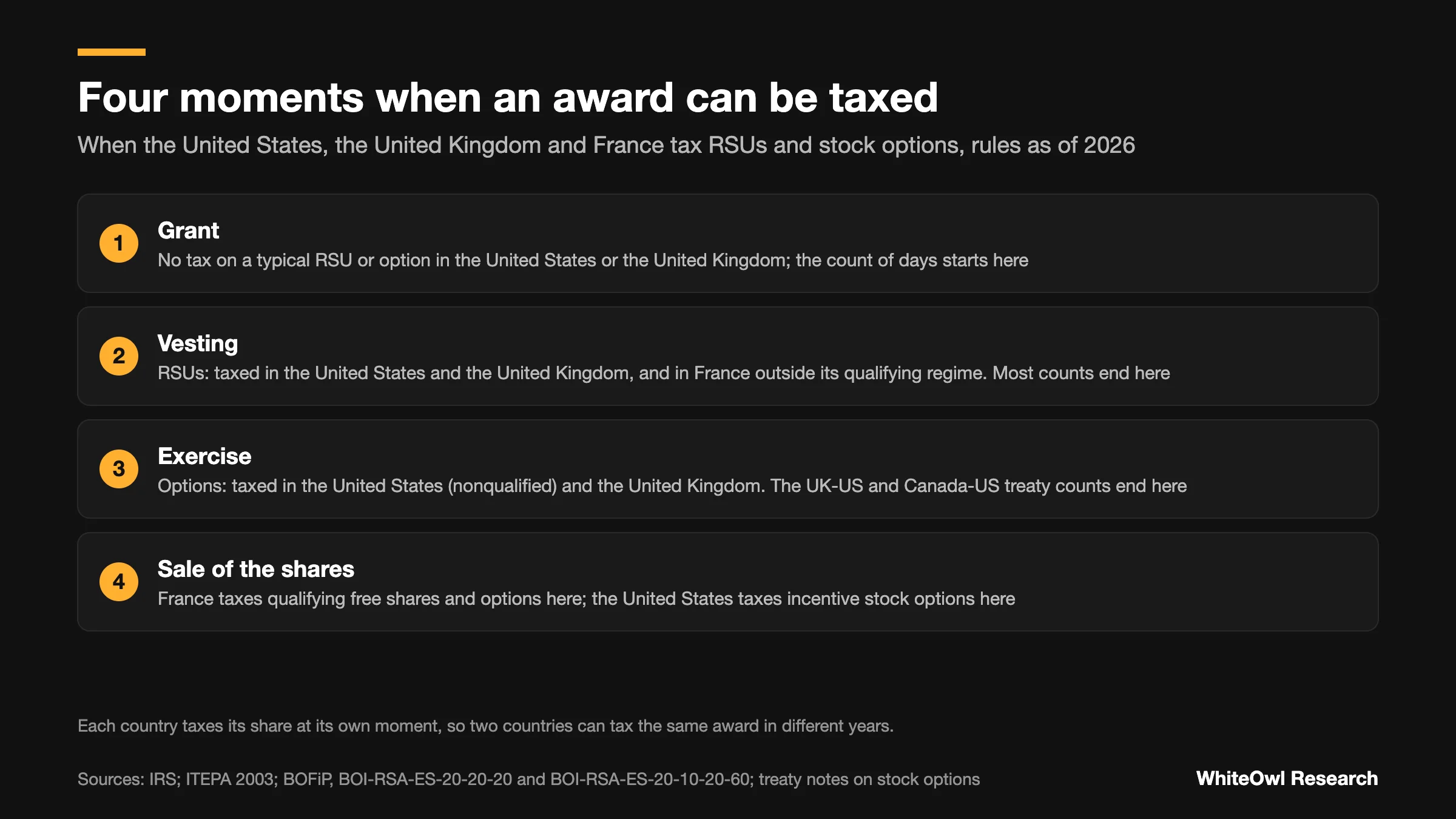
The four moments at which the United States, the United Kingdom and France tax an RSU or option.
When the United States taxes RSUs and options
In the United States, as of 2026, nothing is generally taxed when RSUs are granted. When the units vest and the shares are delivered, their value is ordinary income, reported as wages. For most nonstatutory options, often called nonqualified, there is no tax at grant either; at exercise, the share's value minus the price paid is income of that year.
An incentive stock option (ISO) puts nothing in income at grant or at exercise for regular tax, although the spread at exercise counts for the alternative minimum tax. The gain is a capital gain if the shares are sold more than two years after the grant and more than one year after the exercise. Shares a founder already owns are a different matter: see the qualified small business stock exclusion for founders who move.
Employers may withhold federal income tax on such pay, treated as supplemental wages, at a flat 22%, and must withhold 37% on the part above 1,000,000 USD in a calendar year (IRS Publication 15 for 2026). The tax itself is computed on the return.
How the United States measures its share
US citizens and resident aliens, who include green card holders, are taxed on worldwide income; a nonresident alien is taxed on pay only for work done in the United States. For pay earned over several years, a Treasury regulation sources the amount by time: the days worked in the United States over all the days worked in the period the pay relates to, which for stock options generally runs from grant to vesting. The IRS applies the same count to RSUs, and says the US share is fixed on the vesting date even when an option is exercised later.
If you leave. A nonresident alien is still taxed on the US share when the RSUs vest or the option is exercised, at graduated rates, as income connected with a US business; the rest is outside US tax. If the employer's wage statement shows the whole amount, the IRS says, the return reports the US share and explains why. A US citizen, or a green card holder who keeps that status, is taxed on the whole amount (see US taxes when you live abroad) and can credit the other country's income tax on the share earned there, up to the US tax on that foreign-source income. Unused credit carries back one year and forward ten. Giving up citizenship or a long-held green card is a separate question: see the US exit tax.
If you arrive. A US resident is taxed on the whole value of an award that vests after arrival, including the part earned abroad. That part is foreign-source, so foreign income tax on it can be credited within the same limit.
States. California, for example, taxes a former resident on the share earned on California workdays, counted from grant to vesting for RSUs and from grant to exercise for nonqualified options (Franchise Tax Board Publication 1004, revised January 2015).
The United Kingdom: equal daily amounts from grant to vesting
In the United Kingdom, as of the 2026-27 tax year (6 April 2026 to 5 April 2027), no income tax arises when an employee option is granted; the gain is taxed when shares are acquired on exercise. Since 6 April 2016, RSUs that give a right to acquire shares are taxed under the same rules, at vesting.
For a mobile employee, rules in force since 6 April 2015 (Income Tax (Earnings and Pensions) Act 2003, or ITEPA 2003, Part 2, Chapter 5B) apply whenever the award was granted. The income is treated as accruing in equal amounts on each day from grant to vesting. The part accruing in a tax year, or the overseas part of a split year, when the person was not UK resident and worked wholly outside the UK is not charged; where some of that work was in the UK, the split is usually made by workdays. Someone arriving from Seattle is therefore not taxed on the days before arrival, and someone leaving London stays taxable on the UK days when the award later vests. National Insurance contributions follow the same daily spreading.
Since 6 April 2025, a UK resident's overseas workdays are no longer deducted in this calculation. A new resident (not UK resident in any of the 10 previous tax years, for up to four tax years) may instead elect and claim Overseas Workday Relief on securities income that accrues in a qualifying year and relates to duties outside the UK, up to the lower of 30% of qualifying employment income and 300,000 GBP a year: see Americans moving to the UK.
The UK-US treaty. Notes exchanged with the 2001 convention say that, for an option, the country where the employee does not live at exercise taxes only the part relating to the time between grant and exercise when they worked there. HM Revenue and Customs (HMRC) notes the mismatch with its own rule, which stops at vesting, and gives foreign tax credit relief on any part of the gain also taxed in the UK. The notes do not mention RSUs. Under Article 24, the UK credits US tax on its residents' US-source income, and the United States credits UK income tax for its residents and citizens.
France: two regimes, counted in calendar days
In France, which taxes the calendar year, the timing depends on the plan. For attributions gratuites d'actions (free share awards) made under the conditions of the French commercial code, by a French or a foreign company, the gain is the value of the shares on the day they are definitively acquired, and it is taxed in the year the shares are sold or given away (article 80 quaterdecies of the Code général des impôts). For awards authorised by shareholders after 31 December 2017, the gain up to 300,000 EUR a year is reduced by 50%, and the rest is taxed as salary. An award outside those conditions is salary of the year the shares are acquired. Options follow the same pattern: sale for qualifying plans, exercise for others.
For mobile employees, the tax administration's commentary (BOFiP) follows the OECD approach: the gain is taxable where the work it rewards was done. The reference period runs from the grant to the day the right is definitively earned, for example when a presence or performance condition is met, and the French part is counted in calendar days, 365 a year. A resident of France is taxed only on the French part when the rest relates to work in a treaty country. A non-resident pays tax on the French part through a retenue à la source (withholding tax) under article 182 A ter.
France tests residence at its own taxing moment, and can tax a qualifying gain years after the United States taxed the same award at vesting; the US credit for that later tax carries back only one year. Under the France-United States convention (Article 24), the United States credits French income tax for its citizens and residents, and France gives its residents a credit equal to the French tax on pay taxable in the United States.
Canada, in two sentences
In Canada, as of 2026, the benefit under an agreement to issue shares, a category in which the Canada Revenue Agency lists stock options and RSUs, is generally taxed in the year the employee acquires the shares. Its convention with the United States splits an option benefit by the days the principal place of employment was in each country between grant and exercise: see stock options and RSUs when you move between Canada and the United States.
The rules side by side
Each country taxes an award at its own moment and measures its own share, under the rules in force in 2026 (the 2026-27 tax year for the United Kingdom). Sources: IRS, HMRC, BOFiP, Canada Revenue Agency and California Franchise Tax Board, listed below.
| Country | RSUs taxed at | Options taxed at | Share for a mobile employee | Source |
|---|---|---|---|---|
| United States | Delivery of the shares at vesting | Exercise, for nonqualified options | Days worked in the United States, grant to vesting | Treasury Regulation 1.861-4 |
| United Kingdom | Acquisition of the shares at vesting | Exercise | Equal daily amounts, grant to vesting, minus days not resident and working abroad | ITEPA 2003, sections 41F to 41H and 476 |
| France, qualifying plans | Sale of the shares | Sale of the shares | Calendar days posted in France, grant to the day the right is earned | BOFiP, BOI-RSA-ES-20-20-20 |
| France, other plans | Acquisition of the shares | Exercise | Calendar days posted in France, grant to the day the right is earned | BOFiP, BOI-RSA-ES-20-10-20-60 |
| Canada | Acquisition of the shares | Acquisition of the shares | Days of principal workplace, grant to exercise (treaty with the United States, options) | Canada Revenue Agency; convention, Annex B |
| California | Vesting | Exercise | California workdays, grant to vesting (RSUs) or to exercise (options) | Franchise Tax Board, Publication 1004 |
A worked example: RSUs granted in Seattle, vesting in London
A product manager in Seattle is granted RSUs on 6 October 2022. They vest in one block after four years of service, on 5 October 2026, when the shares delivered are worth 400,000 USD. The employee works only in the United States until 5 April 2025, then only in the United Kingdom from 6 April 2025, and is UK resident from the 2025-26 tax year but not before.
For this employee in 2026, 62.5% of a 400,000 USD award is United States income and 37.5% is United Kingdom income. Sources: Treasury Regulation 1.861-4, ITEPA 2003 and the UK-United States convention, listed below.
| Step | Figure |
|---|---|
| Days from grant to vesting, 6 October 2022 to 5 October 2026 | 1,461 |
| Days working in the United States, to 5 April 2025 | 913 |
| Days working in the United Kingdom, from 6 April 2025 | 548 |
| United States share of days (%) | 62.5 |
| United Kingdom share of days (%) | 37.5 |
| Value of the shares at vesting (USD) | 400,000 |
| United States share of the income (USD) | 249,966 |
| United Kingdom share of the income (USD) | 150,034 |
| Taxed by the United States, if a US citizen (USD) | 400,000 |
| Taxed by the United States, if a nonresident alien (USD) | 249,966 |
| Taxed by the United Kingdom, in both cases (USD) | 150,034 |
(a) A US citizen. The United States taxes the whole 400,000 USD in 2026. The United Kingdom taxes 150,034 USD; the 913 days before arrival are not charged. The United States credits the UK income tax on that share, within the limit for foreign-source wages.
(b) A non-citizen who left. As a nonresident alien in 2026, they are taxed by the United States on 249,966 USD and by the United Kingdom on 150,034 USD. No part is taxed twice, so no credit is needed.
The example counts calendar days, as the UK statute does; by working days (Mondays to Fridays), the US share is 652 of 1,043, again 62.5%. Had these been options exercised on 5 October 2027, after one more year in London, the US rule would still give 62.5%, and the treaty's count to exercise 50.0% (913 of 1,826 days). Amounts are in USD for comparison.
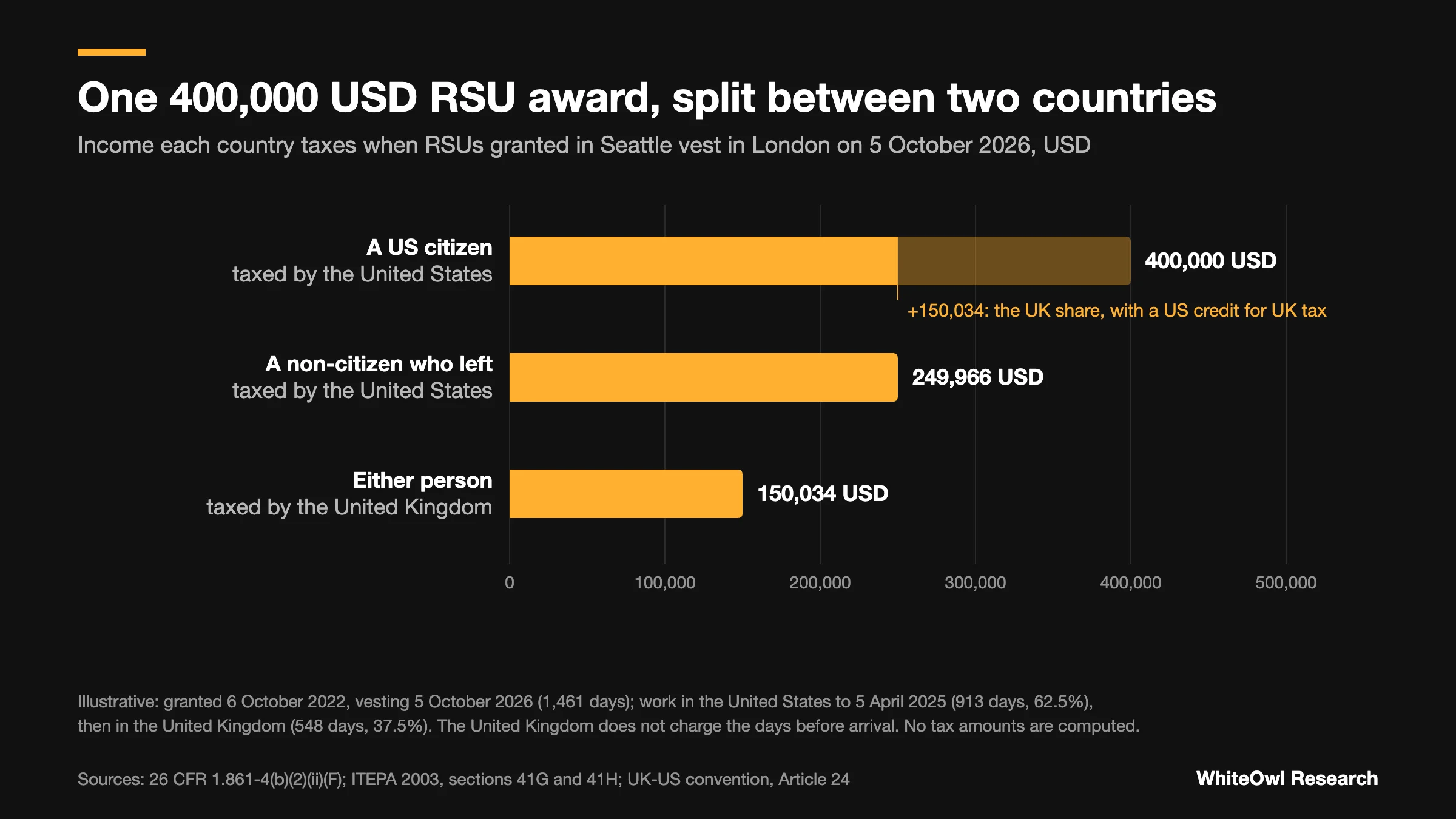
One RSU award split between the United States and the United Kingdom by days from grant to vesting.
The figures that matter
The rates, limits and periods that decide the tax on an award that crosses a border, as of 2026 (the 2026-27 tax year for the United Kingdom). Sources: IRS, Internal Revenue Code, HMRC and BOFiP, listed below.
| Rule | Figure |
|---|---|
| United States: flat withholding rate on supplemental wages, 2026 (%) | 22 |
| United States: withholding rate on supplemental wages above 1,000,000 USD in a calendar year, 2026 (%) | 37 |
| United States: ISO limit on stock first exercisable in a calendar year, value at grant (USD) | 100,000 |
| United States: ISO holding period after the grant (years) | 2 |
| United States: ISO holding period after the exercise (years) | 1 |
| United States: longest term of an ISO, from the grant (years) | 10 |
| United States: foreign earned income exclusion, 2026 (USD) | 132,900 |
| United States: foreign tax credit carryback (years) | 1 |
| United States: foreign tax credit carryforward (years) | 10 |
| United Kingdom: tax years of non-residence required before Overseas Workday Relief (years) | 10 |
| United Kingdom: tax years in which a new resident can qualify (years) | 4 |
| United Kingdom: Overseas Workday Relief limit, share of qualifying employment income (%) | 30 |
| United Kingdom: Overseas Workday Relief limit for a qualifying year (GBP) | 300,000 |
| France: yearly part of a qualifying free share gain that is reduced by half (EUR) | 300,000 |
| France: reduction on that part, awards authorised after 31 December 2017 (%) | 50 |
How WhiteOwl helps
An award granted in one country and taxed years later in another rests on old paperwork: the grant agreement, each vesting or exercise statement, wage statements from both employers and a record of where you worked. WhiteOwl keeps your actual documents from one year to the next, so they are on file when the award vests, is exercised or is sold. WhiteOwl gathers your documents, organizes your file, finds the issues and runs the numbers. A licensed advisor reviews, decides and files. See how it works.
FAQ
Do I pay US tax on RSUs that vest after I leave the United States?
Yes, on the US share. As of 2026, a nonresident alien is taxed on the part earned by work in the United States, measured by days worked there between grant and vesting. A US citizen or green card holder is taxed on the whole value wherever they live, with a credit for the other country's income tax on the share earned there.
Are RSUs taxed twice when I move countries?
Two countries can tax the same RSU, but mostly on different shares: as of 2026, the United States, the United Kingdom and France each tax the part earned by work on their soil. A country that taxes the whole value, as the United States does for its citizens and residents, credits the other's tax on the share earned there, within limits. Tax can remain where the countries count different days or tax in different years.
What is the 100,000 USD rule for stock options?
It is a US limit on incentive stock options: options count as ISOs only up to 100,000 USD of stock, valued at grant, that first becomes exercisable in a calendar year, and the excess is treated as nonqualified. It is a rule of US law only: the United Kingdom, for one, taxes an option gain at exercise, with exceptions only for its own tax-advantaged schemes.
Do RSUs have an expiration date?
Not in the way options do. An RSU is a promise to deliver shares when its conditions are met, with nothing to exercise, while an option can be exercised only for a limited period (for an ISO, at most 10 years from the grant). Across borders, the vesting date of an RSU ends the period that the United States and the United Kingdom use to measure their shares.
What does PSU stand for?
Performance share unit, also called performance stock unit: a share unit that vests only if performance conditions are met. For a mobile employee, France's guidance runs the period used to split the gain to the day those conditions are met.
Does the foreign earned income exclusion cover RSU income?
Only part of it, at most. As of 2026, the exclusion covers pay for work done in a foreign country, up to 132,900 USD, and the IRS does not count pay received after the end of the year following the year of the work. The share earned by work in the United States therefore falls outside, as does any share earned abroad earlier than the year before the award vests. Foreign tax on excluded pay cannot be credited. The IRS publications read for this article give no RSU example.
Sources
- IRS, US taxation of stock-based compensation received by nonresident aliens (webinar script) · Topic no. 427, stock options · Publication 525, taxable and nontaxable income · Publication 15 (2026), employer's tax guide
- Code of Federal Regulations, 26 CFR 1.861-4, compensation for labor or personal services · 26 CFR 31.3402(g)-1, supplemental wages · Internal Revenue Code, section 83 · section 421 · section 422 · section 864
- IRS, Publication 519, US tax guide for aliens · Publication 514, foreign tax credit for individuals · Publication 54, tax guide for US citizens and resident aliens abroad · Instructions for Form 2555 (2026) · what is foreign earned income
- California Franchise Tax Board, Publication 1004, equity-based compensation guidelines
- legislation.gov.uk, Income Tax (Earnings and Pensions) Act 2003, section 41F · section 41G · section 41H · section 475 · section 476 · section 477
- HMRC, Employment Related Securities Manual, international from 6 April 2015 · treaty time apportionment and Chapter 5B · international from 6 April 2025 · restricted stock units · Employment Income Manual, Overseas Workday Relief · National Insurance Manual, internationally mobile employees
- GOV.UK, 2001 UK-USA double taxation convention, with the exchange of notes · US Department of the Treasury, technical explanation of the convention
- BOFiP, BOI-RSA-ES-20-20-20, free share awards · BOI-RSA-ES-20-10-20-60, option gains of migrant employees · BOI-IR-DOMIC-10-20-20-30, withholding on French-source gains · BOI-IR-BASE-10-10-10-30, annual income · impots.gouv.fr, France-United States convention (consolidated text)
- Canada Revenue Agency, employee security (stock) options · Department of Finance Canada, Canada-United States convention, Annex B · Justice Laws, Income Tax Act section 7
- OECD, Model Tax Convention on Income and on Capital, condensed version 2017, commentary on Article 15 · The 2025 update to the OECD Model Tax Convention
This article is general information, not personalized tax advice. Consult a qualified cross-border tax professional about your situation.