In short: As of 2026, Canada and the United Kingdom leave the growth and the qualified withdrawals of a Roth IRA untaxed under their treaties with the United States; Canada requires a one-time election and no contribution made while resident. France's tax authority has published nothing on either point. Contributing from abroad requires pay that stays in United States taxable income.
Why it matters
A Roth IRA is worth its full balance only where nobody taxes the growth or the withdrawals. For an American abroad, or for someone who went home after working in the United States, that depends on a second country: one follows the United States rule, one follows it on conditions, and one has said nothing. One contribution or conversion at the wrong time can end the protection for everything the account earns afterward.
Three questions decide what a Roth IRA is worth abroad
Can you still contribute? Does the country you live in leave the growth and the withdrawals untaxed, as the United States does? What breaks that treatment? The United States rules come first; the answers for Canada, the United Kingdom and France follow.
Contributing from abroad: the pay must be taxed in the United States
In the United States, as of 2026, IRS Publication 590-A sets two tests for a Roth IRA contribution, and neither is your address or your age: you need taxable compensation, and your income must be under a limit. For 2026 you can contribute up to 7,500 USD, or 8,600 USD from age 50, and never more than your compensation.
Compensation is pay for work. Pension and annuity income, interest, dividends and rent do not count, and Social Security benefits are not on the IRS list of what does. Pay you exclude from income does not count either, which is the rule that matters abroad: pay left out under the foreign earned income exclusion, up to 132,900 USD for 2026, is not compensation. Pay you keep in income and relieve with the foreign tax credit still counts, because a credit reduces the tax, not the income. Whether you owe United States tax at all is in do you have to pay US taxes if you live abroad.
The income test adds the exclusion back. For 2026 the contribution shrinks between 153,000 and 168,000 USD of income for a single person, between 242,000 and 252,000 USD on a joint return, and between 0 and 10,000 USD for a married person who files separately and lived with their spouse. A single engineer in London paid the equivalent of 150,000 USD who excludes 132,900 USD keeps 17,100 USD of compensation and can contribute the full 7,500 USD. At 200,000 USD of pay, the test reads 200,000 USD and nothing is allowed.
A contribution above what the tests allow is taxed at 6% for each year it stays in the account, unless you withdraw it with its earnings by the due date of your return, extensions included. Contributions for 2026 can be made until April 15, 2027 for most people; an extension does not move that date.
A conversion from a traditional IRA is not counted against the contribution limit, so it needs no compensation and has no income ceiling. The converted amount is taxed as United States income for that year.
Withdrawals under United States law
A qualified withdrawal is not income. It must come after the five tax years that start with the first year for which you contributed to a Roth IRA, and on or after age 59½; death, disability and a first home purchase are the other cases. Any other withdrawal returns your regular contributions first, free of tax; only the earnings part is income, with a 10% additional tax unless an exception applies. The owner is never required to take money out.
IRS Publication 590-B draws no distinction by residence, so the same holds for a person who is not a United States citizen and went home. Publication 519, the IRS guide for aliens, does not mention the Roth IRA; it says a pension paid to a nonresident alien is generally subject to 30% withholding, or a lower treaty rate, which matters only for the taxable part of a withdrawal that is not qualified.
Canada: a pension under the treaty, on two conditions
In Canada, as of 2026, the Canada Revenue Agency starts from domestic law in its Income Tax Folio S5-F3-C1: a Roth IRA has none of the deferral Canada gives its own registered plans, so the income it earns is generally taxable every year. For a brokerage account, that means interest, dividends and capital gains as they arise.
The Canada-United States tax convention changes the result. Article XVIII counts a Roth IRA as a pension. Paragraph 7 lets a resident of Canada elect to defer Canadian tax on income accrued in the plan until it is paid out, and paragraph 1 exempts in Canada any payment that would not be taxable in the United States if the person lived there. On two conditions, a qualified withdrawal is then taxed by neither country.
The first is the election. It is made once and cannot be revoked, for each Roth IRA, in a signed letter to the agency's Competent Authority Services Division, by the filing due date for the tax year (the calendar year) in which you became resident. A person who missed that date is told to contact the same division.
The second concerns contributions. A contribution made while you are resident in Canada, which the agency calls a Canadian Contribution, splits the account in two. The balance just before it stays a pension; the contribution and all income the account earns afterward are taxed in Canada each year. A rollover from another Roth IRA or a Roth 401(k) does not count. A conversion from a traditional IRA or 401(k) does, and so does a regular contribution that United States law allows. With both conditions met, the agency does not ask for the account on its foreign reporting forms.
How other countries treat Canada's own plans is in your RRSP after leaving Canada and a TFSA as a non-resident.
A worked example: one 7,500 USD contribution made in Canada
A nurse moves from Seattle to Vancouver with a Roth IRA worth 150,000 USD and files the election on time. Five years later the account is worth 180,000 USD, and over the next five years everything in it grows by one third. On one path they add nothing; on the other they contribute 7,500 USD at the five-year mark.
In this illustration, a 7,500 USD contribution made while resident in Canada takes 62,500 USD of later growth out of the treaty's protection, under the rules in force in 2026. Sources: Canada-United States tax convention, Article XVIII, and Canada Revenue Agency, Income Tax Folio S5-F3-C1.
| Step | Amount (USD) |
|---|---|
| Roth IRA on the day they become resident of Canada | 150,000 |
| Value five years later | 180,000 |
| Value ten years later, with no contribution | 240,000 |
| Growth deferred by the election, with no contribution | 90,000 |
| Contribution made at the five-year mark | 7,500 |
| Value ten years later, with the contribution | 250,000 |
| Balance that stays a pension, the value just before the contribution | 180,000 |
| Growth after the contribution, outside the treaty | 62,500 |
| Part of that growth earned on money already in the account | 60,000 |
Without the contribution, all 90,000 USD of growth is deferred and a qualified withdrawal of the 240,000 USD is exempt in Canada. With it, withdrawals stay exempt only up to 180,000 USD, and the income behind the 62,500 USD is taxed in Canada as it arises. The folio gives no rate: the tax depends on what the account earns and sells each year, so the example stops at the amount exposed.
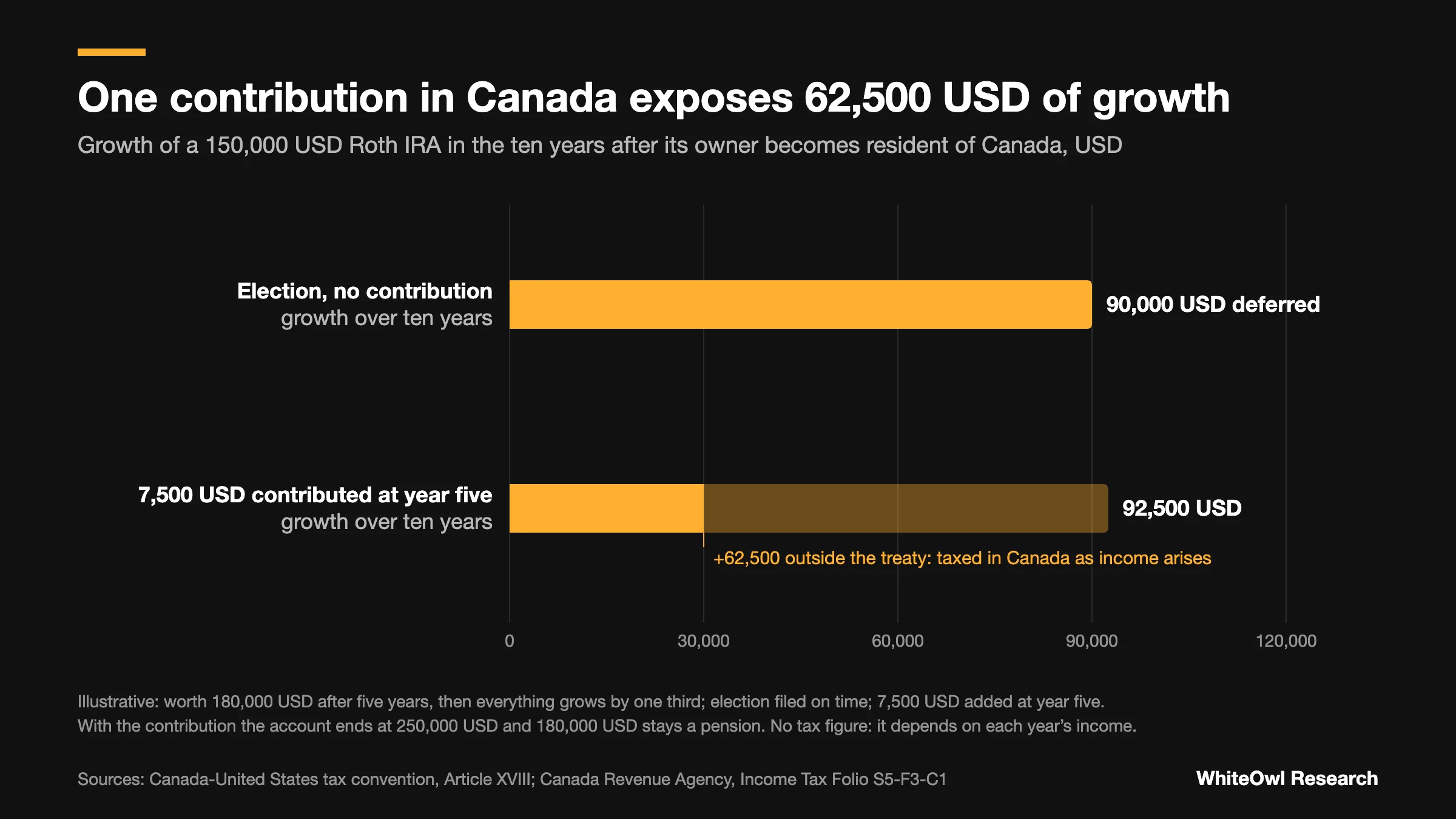
One 7,500 USD contribution made while resident in Canada takes 62,500 USD of later growth out of the treaty.
The United Kingdom: growth and qualified withdrawals untaxed
In the United Kingdom, as of the 2026-27 tax year (6 April 2026 to 5 April 2027), the rule comes from the 2001 convention with the United States. The exchange of notes signed with it names the United States pension schemes it covers, Roth IRAs among them. Under Article 18(1), income earned inside such a scheme can be taxed as the owner's only when it is paid out. Under Article 17(1)(b), an amount that would be exempt in the United States if the owner lived there is exempt in the United Kingdom. Both rules bind a country even for its own residents and citizens, and the convention asks for no election.
The United States Treasury's technical explanation gives a Roth IRA as its example of that exemption. HMRC's Double Taxation Relief Manual states the same rule with a United States individual retirement arrangement as its example; no HMRC manual names the Roth IRA.
The convention has no rule like Canada's on contributions: nothing in Articles 17 and 18 or the notes makes the treatment depend on where the owner lived when the money went in. HMRC's manuals say nothing on a United Kingdom resident's contributions to a Roth IRA.
The reverse does not hold: the notes list no ISA among the United Kingdom's pension schemes, so the United States taxes an American's ISA each year (see ISAs for Americans living in the United Kingdom). Funds bought outside the United States raise the passive foreign investment company rules, and pensions going the other way are in a UK pension when you live in the United States.
France: a treaty rule, and nothing published on the Roth IRA
In France, as of 2026, the 1994 convention with the United States applies as amended by protocols of 2004 and 2009. Under Article 18(1), pension distributions arising in the United States in consideration of past employment, paid to a resident of France by a retirement arrangement established in the United States, are taxable only in the United States, whether paid periodically or as a lump sum. France takes that income into account in computing French tax, for its calendar tax year, and gives a credit equal to the French tax on it.
The convention does not name the Roth IRA. The United States Treasury's technical explanation of the 2004 protocol calls it a type of individual retirement plan, in its passage on paragraph 2, the rule on contributions: a person who works in France, is not a French national and joined the plan before arriving can deduct contributions within French limits, and an employee's benefits accrued in the plan stay out of French taxable income.
The French tax authority's published doctrine mentions the Roth IRA once, in a 2015 list of foreign plans that notes its contributions are not deductible. It has published nothing on the growth inside the account while it is not withdrawn, on whether a withdrawal from a Roth IRA the owner funded themselves is a pension payment under Article 18, or on contributions made while resident in France.
That leaves two readings of a qualified withdrawal. If it is a pension distribution under Article 18, only the United States may tax it, and the United States does not. If it is not, Article 22 of the convention, on income the other articles do not cover, leaves it to France as the country of residence, under French law. Until the French tax authority says which reading it follows, a Roth IRA withdrawal by a resident of France has no settled French treatment.
The three countries side by side
How each country of residence treats a Roth IRA under its convention with the United States, as of 2026 (2026-27 for the United Kingdom). Sources: the three conventions, Canada Revenue Agency, HMRC and the French tax authority, listed below.
| Country of residence | Growth inside the account | Qualified withdrawals | Contribution made while resident | To file or elect |
|---|---|---|---|---|
| Canada | Deferred with the election; taxed each year without it | Exempt, up to the balance before any contribution made while resident | Income the account earns afterward is taxed each year | One election letter for each Roth IRA, by the filing due date for the year of arrival |
| United Kingdom | Not taxed until paid out | Exempt | No rule in the convention; nothing published by HMRC | No election in the convention |
| France | Nothing published by the tax authority | Taxable only in the United States if Article 18 covers them; nothing published on the Roth IRA | No rule in the convention; nothing published | No election in the convention |
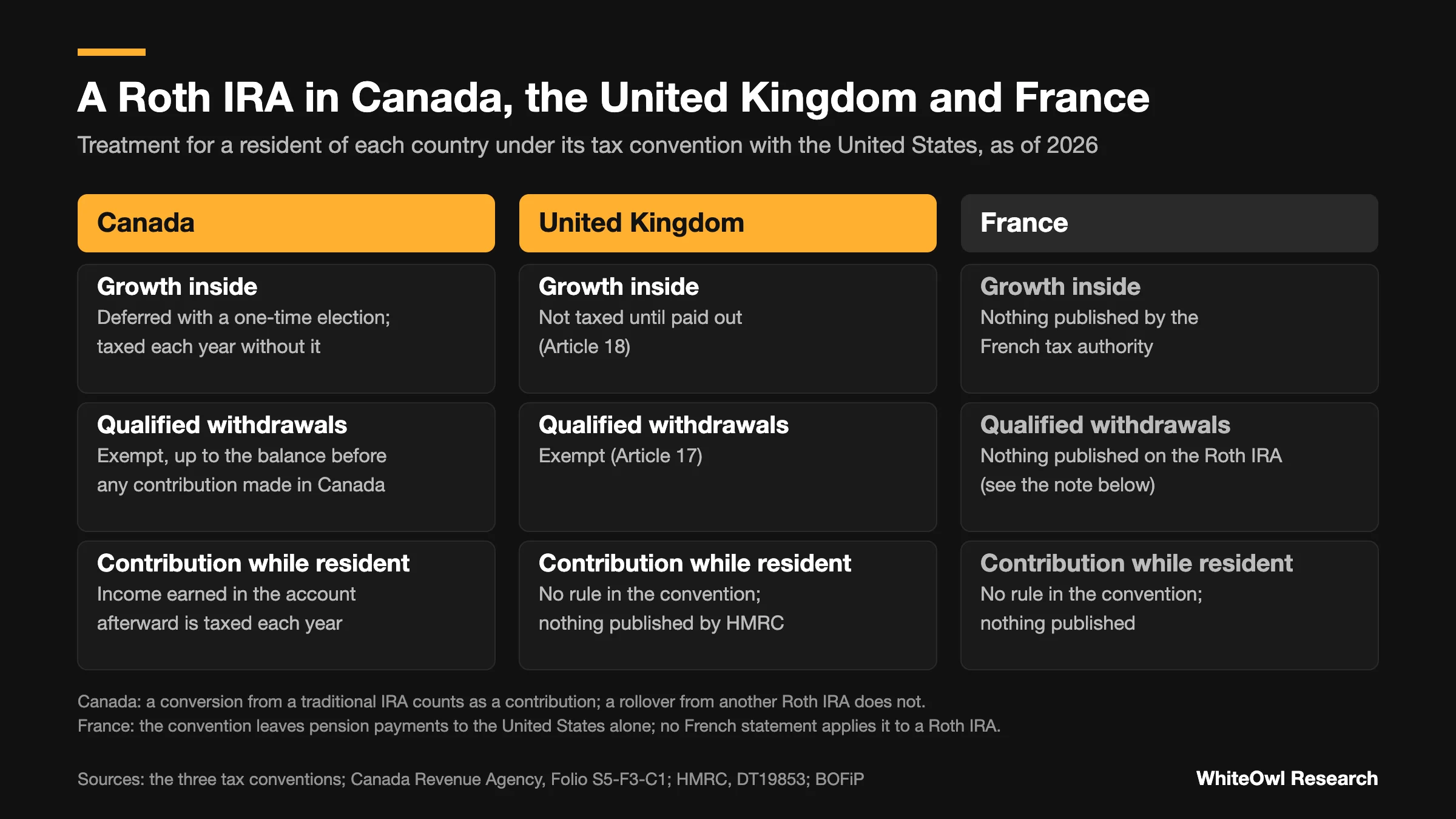
How Canada, the United Kingdom and France each treat a Roth IRA held by a resident.
The figures that matter
The limits and rates that decide a Roth IRA contribution or withdrawal from abroad, for the 2026 tax year. Sources: IRS Notice 2025-67, Revenue Procedure 2025-32 and Publications 590-A, 590-B and 519; Canada Revenue Agency.
| Rule | Figure |
|---|---|
| Roth IRA contribution limit, 2026 (USD) | 7,500 |
| Limit from age 50, 2026 (USD) | 8,600 |
| Income where the limit starts to fall, single, 2026 (USD) | 153,000 |
| Income where no contribution is allowed, single, 2026 (USD) | 168,000 |
| Income where the limit starts to fall, joint return, 2026 (USD) | 242,000 |
| Income where no contribution is allowed, joint return, 2026 (USD) | 252,000 |
| Income where no contribution is allowed, married filing separately and living together (USD) | 10,000 |
| Foreign earned income exclusion, 2026 (USD) | 132,900 |
| Excise tax on an excess contribution, each year (%) | 6 |
| Additional tax on the taxable part of an early withdrawal (%) | 10 |
| Tax years before a withdrawal can be qualified | 5 |
| United States withholding on a pension paid to a nonresident alien, before any treaty (%) | 30 |
How WhiteOwl helps
A Roth IRA abroad sits between two sets of rules, and an advisor who knows United States retirement accounts may know little about the pension article of the treaty with the country where you live. WhiteOwl matches each person with an advisor whose specialties and countries fit their case. WhiteOwl gathers your documents, organizes your file, finds the issues and runs the numbers. A licensed advisor reviews, decides and files. See how it works.
FAQ
Can I contribute to a Roth IRA if I live abroad?
Yes, if you have taxable compensation and your income is under the limit; where you live is not a test. For 2026 the limit is 7,500 USD, or 8,600 USD from age 50. Pay you exclude under the foreign earned income exclusion does not count as compensation, while pay you keep in United States income and relieve with the foreign tax credit does. In Canada, a contribution made while resident ends the treaty's protection for what the account earns afterward.
Can I contribute to a Roth IRA after I retire?
Only if you, or on a joint return your spouse, still have taxable compensation, which means pay for work. Pension and annuity income, interest, dividends and rent are not compensation, and Social Security benefits are not on the IRS list of what is. A conversion from a traditional IRA needs no compensation, but for a resident of Canada it counts as a contribution made while resident.
Is there an age limit for Roth IRA contributions?
No. As of 2026, IRS Publication 590-A says contributions can be made to a Roth IRA regardless of age, and the owner is never required to take money out. The tests are taxable compensation and income, not age or address.
Does Canada tax a Roth IRA?
As of 2026, not if two conditions are met. You file a one-time election under the Canada-United States tax convention by the filing due date for the year you became resident, and you make no contribution, and no conversion from a traditional IRA, while resident. Without the election, Canada taxes the income the account earns each year. After a contribution made while resident, it taxes the income earned from then on.
Does the UK tax Roth IRA withdrawals?
As of the 2026-27 tax year, the convention between the United Kingdom and the United States exempts in the United Kingdom any amount that would be exempt in the United States if you lived there, so a qualified withdrawal is not taxed. It also keeps the United Kingdom from taxing the income earned inside the account until it is paid out. The exchange of notes names the Roth IRA; HMRC's manual states the rule for IRAs without naming it.
Sources
- IRS, Notice 2025-67, 2026 amounts relating to retirement plans and IRAs · news release IR-2025-111 · Revenue Procedure 2025-32
- IRS, Publication 590-A, contributions to individual retirement arrangements · Publication 590-B, distributions from individual retirement arrangements · Publication 54, tax guide for US citizens and resident aliens abroad · Publication 519, US tax guide for aliens
- United States Code, title 26, section 408A (Roth IRAs) · section 219
- Canada Revenue Agency, Income Tax Folio S5-F3-C1, taxation of a Roth IRA · Department of Finance Canada, Canada-United States tax convention (consolidated text)
- US Treasury, protocol of September 21, 2007 to the Canada-United States convention · technical explanation
- GOV.UK, USA: tax treaties (2001 convention, 2002 protocol and exchange of notes) · HMRC, Double Taxation Relief Manual, DT19853
- US Treasury, United Kingdom-United States convention of 24 July 2001 · exchange of notes · technical explanation
- impots.gouv.fr, France-United States convention of 31 August 1994 (consolidated text) · BOFiP, BOI-ANNX-000435, list of foreign retirement plans
- US Treasury, protocol of 8 December 2004 to the France-United States convention · technical explanation · protocol of 13 January 2009
This article is general information, not personalized tax advice. Consult a qualified cross-border tax professional about your situation.